This is a free preview of a paid episode. To hear more, visit groundeddaily.substack.com
Why Belief Must Come Before Practice: Introduction to Imam Al-Ghazali’s 40 Principles
Understanding the foundations of Islamic knowledge requires more than memorizing rulings or performing rituals. It demands a systematic approach to learning that begins with certainty in belief before moving to practice. This article explores the framework laid out in Imam Al-Ghazali’s The 40 Principles of Our Religion, examining why aqidah (creed) forms the essential foundation upon which all other religious knowledge is built.
The Three Dimensions of Islamic Practice
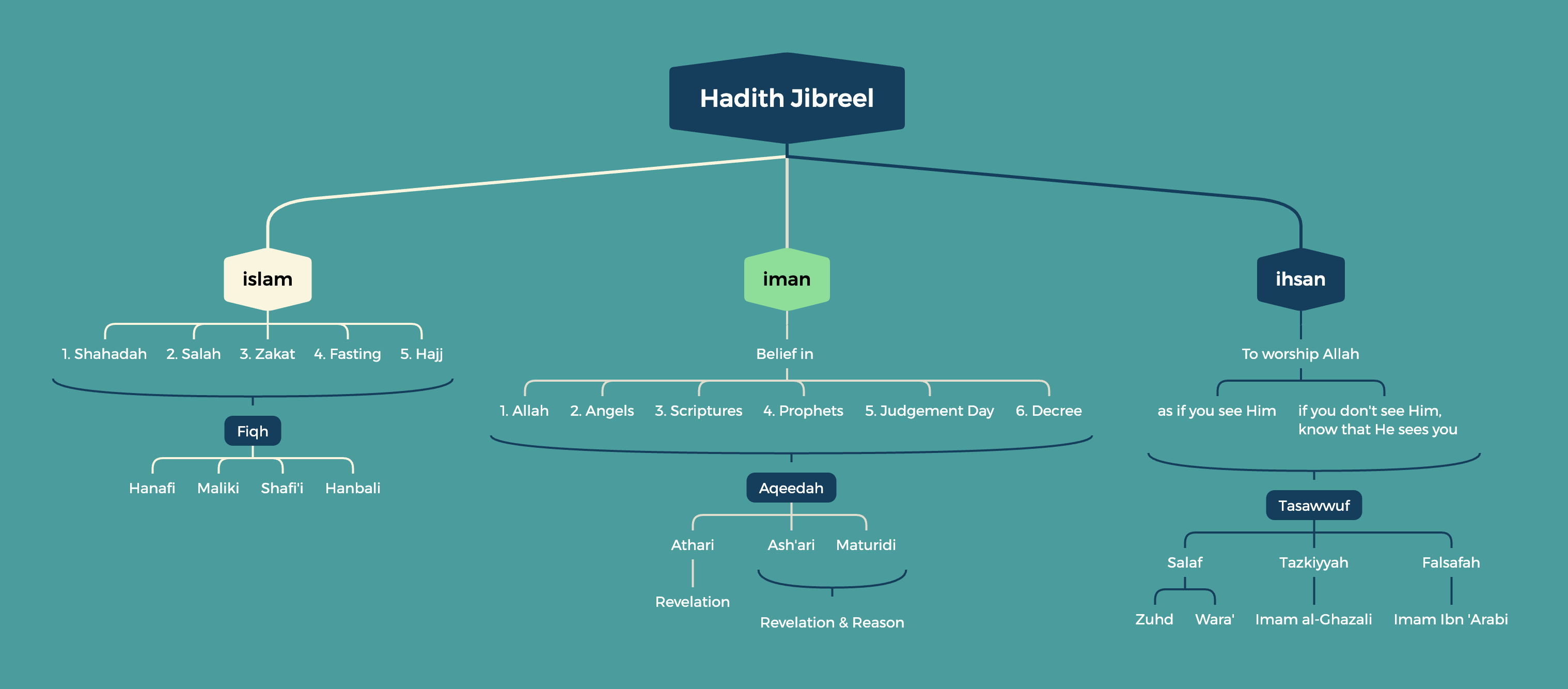
The Islamic tradition recognises three fundamental dimensions of religious life: Islam, Iman, and Ihsan. This framework, derived from Hadith Jibreel (known as Umm al-Sunnah), provides the organisational structure for understanding our religion.
Islam: The Science of Practice
Islam encompasses the ritualistic and practical aspects of religion, which later developed into the science of fiqh (jurisprudence). While four major schools of Islamic law are widely recognised today, the historical reality reveals far greater diversity. Scholars document more than 80 madhabs during the early period of Islamic intellectual development.
The survival of a legal school depends not on the Imam’s knowledge alone, but on the continuity of transmission. Consider the madhab of Imam Al-Layth ibn Sa’d: despite Imam Al-Shafi’i’s assertion that he was “afqahu min Malik” (more knowledgeable in fiqh than Imam Malik), his school did not survive because his students failed to continue the work.
The Importance of Unbroken Transmission
Contemporary practitioners receive their understanding of Islamic law through an unbroken chain of transmission (isnad) extending back to the founding Imams. For Shafi’i scholars, this means a documented chain of teachers and students from the present day all the way to Imam Al-Shafi’i himself.
This chain preserves not just the rulings, but the contextual understanding and technical terminology. Without this living transmission, legal texts become increasingly difficult to interpret accurately. Imam Al-Shafi’i’s magnum opus, Al-Umm, illustrates this challenge. Despite its importance, this foundational text is rarely taught in traditional Islamic circles today because the specific terminological framework has not been preserved in the same way as later works.
Legal terminology evolves across generations. Early scholars often used cautious language when discussing prohibitions, preferring phrases like “I dislike this” rather than definitively declaring something haram. This reflected both their taqwa (God-consciousness) and their reluctance to claim authority over matters of divine law. In communities with high levels of religious commitment, such subtle expressions were sufficient to guide behavior.
As communities changed, scholars adapted their pedagogical approach. The terminology became more explicit and categorical, even as the underlying rulings often became more accommodating. Imam Al-Nawawi’s strict position on Fatiha recitation—invalidating prayer for mispronouncing even a single letter—was later moderated by scholars like Imam Al-Haythami, who recognised that people from certain linguistic backgrounds might be physically unable to produce specific Arabic phonemes.
This adaptation reflects not inconsistency, but the dynamic nature of fiqh as a living discipline that must address the reality of Muslim communities. A contemporary example: visiting a remote fishing village in Malaysia, one encounters Imams who are part-time dive masters or boat captains, leading congregations where the recitation quality varies significantly. The fiqh tradition accommodates this reality while maintaining standards appropriate to each context.
Iman: The Science of Belief
Iman addresses matters of belief, formalized into the science of Aqidah. Within this domain, several schools of thought emerged:
Athari (textual): This approach relies primarily on scriptural authority. The Quran commands belief, therefore one believes. This circular reasoning functions effectively in majority-Muslim contexts where baseline assumptions about God’s existence and the Quran’s authority are shared cultural knowledge.
Ash’ari and Maturidi: These schools, founded by Imam Abu Hassan Al-Ash’ari and Imam Mansur Al-Maturidi respectively, integrate revelation with rational argumentation. This synthesis became necessary as Muslims encountered diverse philosophical traditions and needed to defend their beliefs through reasoned discourse.
Ihsan: The Science of Spiritual Excellence
Ihsan developed into the science of tasawuf (Islamic spirituality), which also encompasses multiple approaches:
The Salaf approach emphasizes wara’ (scrupulousness) and zuhud (asceticism). Note that “Salaf” refers to a historical period—the first three centuries of Islamic history—rather than the modern movement called “Salafism,” which emerged several centuries later.
Imam Al-Ghazali championed tazkiyah (purification of the soul), focusing on removing spiritual diseases from the heart and cultivating praiseworthy character traits.
The Falsafah (philosophical) school, represented most prominently by Ibn Arabi, engaged with metaphysical questions and influenced Islamic mystical thought, particularly in Ottoman territories.
This study focuses primarily on the tazkiyah tradition, as it addresses the practical work of spiritual development most directly applicable to contemporary Muslims.