Hello it’s the Monday Crunch!Prepare to go on a bit of a journey where we unwrap and unveil a part of our political culture that is only leading to bad outcomes. Why? Because sunlight is the best disinfectant, and we all need to know what nonsense is being agreed to on our behalf. Hold on to your hats! This one is quite the ride….
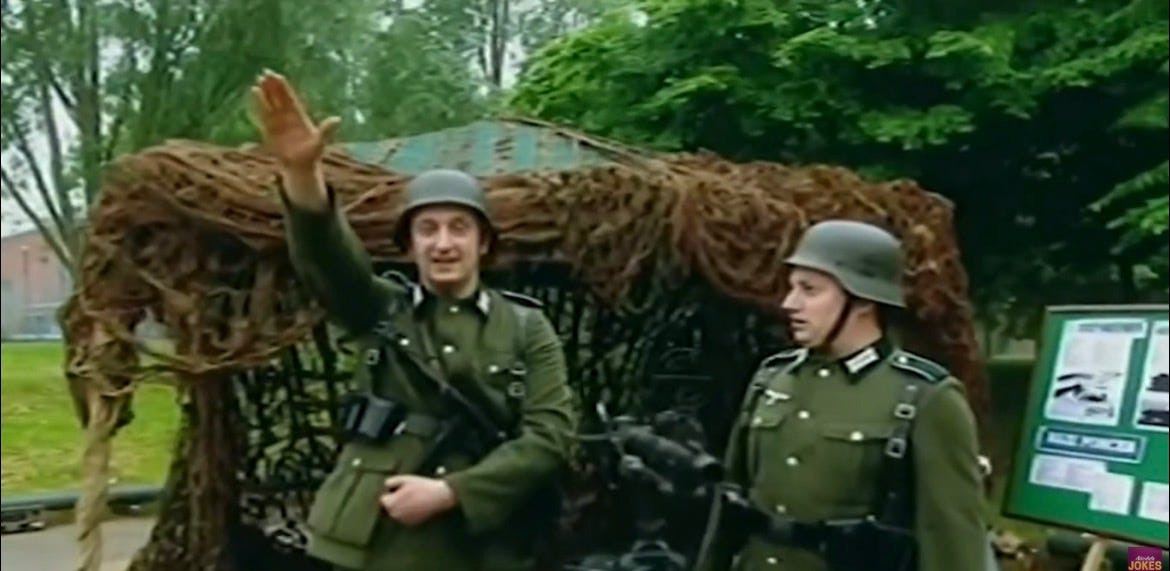
In Peep Show, Daryl - Mark’s colleague revealed his extremism during a WWII reenactment.
The BAFTA for best Nazi goes to….
The BAFTAs took place last night. Apart from skimming through the fashion (old habits die hard; I used to be invested in getting sustainable fashion on red carpets) and a little internal cheer for Jessie Buckley, I’m not up-to-speed on who got what. But I’m pretty sure that there is no gong for ‘acting with military reenactment groups’.
This might be sore news for the Reform UK chair for Bath, Tim Nott who has sought to explain his documented wearing of an SS uniform (the military wing of the Nazi party) by the fact that he got into ‘acting’ some years ago. Presumably he puts himself on a par with all the greats – Branagh, Hopkins, Fiennes who’ve all donned Nazi insignia in search of revealing a greater truth about the banality of evil to a movie-going public. In fact some might argue Tim Nott has gone further than any of these ‘day job’ actors, by inking the role into his life, in what appears to be (in another photo) a large Eagle tattoo across his chest. Stanislavski could only dream of such commitment.
Nott explains it thus, ‘After my 10 year career in the British Army,’ he tells Somerset Live, ‘I found myself working every weekend. Being then unable to do the territorial army/reserve army, I got into acting’. I mean, it’s not exactly a linear narrative, but I see what he’s trying to do. By way of supplementary evidence, he provides an additional (non Nazi) pic of him wearing the uniform of an American WW2 soldier. I like the Somerset Live caption, ‘which is NOT the image in question’.
Nott manages a number of spectacular things here. One, a sleepy form of DARVO (deny, attack, reverse victim and offender) – he’s just looking for a hobby and ends up innocently photographed as a Nazi and is now getting dragged for it because woke. Two, reinforcing the curious sensation that people who enjoy flirting with these types of views never want to own that - they always tripped into the costume. Three, recreating a whole Peep Show episode plotline IRL – the one where Mark realises that Daryl (a colleague) holds extreme views at a WWII reenactment.
Peep Show Predicts Politics
The third represents the most spectacular achievement. It speaks to the genius of Sam Bain, Jesse Armstrong and Mitchell and Webb that twenty years ago Peep Show was able to create a character in Daryl, who foretold the absurdity of the leader of a regional branch of Reform. But while it may seem supernaturally prescient, in truth much of the culture war soup of this present moment, was designated by strange little men with weird little obsessions.
Hayek’s Chicken Shop.
Obsessive Men and the Culture War Soup
I expect lots of people imagine they are in charge of culture wars. Liz Truss, Kemi Badenoch, a thousand commentators might imagine it is them that stir the soup. But the prosaic truth is that much of this was set in train in the aftermath of the Second World War with the creation of right wing think tanks. It was all started by weird men. And the truth is, although Liz Truss is world-class at being disturbing, men generally still outclass women at being think-tank-weird.
These were created by men with obsessive notions, who had actually been in real uniform, and likely seen actually Nazis who weren’t reenactment actors. Many were decorated, veterans of the Normandy landings or Battle of Britain skirmishes. Many already held ‘status’ in a country that was still riven by class division. Nevertheless they felt insecure about holding on to that power when they returned. But what they really hated – on an elemental level – was what they regarded as the postwar social democratic settlement. This included welfare states, labour power, public ownership, and later global institutions. Rather than see this as democratic reconstruction, they saw this as delayed catastrophe. To use a ‘woke’ term, they found it highly triggering.
Hayek’s Chicken Shop
Sir Antony Fisher (1915–1988) was one of these guys. Born into the British elite, he was educated at Eton and later Cambridge, and served as a Royal Air Force pilot during the Second World War, where he was seriously injured in a flying accident. Like many of his generation, the war left him with a deep suspicion of state power, but unlike those who drew social-democratic conclusions (progressive, social justice themes) from wartime mobilisation, Fisher and men with his mindset, saw organising and coordinating people on a large scale as a threat, leading to control and restrictions on freedoms.
In common with right-leaning organisations today, disgruntled and fearful groups are drawn towards thinkers who give them some intellectual scaffolding. It tends to make people feel better to have this – and this is a lot to do with how establishment men self-soothe. The poster boy for the whole movement was Friedrich Hayek whose ideas tended to resonate with this group of men returning from war. He seemed to share with his audience a worldview rooted in paranoia: that any collective action, any planning beyond the market, any supranational coordination was a slippery slope to tyranny. This allowed men returning from war who were profoundly (and understandably) marked by ‘eyewitness’ experiences of state collapse, wartime scarcity, and authoritarian planning in early-20th-century Europe to centre their own experiences, for the rest of their lives. Perhaps in a time when trauma wasn’t really acknowledged, it was a way of making sense of the battlefield.
The Think Tank Blueprint
It’s important to understand that these guys weren’t particularly numerous. Many would have considered them cranks. Most men returning from WWII were interested in progressive ideas. Famously wars cause social mobility and the old guard was uprooted. This landscape is often referred to as the post-war Keynesian consensus. If like me, that doesn’t mean much to you instinctively, the main ingredients are widespread belief that governments should actively manage the economy to maintain full employment, control inflation, and provide social welfare. It combined state intervention, regulation of key industries, and social safety nets with private enterprise to ensure economic stability and social security.
Fisher’s genius was to codify his ideological position. He read Hayek’s The Road to Serfdom in 1945, and then arranged a meeting with Hayek at the London School of Economics. As far as we know, the headline from that meeting was that the great philosopher advised him not to enter politics, but to reshape the intellectual climate that made politics possible. As postwar Britain implemented a revolutionary welfare state, Hayek and his allies were already experienced creating different power bases. Through bodies like the Mont Pelerin Society they pioneered a new institutional form, one designed to outlast governments, colonise media and academia, train elites, and slowly redefine ‘common sense’. The neoliberal think tank was coming to life.
Factory Farming Floats on Stock Exchange
Crucially Fisher had the money to finance such a thing. His strong feelings on freedoms didn’t extend to chickens. Instead he turned millions in profits, turning chickens into industrial widgets by bringing factory farming to the UK. Buxsted chickens brought broiler production into every home and turned chicken from an occasional luxury into a daily dish. The price of chicken plummeted, but the environmental and social costs were outsourced. Buxsted (Fisher’s early brand) set up in Aldershot where there was cheap labour, ‘good water and good sewerage’. By 1962 he had achieved th…