My little 7-year-old pup, Maisy, raced ahead of me last night as I walked to my bedroom, to ready myself for sleep.
She made the leap onto my freshly-made bed with ease––she’s a high jumper––and planted her butt down on what she thinks of as her side of the bed. She wouldn’t budge. All 15 pounds of her. She sat there, trembling––I think it may be an act–– and made timid, hopeful eye contact with me, her nervous brown eyes asking, “can I stay, can I sleep with you tonight?” If you haven’t figured it out yet, Maisy is the boss of me.
I wanted to say yes to her and to Hugo, my other pup. But I don’t sleep well when they’re with me. I wanted to say yes, because there’s nothing better than little Maisy tucked into my right armpit, her head on my shoulder, her body twitching, ensconced in her dreams and relaxed in the comfort of sleep. It’s completely delicious. For about a half hour.
But not for the whole f*****g night, I like to move around. She’s so much bigger than when she tucked in to me the first time; the day I brought her home, when she only weighed four pounds. I stayed up all night then, but the glow of new love overshadowed my sleepiness, and carried me through the next day. As much as I adore her, that kind of glow doesn’t last forever.
The temptation to let go of my resolve was strong, but when I zeroed in on what I was feeling, “should I give in and say yes?” I was rescued by my wiser self. Wiser Nan answered that question. The yes would be the “yes” of guilt. It wasn’t generosity freely offered. It would be the “Yes, I don’t want to hurt my little dog’s feelings,” or “Yes, I want you to love me, and you won’t if I say no.” Or this one, “It doesn’t matter if I don’t sleep well. It doesn’t matter if I’m tired tomorrow.”
But it does matter. Because if I don’t sleep, I’m not effective doing the things that need to get done. It wasn’t just guilt, I noticed fear was there for me, too, as I processed my dog’s simple request. The “you won’t love me anymore” is grounded in fear.
This is a minor example, but it speaks to a behavior that plagued me for most of my life.
Instead of Ellen, “Ambivalent” should have been my middle name. When faced with a request, a perceived expectation from another person in my life, or a chore that needed doing, I would subject myself to a kind of inner torture as I plodded through a list of pros and cons and would inevitably end up saying yes to whatever was asked of me and pretend to myself and the other person that my choice was as much for me as the person I was serving.
But the time it would take to get to that choice felt endless. It was rarely the truth, and didn’t lead anywhere healthy for anyone involved.
I said yes for all the same reasons as I wanted to with Maisy.
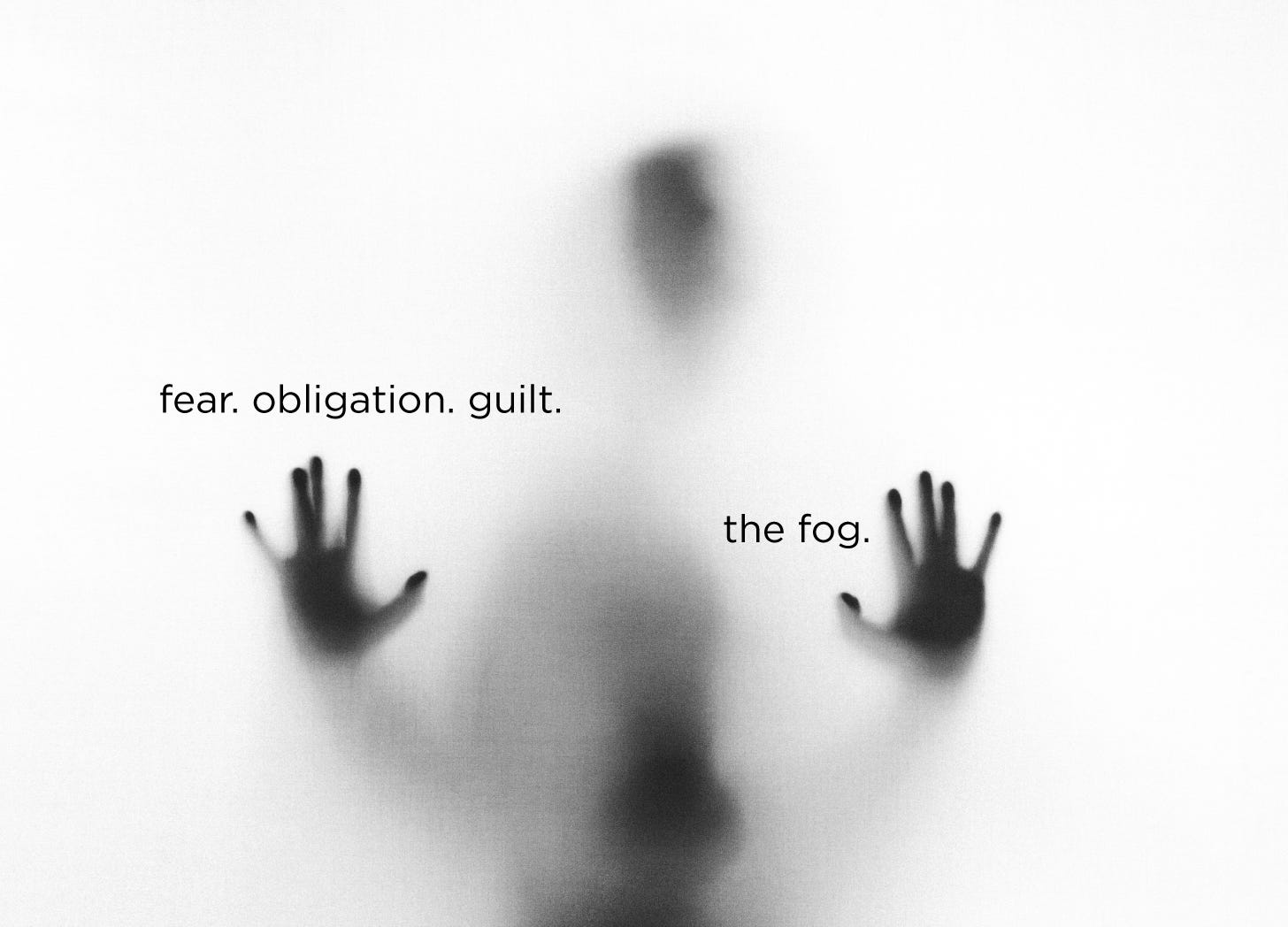
Fear of withdrawal of attention and love. Obligation, because I thought I owed something to the person (or dog) who was making the request, and Guilt because who was I to say no, and attend to my needs first? I got to a point where I couldn’t even name those needs, because I believed I didn’t have any, or worse, that my needs had become whatever that other person wanted.
My worth was dependent on other people’s approval of me.
That’s the way I rolled for more decades than I care to count. What I’m describing is textbook codependence. I’m here to tell you that codependence destroys people and relationships. It almost ground me to dust.
Being codependent is a skill I learned young. It serves as a more than adequate coping mechanism that becomes necessary at times for emotional––and sometimes physical––survival. But using that behavior into adulthood bred resentment, depression, anxiety, and self-hatred in me to the point where I questioned the value of my existence and often thought opting out completely (as in suicide completely) might be a better choice for the long haul. I didn’t know who I was or that what I wanted mattered.
It began when I was a little girl in my relationship with my dad. I adored my father, but I made him into an idol, all-powerful and perfection in my eyes. He wasn’t those things any more than anyone else, but a child’s survival is dependent on the care they receive growing up, and typically that care comes from our parents.
But what happens to children when parents are dysfunctional?
I was hyper-sensitive not just to my father’s moods, but to the moods and desires of everyone around me. I think they call that hyper-vigilance. I was so good at it, I never got less than an A in that class.
I gave myself the job of being his tiny cheerleader. If he was sad, quiet, or angry, I’d get worried and make it my mission to elevate his mood, make him laugh or smile. To distract him from whatever was bothering him. Sometimes it would work, sometimes not. I always assumed that when he was in a bad place emotionally, it had to be my fault, so it was my job to fix it, to fix him. I was wired to believe that if I wasn’t well-behaved, entertaining, and obsessively attentive to his needs, I’d be abandoned. I didn’t make it up, he would ignore me if something I did made him angry. As a result, fear ruled every choice I made. I enjoyed the status of being his favorite child. He’d never say that was true, but I knew it was. And I’d do anything to maintain my special place in his life.
All the choices I made, made me turn away from myself.
Did I say fear ruled every choice? I misspoke. I meant to say terror. Most of the time, I was unaware of the games we played with each other.
My father was a gentle man, mostly; never violent, but often cruel in more subtle ways. I don’t think he understood the effects his covert cruelty had on me. His manipulative nature made an impression. I learned to manipulate him right back, and to do it in my relationships with others. His meanness masqueraded as what he considered playful teasing. It never felt like that to me. His sarcasm stung and when he withdrew his attention, it hurt me more than a spanking ever could.
He brooded like a champion, and when he did, I’d panic, I’d convince myself that his withdrawal from me meant I’d lost him forever. Of course, most of his moods had nothing to do with me.
I learned to put myself aside until I forgot there was a “me.” I disappeared.
Many of you have already met my father in other essays I’ve published here. He was lovely in so many ways. He was generous, talented, smart, and funny. He was also a flawed, complicated person. He was a man with secrets. He was human.
I didn’t know how to sort any of that for myself, to see him clearly, all the parts of him. I was terrified to live without him.
At 24, I tried to leave to start a new life in Los Angeles. I still have the clean handkerchief he pulled from his trouser pocket and handed to me. It was monogrammed with his initials. I blew my nose after sobbing my goodbyes at the United Airlines gate, before I got on the plane to “go west, young Nan.” I lasted 3 months. I spent most of the time curled up on the couch in my sublet, wrapped in a cozy blanket of despair. The minute I returned, order was restored. The depression lifted, but the self-hatred lingered in the background of my life and would multiply every time I tried to cut our cord.
I gave myself over to what we created, the unspoken pact we made that looked more like a marriage than a healthy father/daughter connection. I learned what I imagined was love from my father. I had no clue how to cultivate an intimate relationship with anyone.
After repeating this pattern of people-pleasing in my love relationships, because it was what I knew, I found that the very thing I was terrified of, being abandoned, was the outcome I kept creating. Ironically, in most cases, my partners weren’t the ones who did the leaving. I was.
What I discovered was that I’d abandoned myself so completely, I didn’t have a true self to bring to relationships, in order to find out what healthy love really looks like. I had no faith that I would be loved for me and not for all the “yes, dear, whatever you want” that I was …