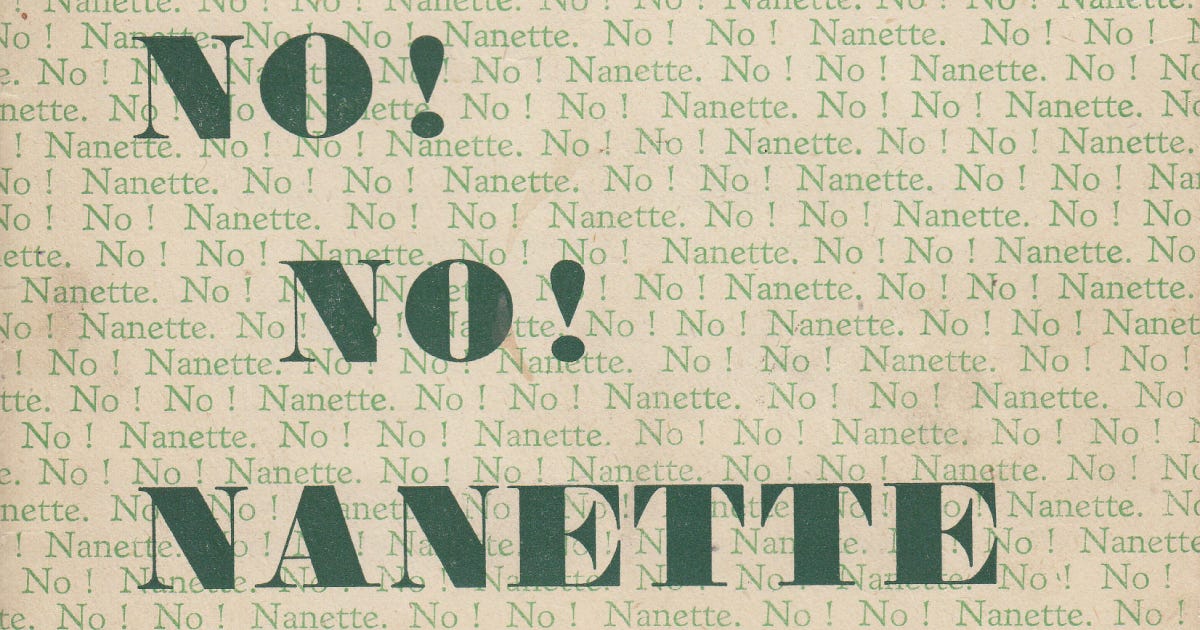
When I was little, I had two nicknames; “Nancy No-No” and “No, No, Nanette.” My folks thought they were hilarious for thinking up these clever monikers, and took enormous pleasure in taunting me with them for years. Backstory is unimportant, so unimportant that I never learned what it was, though I’m pretty certain (because I’m my parent’s daughter and I’m clever, too) that it had to do with me not wanting to be told what to do or how do it. Maybe I just overstayed my terrible twos…until I was sixty-two.
“No” was an immature defense mechanism or a precocious attempt at individuation at a very young age. As I got older, I became a master at digging my heels in.
My reasoning was based on simple logic:
* No one knows anything I don’t already know.
* No one knows what I need better than I do.
* There is nothing anyone can tell me that could possibly contribute to my growth as a human being.
* The end.
This was my stand:
Don’t tell me what to do, think, feel, wear, eat, read, learn, understand, desire, and definitely don’t tell me how to cut my hair. I was a NO waiting to happen because input from others made me feel small, stupid, and inconsequential. The biggest reason for my resistance was that if I was found lacking, it meant I wasn’t good enough. The worst part? The belief that not being good enough was a lifetime sentence. There was no coming back from it.
The chorus of critical voices boomed in my head.
That belief became my excuse for not trying things that scared me, or that I’d have to work for. I’d dip my toe in for a second and if the water was too cold or too hot or the stroke was too complex, I’d signal the nearest lifeguard to rescue me from drowning in water that was only 2 feet deep. If it felt like I might fail at something, I’d abandon the undertaking before I got started. Quitting as soon as I felt challenged was the only coping mechanism I used. One big fat NO, whenever I felt cornered by fear or doubt. For years I avoided pursuing things that I was interested in because I thought everything I wanted to do should be easy or come naturally.
I compared myself to others, obscuring my ability to see my own worth.
I’d lose interest quickly and walk away if I didn’t experience immediate success. When I peeked at a classmate’s sketches and compared them to mine, it never once occurred to me that the reason their drawings were so beautiful was because they practiced; they drew and drew and drew. It was their passion, it was worth working for. All I could see was a finished product. I never saw the hard parts they might have encountered. I filled in the blanks with foregone conclusions that were based in fiction and an affinity for self-deprecation.
The voice in my head would berate me, reminding me that if I wasn’t born talented, I’d never achieve my goal of the minute. I lacked the insight to see that achievement requires commitment, repetition, teachers, helpers, and time. Instead, I stood to the side, safe, sad, and jealous, while I watched others excel, instantly disqualifying myself. I believed in saving time by saving face before my face required saving. Tidy.
It never occurred to me, not once, that I might succeed.
When it was time for me to go to college, I applied to one school. The school had an open enrollment policy. Everyone who applied got in. The idea of rejection was intolerable to me, and if I had to do this thing called college, I’d avoid the stress and worry that came with waiting for an acceptance or experiencing the heartbreak of rejection. I dodged college application essays and getting dragged from one college campus to another with my mother.
Two weeks into my second semester I dropped out. I had no idea what I wanted to learn and didn’t feel prepared for anything. Nobody told me going to college would help me figure it out. I wanted to be in the adult world, making money, and having lots of sex. There’d be no more homework, no more exams, no more papers. Yay!
The idea of writing term papers was daunting and I was embarrassed to ask for help. Me, the one who was supposed to know everything. To avoid dorm life, I purposely applied to a commuter college because I was too insecure and damaged from years of bullying to live with other students.
My social interactions in junior high and high school were pretty disastrous. I didn’t enjoy being around people my age. If I had to live in a dorm, it wouldn’t be easy to hide.
My father was furious when I told him I dropped out. Sitting on his couch, I was stone. My arms locked over my chest, I barely listened to all the good reasons he had for me to stay in school. Throughout his frustrated tirade, I felt nothing except a determination to win. I steeled myself against my quitter shame, I made believe it wasn’t lurking right near by.
My mind was made up. Nothing touched me. Not his words, not his anger. His concern and love meant nothing to me. I just wanted to win. I wanted relief. To be free of the anxiety I conjured while perseverating on scenarios that might never happen. My thoughts were rooted in the past and in the future. I didn’t have a clue how to exist in real time.
My held conviction was that not trying was better than trying and failing.
Don’t tell me what to do.
Relief never came because quitting fired up my critical voice. The sing-song voice that chanted, “see we were right. You are a loser. Now what are you going to do?” To validate my decisions, I had lists of rehearsed excuses on hand. One thing was certain; I was a huge success when it came to failing in advance of an unknown outcome. Call me Nan “Nip it in the bud” Tepper.
Lack of humility and unearned pride drove my heels deeper until I was mired in the quicksand of my self-destructive machinations. I couldn’t admit until my late 50s that maybe I made a mistake, or two, or ten. As a student, I did well without trying hard; I wasn’t into hard. I was into “please make the pain stop.” I was terrified that utilizing the system I relied on in junior high and high school would fail me in college.
I was that student who’d show up late to school the day a paper was due. I’d be late because I’d write the paper that morning. Please note there were never Cliff Notes involved, and AI was 4 decades away. Never. I might have done better had there been Cliff Notes involved. I may have been a procrastinator, I may have been a bit lazy, or just a teenager, but I damn well had ethics.
I said no to travel, to new experiences, to anything, ANYTHING outside of my carefully crafted comfort zone. Not participating or taking risks was the perfect antidote-in-advance for anything I deemed vaguely threatening.
I spent years avoiding writing because I convinced myself that I couldn’t, even though the people in my life experienced me differently. They saw my potential; they took the time to tell me they saw it. They saw talent. Writing the word “talent” makes me cringe. I had trust issues. Now, those trust issues come up less frequently, but there are vestiges that cling. I get suspicious if someone says nice things about me. My suspicion is that although they’re being kind they really feel sorry for me. Or worse yet, they’re trying to humiliate me and laughing behind my back.
What an awful load to carry.
Because of the work I’ve done in therapy and 12-step recovery I recognize my stubbornness, my need to defend, my fear of new things.When that NO wants to pop out of my mouth, I pause and get curious.
When my NO comes up, after some internal kicking and screaming, I’m learning to shift my perspective. I take a deep breath and ground myself, become more present to the feelings in my body, the tightness in my jaw, the constriction in my solar plexus. I talk to the scared little kid who lives inside of me. I tell her, “It’s okay, hold my hand. I’ve got you. You’ve got me. We can figure this out together.”
Calling myself a writer and doing the work is a triumph for me.
My resistance is my opportunity to learn something new, to examine the flip side of my NO. Whe…