I wrote this essay because September is Suicide Prevention Month. I have a history of depression and suicidal ideation.
More than anything I know it’s crucial for those of us who’ve experienced mental illness to talk about it, openly and without shame.
We need to be the example that makes it safer for others to ask for help. We need to come out about it, so others can find us. At the end of the essay, there are links to resources. Please use and share, and if you know of other great resources, share your info in the comments or send me a private message.
I published this story a year ago, when I returned from a trip to visit my brother in L.A. after he was badly injured in a motorcycle accident. When I wrote this piece a year ago, it was the first time I recorded myself on video. It terrified me, but I needed to show myself to tell this story, even with the body shame I still carried.
I’m here today to tell you that I’ve fully embraced being on camera, as the host and creator of Wham! Bam! Thank You! Slam! Healing from major depression and trauma is possible. It’s doable. I’m living my best life. A life I never imagined.
Don’t give up, you’ll miss the beauty. For what it’s worth, I’d hate that for you.
Kurt Vonnegut hated them; Melville couldn’t get enough of them––he used more than 4000 in Moby Dick. Can you believe there are people who do things like count semicolons in literary masterpieces? Oh, wait. We don’t need people for that, because we have AI.
Virginia Woolf sprinkled Mrs. Dalloway liberally with the winking little buggers, and Gertrude Stein thought they were the same as a comma. What did she know? She barely used punctuation at all and Gertrude is the only one who understood her own writing; I still scratch my head when I try.
The semicolon was invented by the Italian Renaissance printer Aldus Manutius in 1494, and first appeared in his publication, De Aetna. He created it to function as a mark indicating a pause stronger than a comma but weaker than a full stop, serving as a helpful tool to clarify complex sentences for readers.
I’ve never been good at punctuation. Somehow, I got through school without learning the rules of grammar. I try to remember whether to put a period or a comma inside or outside quotation marks. I managed; learning most of what I think I know from being a reader.
I use punctuation primarily as visual cues to myself to pause, stop, or slow down. They’re a form of private notation because I’m first and foremost a spoken word storyteller. You’ll be relieved to know that I’m partially recovered from the felonious overuse of exclamation points. I am, when all is said and done, quite enthusiastic.
It’s sometimes hard to rein it in.
But I have a deep fondness for the semicolon, an intimate connection formed late in life. My infatuation with that very same winking little bugger that Mrs. Woolf loved, has less to do with its function in a sentence––joining two related independent clauses without a conjunction––I have no idea what that means.
My association with the semicolon has to do with being and staying alive. It has to do with living my best life.
If Virginia had used them the way I do, she might have lived longer.
I learned about another use for a semicolon the day before my 60th birthday. I wanted a new tattoo to mark my transition from a very depressed person who took piles of meds for 32 years to becoming a person who was much less depressed and had just completed a slow wean from most of them. I was beginning the experiment of living my life without psych meds.
I made a lunch date with my trusty companion, Ms. Google (we’ve since divorced, because Google). We searched for symbols connected to recovery from mood disorders. Up popped Project Semicolon.
Project Semicolon is a non-profit organization; a compassionate online community that promotes mental health and suicide prevention awareness. It was founded in 2013 by a woman named Amy Bleuel, to honor the memory of her father when she lost him to suicide.
This is why she chose the symbol to represent the mission of the project:
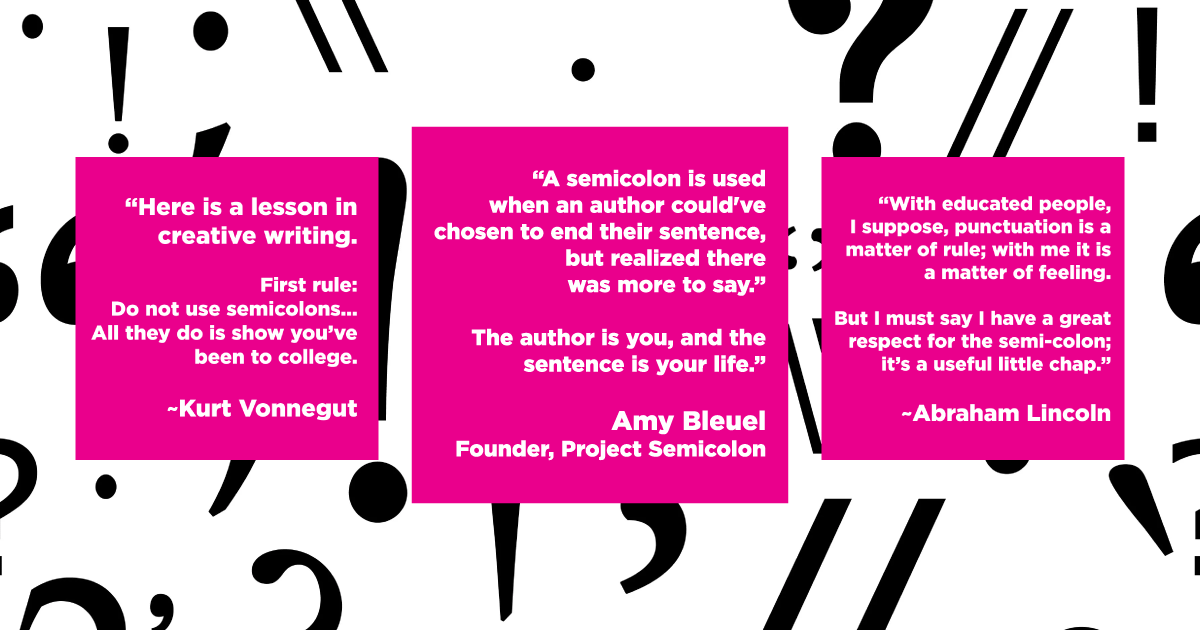
“A semicolon is used when an author could’ve chosen to end their sentence but realized they had more to say. The author is you, and the sentence is your life.”
In the context of someone who suffers suicidal ideation or attempts to take their own life, this is a reminder to carry on, to go forward. To continue living, instead of leaving. A promise of something to come. Something yet to be realized.
In 12-Step programs they say, “don’t leave before the miracle happens.” If we kill ourselves, we never get to find out how the story might have ended, if we stayed.
People began getting semicolon tattoos, as a way to signal a commitment to life, to say, “I’m a survivor,” or know someone who is. To be allies with those who suffer and those who’ve lost their loved ones. To honor the memory of those we loved who did choose to leave.
I found out later that like her father, Amy Bleuel died by her own hand. Her death was a terrible end to a life dedicated to making a difference. To saving lives and taking mental illness out of the closet and into full view.
She had a reason to speak out, to make visible and remove shame from these diagnoses. Her depression caught up with her, overwhelmed her, and claimed her, too.
One more loss among far too many. Another reason to stay visible, to talk about our lives without shame or apology. Amy Bleuel becoming a poster child for mental illness is a heartbreaking example of how insidious depression can be.
So, with this knowledge in hand, and the powerful symbolism of the semicolon, coupled with the appeal of joining an established community of gentle and passionate activists, I set out to design my birthday tattoo.
Even though my design aesthetic is clean and simple I’m never happy doing things the easy way––in this case, I would have opted in for a single semicolon as is the custom––but I decided I wanted a wristband, instead. A tennis bracelet of semicolons. I designed it with 32 of them, to circle my left wrist, one for every year I’d taken meds for mental illness.
I designed the tattoo on the last day of my 59th year and by a stroke of good luck, synchronicity, or Grace, I found a tattoo artist with a last-minute cancellation who inked it with care and love.
I’ve had my tattoo for almost 6 years, and in that time, I’ve bumped into others bearing this symbol of survival and support.
Some of you already know I was in California recently. But I haven’t shared this part of my trip yet. When I landed in Los Angeles, I rode a shuttle to the rental car lot. I was chatting with my seatmates, and we got into a conversation about our tattoos. I love it when people are willing to chit-chat about their tats. I’ve never had anyone say no. Tattoos are a point of pride––badges of honor, filled with meaning. They carry the history of our lives.
We sat side by side, telling our stories, when the bus pulled to a stop, and a horde of people piled on, packing it full. I noticed a young man standing across from us. He was looking at my arms; 2 tats on my left and one on my right.
He smiled at me, I smiled back, wondering if he was going to join us in our conversation, and then we pulled up to our destination.
I suffered the rigamarole required to rent the car, and agitated, tired, and done, (I’d been traveling for hours), I schlepped my luggage out to the lot where I was told my car would be waiting for me.
I walked by a dark blue Toyota baking in the heat. The young man from the bus was sitting in the driver’s seat. He saw me, smiled wide, said a shy hi, and then said, “I wanted to tell you how much I love your tattoo.” Since I have more than one, I wasn’t sure which he was referring to. I was about to ask, when he raised his arm to show me the single semicolon gracing his right wrist.
He blurted, “Oh, I have chills, can I get out and give you a hug?”
I nodded my agreement, and this stranger and I found ourselves gripping each other, hanging on to …