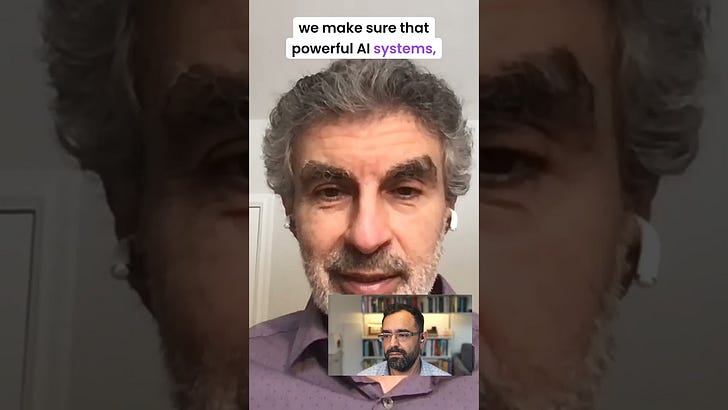
Earlier this week, I spoke with Yoshua Bengio. In 2018, he, Geoff Hinton and Yann LeCun were awarded the Turing Award for advancing the field of AI, in particular for their groundbreaking conceptual and engineering research in deep learning. This earnt them the moniker the Three Musketeers of Deep Learning. I think Bengio might be Aramis: intellectual, somewhat pensive, with aspirations beyond combat, and yet skilled with the blade.
With 750,000 citations to his scientific research, Yoshua has turned to the humanistic dimension of AI, in particular, the questions of safety, democracy, and climate change. Yoshua and I sit on the OECD’s Expert Group on AI Futures.
He is cautious and deeply concerned about our ability to reign in the power dynamics that are driving AI development. He sees the problem as scientific and political.
In this conversation, you will hear us discuss…
* Rogue AI: The pathways to designing highly capable AI agents — and what could go wrong.
* AI as global public good: Could democracy offer a solution to the dangers of AGI?
* Why Yoshua changed his mind on the long-term benefits of open-source AI.
* We leave space for optimism, but you have to listen until the end.
Full audio of my conversation with Yoshua Bengio and the transcript are available to paying members of Exponential View.
Enjoy!
Transcript
[00:00:00] Azeem Azhar: Today, I am joined by an exceptional researcher. He is widely regarded as one of the scientists whose work has built the foundations for today's progress in artificial intelligence. A Turing award winner with more than 750000 citations. Of course, naturally, a full professor at the University of Montreal. I could go on, but most of all, he's a fantastic human. And I'm delighted to be in conversation with Yoshua Bengio.
[00:00:31] Yoshua Bengio: Thank you, and thanks for the nice words.
[00:00:34] Azeem Azhar: Well, thank you for all of your work over the previous decades. You and Geoff Hinton and Yann LeCun have sometimes been called The Three Musketeers of Deep Learning. And I'm curious, you've heard that description. Which Musketeer do you most closely affiliate with do you think?
[00:00:55] Yoshua Bengio: This dates from a time when deep learning was not at all a popular endeavor in machine learning or in AI in general. So, we we have to we had to really, really stand defending these ideas for a number of years at that point.
[00:01:10] Azeem Azhar: Yes. It was not very popular when it when you first started to work on these these processes. I will give you my suggestion as to which musketeer you are, by the way, Yoshua. I see you as Aramis, who ChatGPT tells me is intellectual and romantic, somewhat pensive, with aspirations towards a religious life, but very, very skilled in combat. And I'll explain why I think that which is essentially, in the last couple of years, you have switched the focus of your research towards really humanistic dimensions of AI. And that felt a little bit Aramis to me.
Maybe we could start at the beginning. As a researcher in the field of artificial intelligence. How do you define AI? And has your definition of it changed over the course of your career?
[00:02:07] Yoshua Bengio: Well, I think the part that's really difficult to define is the intelligence than just stick the word artificial since it's in machines. And the way I think about intelligence is taking appropriate decisions.
But in order to do that, you need understanding.
In fact, you could be intelligent and just have understanding and take no decision, but it would be difficult to see that you have understanding.
And in order to get both understanding as in, like, having a good inter you know, internal model of how things work and being able to achieve goals, to take good decisions you need learning because, You know, the the nature of the world and the ways to optimize our decisions are not something that are given to us, we have to acquire that through experience and computation, and that's what learning is about.
[00:03:08] Azeem Azhar: And, of course, if you take a decision in the world, you'll have an action in the world, so the environment will have changed as a consequence of the decision you've taken.
So you need to be able to learn because you have to observe that new different environment to make your next decision.
[00:03:23] Yoshua Bengio: Yes. In fact, it's even more tricky than that. Given any life experience, rationally speaking, we can't rule out a lot of possible explanations for all our life, a lot of possible world models. And when we acquire new information from data, for example,
we need to revise those beliefs. And humans do that, by the way, to some extent, not perfectly. Would like to build machines that have similar capabilities.
[00:03:54] Azeem Azhar: It's fascinating this idea that, you know, we look at how humans learn, and and we can see how we exhibit intelligence.
We obviously exhibit that intelligence in differing ways from individual to individual. And in also, there there are many expressions of what that intelligence might be and, you know, you just see it in any organization. There are certain organizations where the intelligence that you need to have is dealing with the squishy complexity of human relationships. And there are other organizations where the intelligence you need is very specific, tangible, quantitative. And those different expressions clearly form part of what it is To Be Intelligent.
Will the same be true in artificial intelligences, do you think?
[00:04:43] Yoshua Bengio: Yeah. Certainly. And in fact, because of my definition of intelligence you could be intelligent for some things.
In other words, you have a lot of knowledge and skills in some domain, but you could be stupid in another domain. Right? And humans vary in the areas of of scale, of course. And we already see this with AI systems that are what we call narrow AIs that are really good at one type of problems.
[00:05:09] Azeem Azhar: Now we've seen a lot of progress at least to the layman in in the last a few years in particular since November 2022.
And and my sense is from the things that you've said publicly that you think things are moving faster now in the last couple of years towards that artificial intelligence than perhaps you had expected, what was a specific turning point for you? What did you see that you didn't expect to see.
[00:05:39] Yoshua Bengio: Oh, the mastery of language, obviously.
[00:05:42] Azeem Azhar: Yeah. So the ChatGPT mastery, the the what ChatGPT delivered over the previous iterations of large language models from a year or 2 earlier.
[00:05:51] Yoshua Bengio: Yeah. And in fact, going from 3.5 to 4, GPT-4, there was also a noticeable improvement in many areas. And language well, language is important because it's the glue that connects us. It's the social, you know, fabric. And it opens the door to accessing huge quantities of knowledge about the world that humans have put down in, you know, writing and forms that computers can digest.
[00:06:21] Azeem Azhar: In some sense, that corpus of text, the trillions of words that the ChatGPT or GPT-4 is trained on is reflecting many, many different models of the world that we have imperfectly expressed through our own subjectivity and some ways of expression are much more subjective poetry or fiction or my diary, And some have a veneer of more objectivity, for example, scientific research or economic statistics. But there is this corpus out there which, in some sense, reflects the collective human view of what it is to be in the world. Is Is that too grand a statement, do you think?
[00:07:00] Yoshua Bengio: No. No. It's absolutely right. Now researchers are quick to point out that there's still a lot of things that are pieces of knowledge that are not visible in that corpus. For example, you know, bodily experience and things like this. But still If you did master the knowledge in such a corpus, you could do a lot of good in the world. And a lot of damage.
So …