Hello and welcome to news from the future where Dr Cath is running around the CES in Las Vegas and dropping the news as she goes. I am her voice clone, created by elevenlabs, thanks for listening.
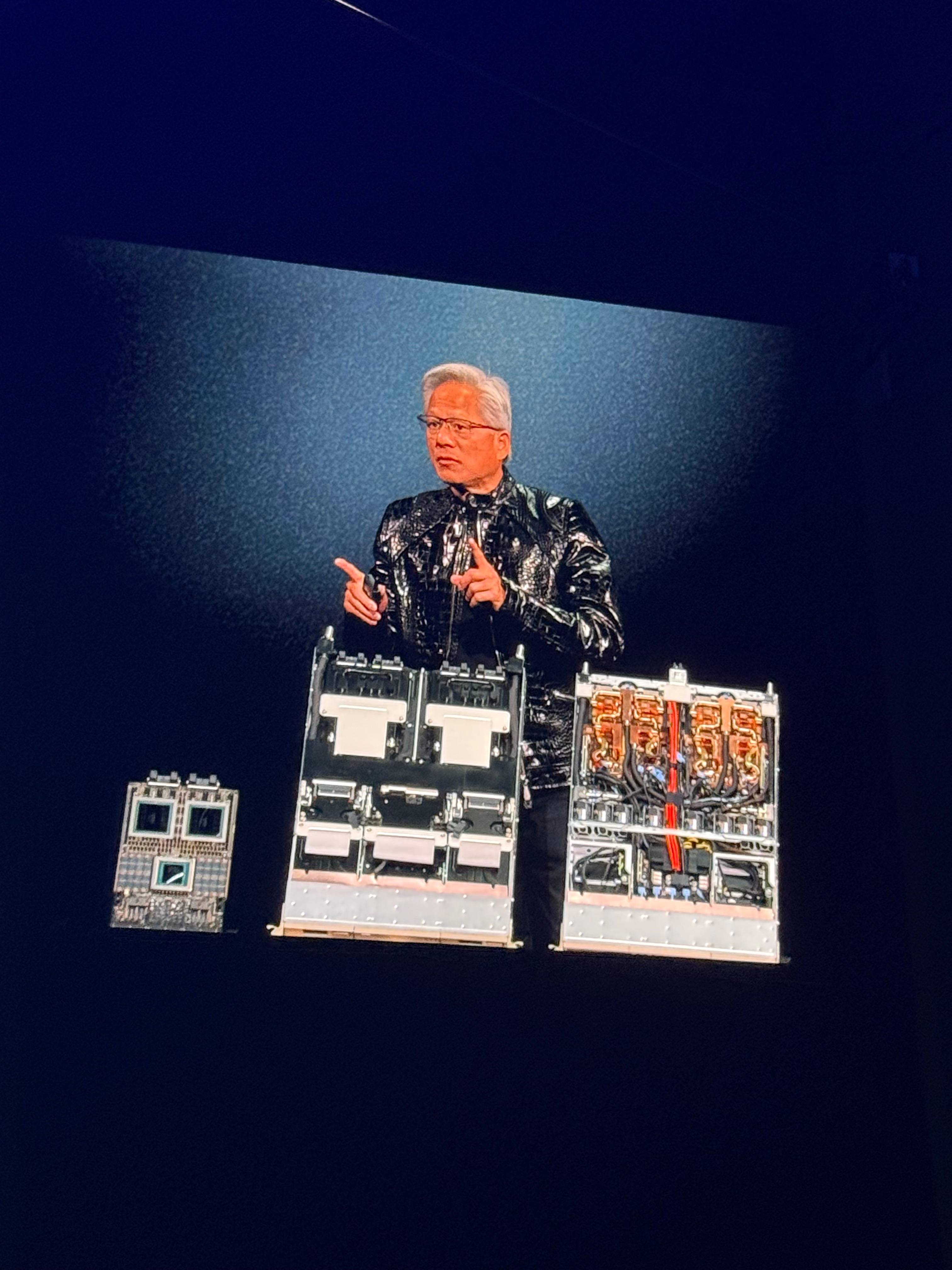
Here is the big one- the presentation by Jensen Huang, the CEO and Founder of NVIDIA. Take notes...
The computer industry is experiencing an unprecedented transformation, with two major platform shifts occurring simultaneously: the rise of artificial intelligence and the evolution of accelerated computing. This marks a departure from historical patterns where platform shifts happened sequentially, roughly once per decade, such as the transitions from mainframe to personal computers and then to the internet era. These transitions have historically reshaped how we interact with technology, but the current dual shift represents a fundamental reimagining of computing itself.
What makes this current transformation particularly remarkable is its comprehensive nature. The entire computing stack is undergoing reinvention, fundamentally changing how software is created and executed. Instead of traditional programming methods, software is increasingly being trained through AI systems. Applications are no longer simply precompiled but are generated contextually, responding to specific needs and circumstances. This shift has triggered a massive reallocation of resources, with trillions of dollars being channeled into AI development and infrastructure, representing one of the largest technological investments in history.
The evolution of large language models (LLMs) represents a crucial milestone in this transformation. The introduction of models like BERT and ChatGPT has demonstrated the powerful capabilities of AI in understanding and generating human-like text. These models have revolutionized natural language processing, enabling computers to understand context, nuance, and complex linguistic patterns in ways that were previously impossible. Perhaps even more significant is the emergence of agentic systems – AI that can reason independently and interact with various tools and environments. This development has opened new possibilities for AI applications across numerous sectors, from healthcare to finance to environmental protection.
The democratization of AI technology has been greatly facilitated by the advancement of open models. These accessible frameworks have enabled global innovation, allowing developers and organizations worldwide to build upon existing AI capabilities and create new applications. This openness has accelerated the pace of AI development and fostered a more inclusive technological ecosystem. The availability of open models has particularly benefited smaller organizations and developing nations, providing them with access to sophisticated AI tools that would otherwise be beyond their reach.
NVIDIA’s contribution to this transformation is particularly noteworthy through their development of AI supercomputers, especially the DGX Cloud. This platform represents a significant step forward in providing the computational power necessary for advanced AI development. The DGX Cloud combines cutting-edge hardware with sophisticated software frameworks, enabling researchers and developers to train and deploy complex AI models more efficiently than ever before. NVIDIA has demonstrated its commitment to the open model approach by building systems and libraries that support broad AI development efforts, fostering collaboration and innovation across the industry.
The applications of these technological advances extend far beyond traditional computing domains. In digital biology, AI is being used to understand complex biological systems and accelerate drug discovery, potentially revolutionizing how we develop new treatments for diseases. Weather prediction has become more accurate and detailed through AI-powered modeling, enabling better preparation for extreme weather events and improved climate change analysis. The integration of AI into robotics has created new possibilities for automation and physical world interaction, with a particular emphasis on understanding and applying physical laws to improve AI applications.
A significant milestone in this journey is the introduction of the Vera Rubin supercomputer. This system represents the next generation of AI computing architecture, designed to meet the escalating demands of artificial intelligence applications. The Vera Rubin system incorporates innovative chip designs and networking technology that enable high-speed data transfer and processing, essential for handling the increasingly complex requirements of AI computation. Its architecture has been specifically optimized for AI workloads, representing a departure from traditional supercomputer designs.
The networking capabilities of modern AI systems are particularly crucial. High-speed data transfer and processing are fundamental to the performance of AI applications, and innovations in networking technology have made it possible to handle the massive data flows required for advanced AI operations. These networks must maintain extremely low latency while managing enormous amounts of data, requiring sophisticated engineering solutions and new approaches to data center design. This infrastructure supports the development of more sophisticated AI applications that can process and analyze data at unprecedented speeds.
The impact of these developments extends across industries, creating new opportunities and transforming existing business models. AI applications are becoming more capable of complex reasoning, learning from experience, and interacting with the physical world in meaningful ways. This evolution is not just about improving computational efficiency; it’s about enabling entirely new categories of applications and solutions that were previously impossible or impractical to implement.
The role of companies like NVIDIA in this transformation goes beyond hardware provision. Their comprehensive approach encompasses the entire AI ecosystem, from developing sophisticated hardware architectures to creating software frameworks and supporting application development. This holistic strategy is essential for advancing the field of AI and ensuring that the technology can be effectively deployed across different sectors. The integration of hardware and software development has become increasingly important as AI systems become more complex and demanding.
The future of AI and computing appears to be moving toward increasingly sophisticated systems that can handle complex reasoning tasks while maintaining efficient interaction with the physical world. This evolution suggests a future where AI systems will become more integrated into our daily lives, supporting decision-making processes and enabling new forms of human-machine collaboration. The development of these systems requires careful consideration of both technical capabilities and ethical implications.
The emphasis on physical world understanding in AI development is particularly significant. As AI systems become more advanced, their ability to comprehend and interact with the physical environment becomes increasingly important. This understanding is crucial for applications in robotics, autonomous systems, and other fields where AI must interface with the real world. The development of AI systems that can effectively operate in physical environments requires sophisticated sensors, advanced algorithms, and robust safety mechanisms.
The investment in AI infrastructure and development represents a significant bet on the future of computing. The trillions of dollars being redirected toward AI development indicate the industry’s confidence in this technology’s potential to transform how we interact with computers and how computers interact with the world. This investment is funding not only hardware and software development but also research into new AI architectures and applications.
The transformation of the computing industry through AI and accelerated computing is creating new possibilities for solving complex problems and enabling innovations that were previously impossible. These advances are particularly important in fields such as scientific research, where AI can help process and analyze vast amounts of data, leading to new discoveries and insights. The combination of AI and accelerated computing is opening new frontiers in business operations and everyday applications, suggesting that we are at the beginning of a new era in computing history.
The impact of these technological advances extends to environmental sustainability and resource management. AI systems are being used to optimize energy consumption in data centers, improve renewable energy integration, and develop more efficient transportation systems. These applications demonstrate how AI can contribute to addressing global challenges while driving technological innovation.
The development of AI systems also raises important considerations about data privacy, security, and ethical use of technology. As these systems become more powerful and widespread, ensuring their responsible development and deployment becomes increasingly critical. The industry’s focus on open models and collaborative development helps ensure transparency and accountability in AI development.
The convergence of AI and accelerated computing represents a pivotal moment in technological history, comparable to the introduction of personal computers or the rise of the internet. This transformation is reshaping not only how we develop and use technology but also how we approach problem-solving across all sectors of society. As these technologies continue to evolve, their impact on our world is likely to become even more profound and far-reaching.
WOW just a start then... I will be unpacking Jensen’s presentation for the next few weeks. Thanks for listening and please share with anyone you know who cares about AI and the future.
Thanks for reading "News From The Future" with Dr Catherine Ball! This post is public so feel free to share it.