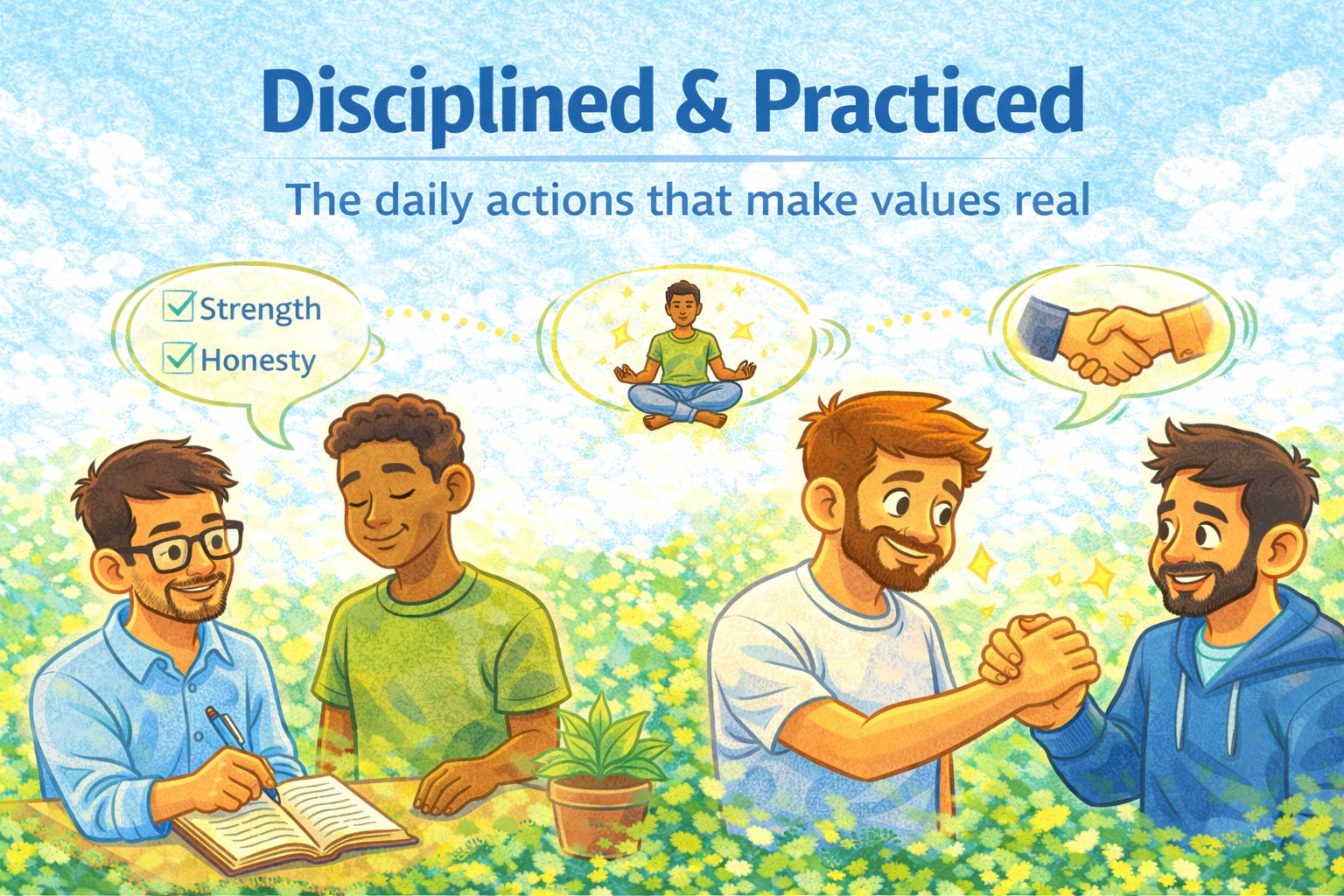
Intelligent Masculinity isn’t proven by how a man talks about his values. It’s proven by whether a man can live with the consequences of them—especially when it’s inconvenient, unglamorous, and unobserved. That’s really what discipline boils down to: it’s not self punishment, not strict rigidity, not dominance over the self or others—rather, it’s the repeated act of choosing your values over your impulses.
We started this series with a thesis:
“Intelligent masculinity is the refusal to outsource accountability onto others—and the discipline to live with the consequences of your actions and values.”
Through the first 3 articles—Masculinity and the Lie of Outsourced Accountability, Who Shapes A Man, and Defining Intelligent Masculinity—we have clarified this definition. Now, we do the heavy lifting: we treat masculinity as an active practice instead of a passive identity. Frederic Poag’s framing provides us with the perfect entry point into this practice—he rejects the modern temptation to treat masculinity as a self-expression. Instead, he describes it as something more—stewardship—and stewardship is always a disciplined practice. It’s the obligation to remain reliable when you’re tired, frustrated, unseen, and un-praised. Frederic says:
“Masculinity that lasts isn’t built in moments of intensity—it’s built in repetition, consistency, and the willingness to be accountable even when no one is applauding.”
That’s the philosophical pivot point: discipline isn’t intensity, it’s continuity. It’s the willingness to be the same person on the boring days too.
Discipline is often purposely misconstrued because fragile masculinity worships the appearance of control while avoiding the internal work required to actually achieve that control. We are living through an age where men are trained to confuse dominance with strength—while ‘discipline’ becomes just another way to control others, rather than regulating one’s self.
So what do we do about it? First, we collapse this confusion into a simple, clear idea outlined by Dr. Eric Lullove:
“Power without restraint is destruction.”
His statement is more than a piece of moral advice—it’s a reality check about what power does when it’s ungoverned and unaccountable. In intelligent masculinity, discipline is what turns power into protection while replacing the harm.
Restraint and self-control aren’t weaknesses—they’re the foundations of the ethical container that keeps strength from becoming a weapon. Restraint and self-control aren’t abstractions either—they’re behavioral. They manifest as living mindfully—finding the balance on the scales between our intelligent mind and our emotion mind—the wise mind—while knowing that that balance is a sliding scale. That scale appears as the pause before the text, the breath before the reply, the ability to slow down in conflict so you don’t punish someone else with your nervous system.
If Dr. Eric gives us the core principle—restraint—Walter Rhein gives us the method—repair. A disciplined man doesn’t just avoid harm. He knows what to do when harm happens anyway. Naming the simplest practice that ego-based masculinity tries to outlaw, Walter says:
“An unqualified ‘I’m sorry’ is one of the strongest things a man can say.”
What makes that “strong” isn’t the phrase itself—it’s the refusal to slip out of consequence with qualifiers, excuses, or counterattacks. An unqualified apology is discipline because it demands you stand in reality without reaching for a mask. And this is where the series’ thesis becomes physical: refusing to outsource accountability means you don’t dump your guilt onto someone else through defensiveness. You carry it. You own it. You repair what you can. You change what you must.
Sharad Swaney’s story adds something that many men often forget: discipline is not just a skill—it’s also a survival response to instability. When you inherit disorder, you either reproduce it or you become intentional. Sharad said it plainly:
“I had to figure out how to be my own father.”
That isn’t motivational. It’s costly. But it produces a particular kind of masculine clarity: the recognition and acceptance that nobody is coming to do the inner work for you. Discipline becomes the bridge between who you were shaped to be and who you choose to become. Sharad’s arc reinforces the core theme of intelligent masculinity: responsibility without shame. You don’t punish yourself into growth—you train yourself into it.
Lawrence Winnerman gives us the daily nuances of that training. He refuses the idea that intelligent masculinity can be reduced to a tidy definition—it has to be lived, chosen, and practiced. This texture is best said in Lawrence’s words:
“I think the word intelligent masculinity is more of a theme than it is a definition… it’s more about how you live your life… It’s about the choices you make each day…”
Then he brings it down into a concrete behavioral contrast: the difference between domination and coaching; between humiliation and repair. Offering us this contrast, Lawrence says:
“It’s taking a different approach that’s more calm, more collected… instead of… coaches grabbing my hockey mask and getting in my face… [you] put your hand on the kid’s shoulder and say… ‘Okay, so you made a mistake… So how can we fix this?’”
That is discipline as relational ethics. It’s not about being “nice” or “soft.” It’s about rejecting the idea that power must be expressed through fear. The disciplined man doesn’t reach for dominance when someone fails—he reaches for instruction, calibration, and stability. Lawrence’s other practice is deceptively hard: listening. Putting this into words, Lawrence says:
“Even if you don’t agree, listen… Listen twice as often as you speak.”
Listening is discipline because it blocks the ego’s favorite move: turning every conversation into a performance.
Evan Fields forces the next step: discipline can’t remain a private practice. If masculinity is only an internal self-concept, it can stay untested forever. Refusing that escape, Evan says:
“Values create obligations, not identities.”
Obligations mean friction. They mean cost. They mean showing up when it would be easier to posture online or retreat into cynicism. Evan names that temptation directly when he says:
“Cynicism is avoidance dressed as intelligence.”
Discipline is what keeps moral seriousness from dissolving into baseless commentary. It makes participation possible without spectacle—because disciplined masculinity doesn’t need to be seen to be real.
Tim Fullerton layers in an essential civic dimension: discipline isn’t just personal. It’s cultural. It’s narrative. It’s what we normalize and what we refuse to normalize—especially for men. Tim describes his mission using clear behavioral terms: reach men, move them, and build something that changes outcomes. Backing this up, Tim says:
“We are building content to appeal to men, which we hopefully think will move more of them to our side on the left.”
That’s not just strategy. That’s accountability at scale: refusing to outsource the work of persuasion, refusing to abandon men to grievance ecosystems, refusing to treat masculinity as someone else’s problem. This is one of the heaviest philosophical points in the whole project: a man’s discipline is not only what he does when tempted—it’s also what he refuses to let become normal around him.
With that in mind, what is the ‘philosophical heavy lifting’ of discipline?
Simply put: discipline is the mechanism by which values become consequences you can live with. Without discipline, our values become mere decorations. With discipline, values become structure—reliable, repeatable, and real.
Frederic Poag’s calm becomes the emotional container.
Dr. Eric Lullove’s restraint becomes the power container.
Walter Rhein’s apology becomes the repair container.
Sharad Swaney’s self-fathering becomes the agency container.
Lawrence Winnerman’s daily choices become the practice container.
Evan Fields’ obligations become the civic container.
Tim Fullerton’s narrative work becomes the cultural container.
In other words: discipline is not just one thing—it is the full architecture of accountable masculinity.
Actions You Can Take
* Check out the new Sick of this Shit Publications Merch Shop!
* Check out Banner & Backbone Media’s new BroadBanner network and affiliate calendar — including all Sick of this Shit Publications branded shows!
Sign the Petitions:
* Demand Congress Subpoena Key Figures on the Epstein Case
Submit questions, feedback, and artwork for Notes of the Week with Nick and Walter:
* Sick of this Shit Community Comment Form
Support Ukraine:
Call your public servants on important issues:
Join the efforts to unmask law enforcement:
Learn empathy forward, human centered, experiment based Leadership & Growth Courses for Higher Ed & Non-Profit Professionals:
Nick’s Notes
I’m Nick Paro, and I’m sick of the shit going on. So, I’m using poetry, podcasting, and lives to discuss the intersections of chronic illness and mental wellbeing, masculinity, veteran’s issues, politics, and so much more. I am only able to have these conversations, bring visibility to my communities, and fill the void through your support — this is a publication where engagement is encouraged, creativity is a cornerstone, and transparency is key — please consider becoming a paid subscriber today and grow the community!
Join the uncensored media at the 1A Collective
Support as a paid subscriber however you can — to help get you started, here are a few discounted options for you
A special thank you to those who are a part of the Sickest of Them All
~ Soso | Millicent | Courtney 🇨🇦 | Eric Lullove | Terry mitchell | Carollynn | Julie Robuck | Mason/She/Her🩷💜💙 ~
For support, contact us at: info@sickofthisshitpublications.com