Day 13
Have you or someone you love struggled with chronic pain or disease? Perhaps an injury has left you in constant pain, only helped when on the strongest of pain medications, yet leaving you so numb that you have difficulty engaging in conversation. Or maybe you developed an autoimmune disease as an adult that has left you fighting constant fatigue, pain and isolation. When you first receive the diagnosis, everyone in your family and community quickly encircles you, ready to help, give rides to treatment, shop for groceries, get your kids to all of their activities. Your church family makes a point to check with you, provides meals and prays over and with you regularly. But as the unexplainable pain continues to wreak havoc on your body and mind, with no end in sight, you and your helpers struggle to remain hopeful. The joy you once exuded, confident that God would see you through this season of pain is choked and shriveled. Instead of words of hope being on the tip of your tongue, you find yourself complaining, crying out in agony, pessimistic that God has good for you.
You find yourself vacillating between craving your care team’s presence, so thankful for them and pushing them away, not trusting they really care for you. Eventually, it becomes difficult for your family and community to stay positive and hopeful, to continue caring for you, even to be around you. They might begin to wonder if you truly want to be healed and set free from the disease that has entrapped you. You might wonder that as well, but it’s more likely that your attitude that pushes others away, is rooted in self-protection. You just can’t let yourself hope anymore, only to be crushingly disappointed one more time.
Today’s reading from the Gospel according to John highlights a man who has been struggling with paralysis for most of his life. When Jesus sees him lying there and learns that he had been in this condition for a long time, He asks the man an unusual question that would surgically probe the depths of the man’s heart, “Do you want to get well?” (v 6)
And while this question Jesus asked may have seemed insensitive to the casual observer, and perhaps even to us, His inquiry launched a major event - Jesus’ third divine sign!
Read John 5:1-23
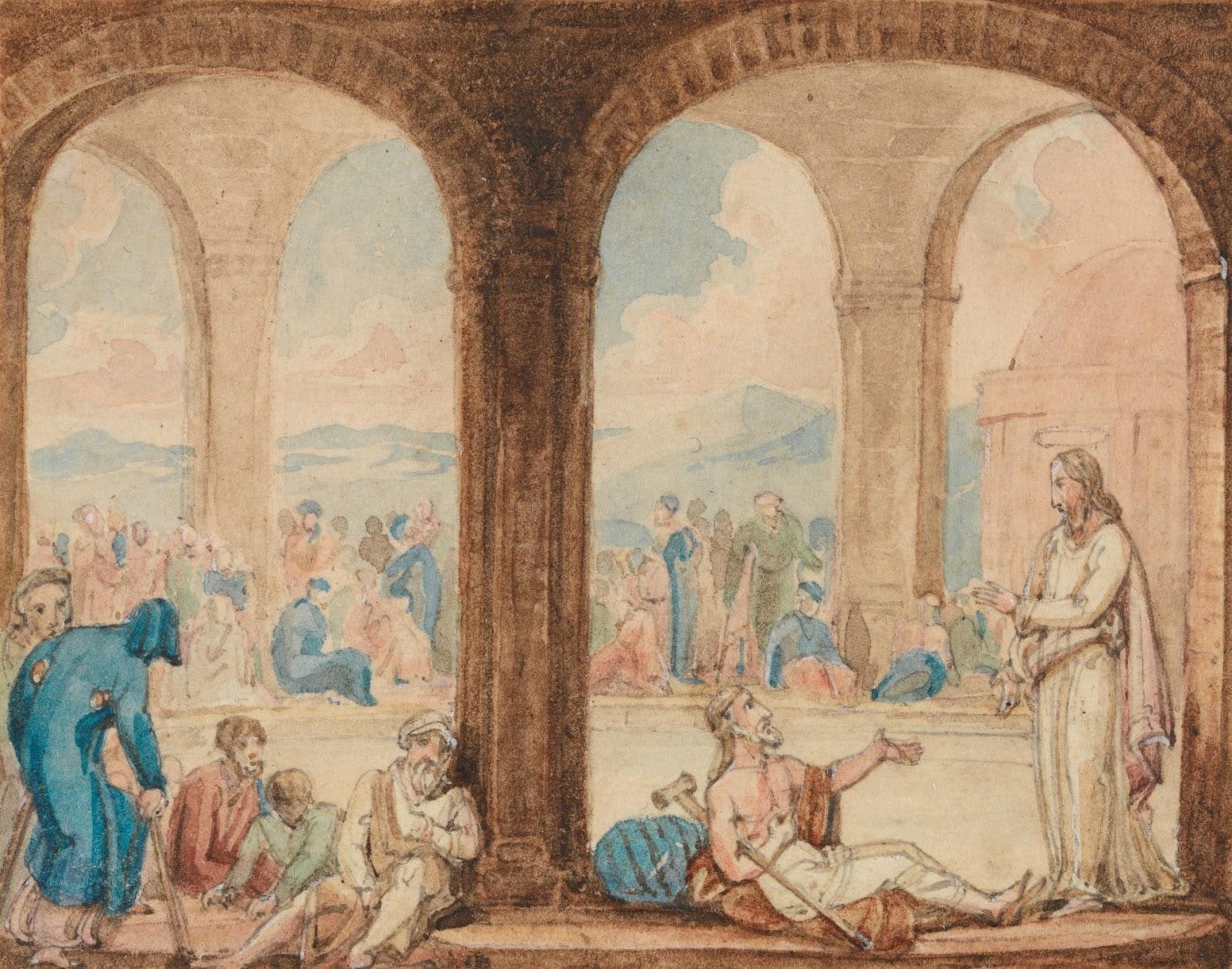
The Pool of Bethesda was a multilevel inground pool, banked by five colonnades - column-lined covered walkways - and stairs that led into multiple pools of water. “Bethesda” means “house of mercy,” a fitting term given the desperate state of the people lying there in hope of a miracle cure. During Jesus’s time, a large crowd of disabled people would regularly gather at the pool and wait for the opportunity to be healed. They believed that at certain seasons an angel would come down and “stir” the water, giving it healing properties. Legend had it that healing was available to anyone who was able to enter the pool first after an angel stirred the water. In fact, a few translations of John’s gospel include verse 4 of chapter 5 which claimed that the lame and sick would wait near the pool, “because an angel would go down into the pool from time to time and stir up the water. Then the first one who got in after the water was stirred up recovered from whatever ailment he had.” (v 4)
For 38 years the paralytic man frequented the Pool of Bethesda, hoping to be healed. Something drew him and the multitudes of other disabled people there year after year. Had healing actually taken place in the mysterious waters before? In addition to the rumor that angels came and gave the waters healing properties, a second theory suggests healing took place in the waters of Bethesda because the pool was fed by a mineral hot spring. Supporters of this view believe that the naturally occurring minerals in the spring would have spontaneously cured many ailments upon contact. The truth is Scripture doesn’t provide details about what exactly the Pool of Bethesda was used for nor does it explain why so many sick people came to believe in the healing powers of the water. But there’s one thing we do know for certain. The paralytic man was healed near the Pool of Bethesda—by Jesus alone.
I wonder if the lame man awakened that momentous morning, wishing that he hadn’t? In bitterness, did he scoot himself to the edge of the water hating the world, hating his life, and despising the waning hope that had drawn him to the pool in the first place? Had guilt and shame gripped the man to the point that it kept him from believing he ever could be healed?
Jesus enters the Pool of Bethesda through the colonnades on the Sabbath and sees the paralyzed man lying there. He sees the man’s shriveled legs and knows that he has been there a long time. Jesus gently asks, “Do you want to get well?” (v 6) The man possessed so little hope that he couldn’t answer Jesus’ question directly. Instead, he replied with a statement that revealed a deeper, more painful burden than the need for physical healing. “I have no one to put me into the pool when the water is stirred up, but while I’m coming, someone goes down ahead of me.” (v 7)
The man had no one to help him. Can you imagine, having no one? The isolation must have been as emotionally and spiritually debilitating as his paralysis was physical. Was it the man’s fault he had no one with him? Perhaps he had driven every possible helper away with his defeatist attitude, cynicism, or simply his own overwhelming neediness? Maybe over the course of 38 years, his helpers had fallen away as they began to realize there was no point in wasting their time. He was never getting better and was so hard to be around. And so he was all alone.
“‘Get up,’ Jesus told him, ‘pick up your mat and walk.’ Instantly the man got well, picked up his mat, and started to walk.’ (vv 8-9) Did I mention that it was the Sabbath? While the Old Testament did not prohibit such an innocent activity as carrying one’s sleeping mat on the Sabbath, the man was violating Jewish traditions that had instituted hundreds of minutely detailed rules about what kind of “work” was prohibited on the Sabbath. Hidden deep within the fine print of Jewish regulations was a code that forbade carrying an object “from one domain into another.”
(Mishnah, Shabbat 7.2)
Jesus does not defend himself by getting into a rabbinic discussion on the nature of work. Rather, he claims he is working, just like God (from v 17), and hence is, as the Synoptic Gospels teach, the Lord of the Sabbath. In healing the invalid man, Jesus was exemplifying genuine love and compassion for the weak, marginalized and overlooked. The ones others had grown tired of helping or listening to their pain. They had set up such high walls of standards and rules that they no longer even saw these wounded people in pain.
In healing this man, and specifically on the Sabbath when it caused such an uproar, Jesus was claiming to be the Son of God, not in the way that ordinary human believers are sons of God but in the sense of one who was equal to God in his nature and in every way. Jesus had come to “heal the brokenhearted.” (Isaiah 61:1) And while He spoke life into the paralytic’s legs that were for all intents and purposes dead, He offered so much more - for “just as the Father raises the dead and gives them life, so the Son also gives life to whom he wants.” (v 21) It was totally worth the wait!
“Humble yourselves, therefore, under the mighty hand of God, so that he may exalt you at the proper time, casting all your cares on him, because he cares about you. Be sober-minded, be alert. Your adversary the devil is prowling around like a roaring lion, looking for anyone he can devour. Resist him, firm in the faith, knowing that the same kind of sufferings are being experienced by your fellow believers throughout the world.” 1 Peter 5:6-9
Big Picture Questions for Today:
* How about you? Have you ever felt forgotten by God, as if He isn’t listening to your prayers?
* Do you tire of watching others prosper - physically, relationally, materially - receiving all manner of blessings while you are required to wait?
* Are you exhausted from the physical and emotional pain? Discouraged in the waiting? Consumed with loneliness? Watching your hope fade away, replaced with bitterness?
Pray, for faith to trust that God’s plans and timing are perfect and will not be thwarted. We can rest, knowing that He sees and cares for us, even when He seems distant or silent, “casting all your cares on him, because he cares about you.”
Lastly, please enjoy this musical exhortation to find Joy in the Waiting by Aaron Bacus. Listen to these lyrics, “I’ll stay right here believing You’re not running late…I’ll find joy in the waiting, I’ll find peace in the pause. You’re still working while I’m praying. You’re not finished at all!”