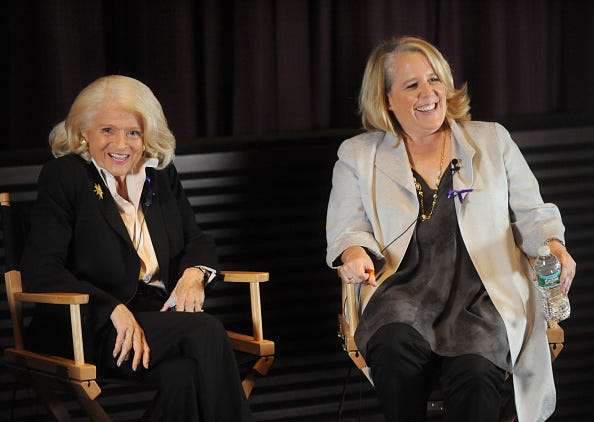
Depositions are a crucial part of discovery—and they can also be, in the hands of a talented litigator, torture for the witness. So I suspect that many lawyers on the left—and beyond—might be jealous right now of Roberta “Robbie” Kaplan, the iconic lawyer and founding partner of Kaplan Hecker & Fink (“KHF”). Last month, Robbie had the pleasure of deposing former president Donald Trump—not once, but twice.
I’m guessing it wasn’t a fun experience for the Donald. His niece Mary Trump, who hired Kaplan Hecker to sue her uncle for fraud, described Robbie to Bloomberg as follows: “She’s brilliant, she’s unrelenting, she can’t be intimidated, and she’s not going to back down. She eats bullies… for lunch.”
Deposing the president twice in the same month is only the latest distinction for Robbie, known for handling some of the most high-profile and high-stakes cases in the country. She’s most well-known for representing the late Edie Windsor in United States v. Windsor, the landmark gay-rights case in which the Supreme Court held unconstitutional section 3 of the Defense of Marriage Act. But Robbie is also the lawyer of choice for major corporations like Goldman Sachs and Uber, who hire her and KHF to handle their most complex legal problems.
On Monday, I was delighted to speak with Robbie for the fourth episode of the Original Jurisdiction podcast. She wasn’t able to say much about the Trump depositions, but she did talk about her multiple cases against Trump in broader terms. We also spoke about what makes her unique as a litigator; her epic victory last year in Sines v. Kessler, in which she won damages of more than $25 million from the white supremacists behind the violent “Unite the Right” rally in Charlottesville in August 2017; her vision for Kaplan Hecker & Fink, the thriving litigation boutique she founded after more than two decades at Paul, Weiss; free-speech and cancel-culture controversies in the legal world; and whether she’s a tough boss.
Please check it out by clicking on the embed at the top of this post. Thanks!
Show Notes:
* Roberta A. Kaplan bio, Kaplan Hecker & Fink LLP
* Then Comes Marriage: How Two Women Fought for and Won Equal Dignity for All, Amazon
* A History-Making Litigator Leaves Biglaw To Launch A Boutique, by David Lat for Above the Law
* Roberta Kaplan Builds Progressive Firm Suing Trump, Defending Wall Street, by Erik Larson for Bloomberg
* 2020 Attorney of the Year: Roberta Kaplan, by Jane Wester for the New York Law Journal
* Lady Justice and Charlottesville Nazis, by Dahlia Lithwick for Amicus/Slate
Prefer reading to listening? A transcript of the entire episode appears below.
Two quick notes:
* This transcript has been cleaned up from the audio in ways that don’t alter meaning—e.g., by deleting verbal filler or adding a word here or there to clarify meaning.
* Because of length constraints, this newsletter may be truncated in email. To view the entire post, simply click on "View entire message" in your email app.
David Lat: Hello, and welcome to the Original Jurisdiction podcast. I’m your host, David Lat, author of a Substack newsletter about law and the legal profession also named Original Jurisdiction, which you can read and subscribe to by going to davidlat.substack.com.
You’re listening to the fourth episode of this podcast, which airs every other Wednesday. Today I’m honored to be joined by one of the nation’s most celebrated, successful, and significant litigators: Roberta “Robbie” Kaplan, founding partner of Kaplan Hecker & Fink. She is most famous for winning United States v. Windsor, the landmark case in which the Supreme Court held unconstitutional a key provision of the Defense of Marriage Act, paving the way for nationwide marriage equality a few years later. But she has worked on many other fascinating cases over the course of her career, including two pending cases against Donald Trump in which she deposed the former president—twice in the past month.
Robbie was born in Cleveland and grew up in Ohio. After graduating from Harvard College, magna cum laude, and Columbia Law School, Robbie clerked for Judge Mark Wolf of the District of Massachusetts and the late Chief Judge Judith Kaye of the New York Court of Appeals, the state’s highest court. Robbie then practiced for more than two decades at the major law firm of Paul, Weiss, where she built a thriving commercial and pro bono practice, including her big win in Windsor.
In 2017, Robbie left Paul Weiss to launch Kaplan Hecker & Fink (“KHF”), one of the nation’s top trial boutiques, known for handling both complex commercial and white-collar cases and landmark public-interest matters. One of the first such cases filed by KHF was Sines v. Kessler, a high-profile lawsuit under the Ku Klux Klan Act of 1871 against twenty-four neo-Nazi and white supremacist leaders responsible for organizing the racial- and religious-based violence in Charlottesville in August 2017. That case went to trial, and a year ago this month, the jury awarded a total of more than $25 million to Robbie’s clients.
In our conversation, Robbie and I talked about her various Trump cases, how she knew she was destined for a legal career from a very young age, two qualities that have made her so successful as a lawyer, how KHF has managed to be so financially successful while also doing so much public-interest work, and her vision for the firm’s future. Without further ado, here’s my interview of Roberta “Robbie” Kaplan.
DL: Thanks so much for joining me, Robbie—it's an honor to have you!
Roberta Kaplan: It's a pleasure to be here.
DL: To start with what's in the news—and I feel like you're always in the news—what can you tell us about your latest high-profile case, namely, E. Jean Carroll's lawsuit against former president Donald Trump? I know that you recently deposed him. Is there anything you can say either about the deposition specifically or about the litigation more generally?
RK: Sure. We actually have two litigations that are very active against Donald Trump, and I actually deposed him in both, on two successive weeks. So it was a relatively exhausting period for me. I literally went to Mar-a-Lago two weeks in a row to depose him. That's about all I can say about it, in terms of the depositions themselves.
But in terms of the cases, it's very interesting. The E. Jean case, which you asked about, is on the fastest track. Right now, trial is scheduled to happen on February 6th. Right now we have one case against Donald Trump for the defamatory statements he made in June 2019. That case is currently certified to the D.C. Court of Appeals as to the question of whether when he made those statements, he was acting within the scope of his employment as president—sounds like kind of a crazy question, but that's the question. And the D.C. Court of Appeals, I believe, recognizing the need for speed here, has scheduled that case on a very, very expedited schedule, with oral arguments to be on January 10. So I think it's entirely possible that we have a ruling from the D.C. Court of Appeals before the trial before Judge [Lewis] Kaplan starts.
Even if that's not true, however, we have a second case that we've told everyone in the world, including Judge Kaplan and Trump's lawyers, that we intend to file on November 24, which is the first day we can file it. That is a case directly for battery, the common-law cause of action by E. Jean against Donald Trump, based on a new law that was passed in New York called the Adult Survivors Act. It’s patterned on the Child Victims Act, and it gives people who were survivors of rape that happened a long time ago basically a free one-year period to bring claims, notwithstanding statutes of limitations. That case we're definitely bringing out November 24th, and I don't think anyone will be surprised to learn that we probably will add to that case some new defamatory statement…