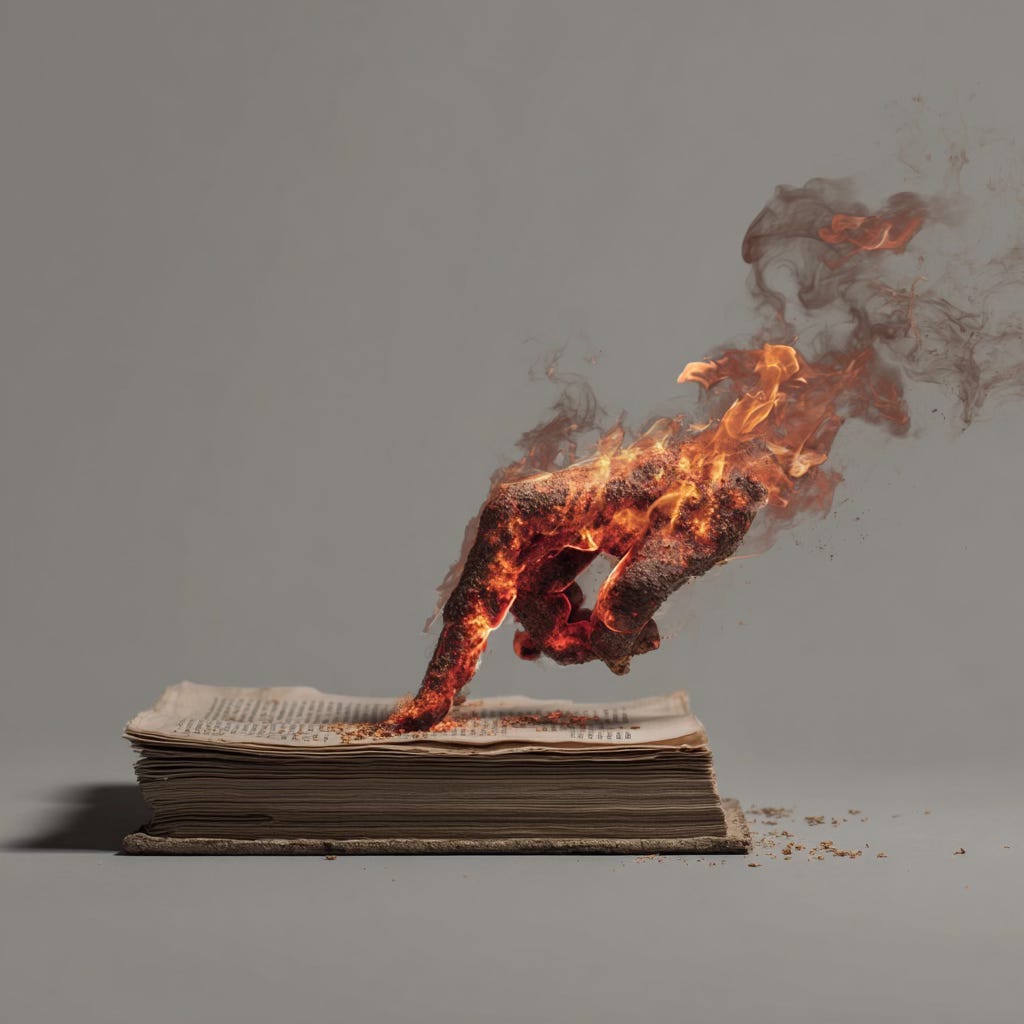
To break the rules, we must know the rules, but an even more crucial piece in gathering the troops for your rebellion is knowing your true self. It is our essence, our dimension-jumping higher being who transcends earthly constraints and human form that should be busting through creative barriers in hot pursuit of making authentic treasures.
Creating good art is about trusting in the muse, isn’t it? And/or in God, and/or whomever/whatever guides you. For atheists, isn’t it about trusting the deep brain, the subconscious, that part which operates with far more efficiency than the lizard brain that we’re most often letting steer our lives. Yes, the left brain is essential to sculpting a novel, but you will create a more profound piece if you can push your ego out of the way and set loose your right brain, the part plugged into the outlet of the infinite.
Drowning in Words is a reader-supported publication. To receive new posts and support my work, consider becoming a free or paid subscriber.
I was chatting with my friend Barbara O’Neal, who is a novelist I greatly admire, and she offered some wisdom that I have to share:
“I have no idea where my books come from—they just present themselves and coyly flirt, and then I do my best to bring them over to this world with as little damage as possible, but I do know I ruin the perfectness of them the minute I begin to write.”
Oh. My. Read that again. If you’re trying too hard to follow the rules—or to follow a recipe in order to create a bestseller, how in the hell are you going to usher something into this world that already exists in a perfect state? We’re not cowhands trying to break a horse here. We want that wild animal to stay wild on the page.
What gets in the way of such magic?
For me, it’s a battalion of fear that waits in the fog of morning on a battlefield that reeks of burning flesh, each enemy more terrifying than the next, the undead servants of Sauron, blood dripping from their axes, evil glowing in their eyes, all of them there to slaughter me with sharp blades of self-doubt, imposter syndrome, fear of failure, a need to matter.
It’s hard not to identify with being a writer. Ask me who I am at a dinner party, and I might tell you that I’m a novelist. (Then I’ll be in my head for ten minutes wishing I’d answered differently.) Writing books is a giant part of what gets me out of bed; it’s my calling. To that end, I don’t want to fail. When I’m not centered, I dread the idea of messing up and writing one that my readers hate, that would make them give up on me.
On top of that, I do this crazy and wonderful gig for a living. If I write one book that gets panned on Amazon and elsewhere, I’ll be okay. Ego-hurt, but fine. Two or three more misfires and I might be in trouble. I’ll end up considering a new career path or begging my brilliant wife to resurrect her Buddhist psychotherapy practice so I can sit around in sweats and slippers and make noise on the banjo.
I’m ashamed to admit, though not afraid to admit (there’s a difference), that one of my biggest recurring daymares, kept alive by a wounded younger part of me, would be to announce that I’m hanging this writing thing up, that I was always just a hack and got lucky a few times, a few-hit wonder and impostor that isn’t worthy of a platform and a readership, that I have no business making art.
That’s kind of sad, isn’t it? Maybe…but it’s through this fearful voice that I find a direct line of communication to that damaged younger me. How beautiful is that? I have direct access to my inner child, a doorway that’s always there in the chambers of my mind. I can pick little Boo up and hold him and listen to him with all of me, tell him I appreciate that he looks out for me, and then I can assure him that all is well, that his higher self has his back; that his job now is to be the Captain of Fun, the CEO of Playfulness in the kid’s club on the Boo Cruise. His responsibility is to constantly remind me that life is better when it’s a sandbox. (I really do have these conversations with him; he loves this new role to which he’s been assigned.)
Aren’t all these worries getting in the way of my creative potential? Is fear the only obstacle stopping me from breaking more rules? Am I really letting my ego captain this ship? Don’t I want to leave it all out there, like I’m doing right now? Isn’t that the only way to offer true homage to the grand design?
These are the challenges I face every year. What I’m excited to report is that I’m increasingly moving to a place where I don’t care as much; where the boy inside of me is starting food fights with run-on sentences and painting his face with his mom’s makeup; where I trust the energy that rises up from the earth, entering through my feet, and that same energy that shoots down from up above, piercing my third eye; and I know from the depths of me that what I create from this egoless, carefree, boundaryless, childlike, joyful place hits harder, bores deeper, and vibrates with more resonance.
I’m far more than merely a novelist. Actually, I don’t need a label but let me try. What I want to say, if you ask me who I am, is:
“I’m just little ol’ boo with a lowercase “b”, a mere speck of stardust, a being of love, of open-mindedness, a father and husband and friend and son, a member of my community and my world. I’m a creation of the great divine.
And yes, I’m a creator! A creator who creates best when I’m behaving as nothing more than a vessel, a sieve, wholly undefined by my output. Any talent and skill I have lies in how I can sometimes let a power far greater than me jab at these keys. In the end, though, we’re all one beating heart, one interconnected organism, and I’m simply one of its cells.”
Can you imagine the look on someone’s face at this dinner party? “I’m sorry I asked,” they might reply, gulping their martini. “I was just making conversation.” Or they might shed a few layers of themselves and open up their arms for a warm embrace: one speck of stardust stuck to another.
So what if I write a book that doesn’t inflate my ego! I’m just hacking away at being human, and my book becoming the next giant hit won’t make me matter any more. And if it flops beyond my wildest nightmares, if critics shred me to pieces, if I have to go get a real job, I won’t matter any less. The only real matter is authenticity here. And starmatter, of course.
You must face that which haunts you before you can truly let go and create something deeply meaningful, a piece that rises from the pit of your being. Without knowing your authentic self, without shedding the skins of disillusionment, without embracing the younger pieces of the you who is in need of your attention, you’ll break rules just to break them, to simply stoke the rebellious fires of your inner teenager—he who smoked Camel Lights under the bleachers—not to fuel the rocket ship that is the real you.
I’m aligning my creative process with my life more and more. On the good days, when fear doesn’t grip my throat, I remember that there is a larger design at play. I don’t have to wake up and scramble to stay afloat. I am not defined by the last piece I published. I don’t have to know exactly where I’m going. I don’t need to be in control.
Yes, having agency is paramount. I must rise in the morning and make choices that form the creative life I desire, but it needs to be of the one-hand-on-the-wheel sort, not the white-knuckle kind.
Because we’re just passengers, dear humans. There are larger forces at play. There is a magnetism that we must feel into, that we must let guide us. If we comfort our wounded pieces and quiet the ego, we will find that our instincts are connected to that magnetism—or call it what you will! All religions, spiritual convictions, or lack thereof, are welcome here. We will find that one hand on the wheel will suffice because our car is actually self-driving.
To that end, in tying this idea to creating, we must let our inner child throw paint at the wall, type sentences that we couldn’t bear to share. We must not let fear win. We have to know that these stories, these sentences—or sculptures or quilts, whatever your medium—are out there waiting to be discovered, and if you stretch out your rabbit ear antennas and point them the right way, then they’ll come pouring out in a fashion that will greatly appeal to your audience. These artistic gems sure as hell don’t care what rules you’re following.
We were born storytellers, but then got blocked by the mess of our childhood. We must return to who we were in the first place, before rules got clamped around our wrists like handcuffs. What would we call them? Musecuffs? Yep, I better jet after that one. I’m out of quarters. Someone tripped on my plug, and it’s slipping from the outlet.
What’s curious about all of my rambling is that this turned into so much more than a discussion on breaking writing rules, didn’t it? But we can’t separate living from writing; they need each other.
It’s not only about reconsidering the guidelines that were set upon us for our particular medium, like whether you should stick to such firm advice as giving your characters “one measurable, external goal,” as I addressed ad nauseam in Part I of this essay.
The marrow of this entire exploration is to suggest that you must break free from every damn thing that you were ever told you couldn’t do or be!
Where are you in your journey? Do you know the rules? Are you clinging to them unhealthily? Then why? What’s stopping you from letting the bird or the beast out of its cage? That’s what I want from you.
I want to see your wings flapping, to feel the burn of the fire that spews from your dragon mouth! Stick out your chest and roar till the windows of every house in your neighborhood shatter.
Or, make your art silently. Send out a penetrating whisper that sneaks under every doorway, that slips between the bones of ribcages and settles into the hearts of your audience—not by brute force, but sneakily, wisely, quietly. Authentically.
Once you’re in that place, I dare anyone to try to put you into a box, tell you what you need to be doing.
Who are you, my friend? What are you doing here? What are you making today?
As you can see, I’m not holding back. Are you?
(You can read Part I of this essay here.)
Drowning in Words is a reader-supported publication. To receive new posts and support my work, consider becoming a free or paid subscriber.