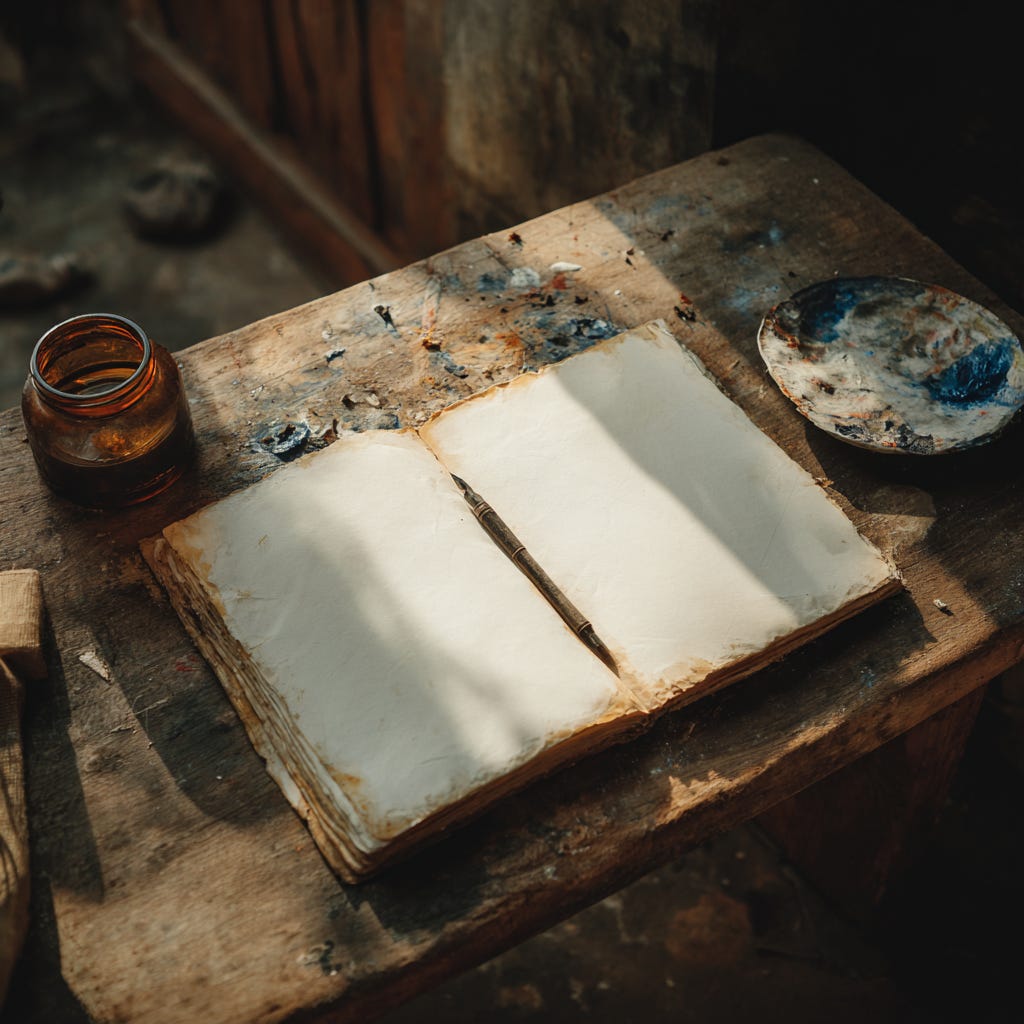
It’s hard to define which draft you’re working with once you’ve type “The End” for the first time while creating a novel. I’ll ram my head into the wall if you insist that it’s the first draft, because there are giant chunks of my manuscripts that I’ve deleted, changed, hacked, and re-worked ten times before I arrived at a completed draft. Does that make it the tenth?
Drowning in Words is a reader-supported publication. To receive new posts and support my work, consider becoming a free or paid subscriber.
Typing “The End” is such a massive step toward completing a novel. You’re not even close to done, but you finally have a glimpse of the story you’re trying to tell, and for me, I’m leaving the part of the project that’s all writing sprints, a war with my inner demons, a leap into the unknown.
No more do you have to pull words, images, and ideas out of nowhere, all while trying to juggle a thousand other pieces. It’s not easy to get it all right on the first or second or tenth attempt, but we try.
Oh, boy, do we try.
While carving out the bones of my story, I’m thinking about sticking to the premise, staying on course, character arcs, weaving the characters around each other, pacing in general, the push/pull of the love stories, the gradual build of tension, the growing degree of conflict, how we shouldn’t keep the characters in one room for too long (Dennis Lehane says get ‘em out after six pages), and the necessity to capture the reader and have them race to the end.
In the back of my mind, I have to be cognizant of my tendency to give characters pity parties, and also my bad habit of allowing for too much interiority—meaning going on for paragraphs about what’s in their head. I’m also considering how I can be guilty of slow starts and how I might light a stronger fire in the first few chapters.
And how about writing strong and unique sentences? I want to keep the writing fresh, steer clear of clichés, focus on active verbs, abolish as many present participles (-ing verbs) as I can, and avoid boring words that love to sneak into my manuscript, such as just and really.
Like all my other writer comrades, I’m also questioning how many sentences start with And or But, because some are okay, but they can get old quickly. Might as well steer clear of them early on, as opposed to hunting them down later. Since I love to torment myself and often set my books in foreign lands, I’m attempting to conjure up images from my research travels, trying to make the book read as if I’m an expert on the locale.
Though I can’t possibly nail it all down, I’m going for as many details as I can while I race to get in my daily word count. I don’t want the pickpocket to steal her money, I want him to slip his calloused hand into her knock-off Louise Vuitton and grab the pearl necklace she’d just haggled for at the market. There’s no room for boring or vague.
And don’t forget about timing. I try to get the timeline right, which is damn near impossible, because I know it’s going to change—despite the prep I put into the book before I even wrote the first word. I’m accidentally going to set a big scene on a Saturday, which will screw up every other day beforehand. Or I might realize the story should span the course of three weeks as opposed to a year-long journey.
All that’s a lot to think about in the “first” draft! And I’ve barely scratched the surface (shit, cliché, delete). Still, we try to get it all in there early on, and yes, it’s exhausting.
Now, let’s be clear. When I’m hammering away at that first draft, the idea is to get into a flow state, which is why I write to a timer and don’t allow myself to stop. I crank music super loud and go. More often than not, I can enter this place where I become a conduit, sentences and ideas spilling out that don’t even feel like mine. Bombs could be going off outside my window, and I wouldn’t notice. Even then, even in the deepest flow, I’m still aware of the things I’d like to get right on the first go.
Let’s use a Formula 1 analogy. While drafting my novel, I’m not only the driver on the track, but I’m also the race engineer, the guy whispering strategy into his earpiece.
It’s a lot. Don’t even get me started on facing fear, the voices in your head questioning whether this story is working at all or if you’re even worthy of making art in the first place.
Of course it’s fun—the most exhillerating activity I know—but it’s not without its challenges.
Fortunately, there’s a shift that happens when we type “The End” and move on to the next part of the journey. It’s like climbing out of your Formula 1 car and jumping into a sailboat. Oddly, despite the next stage becoming more about “editing,” my right brain becomes even more alive. I adore this part of the process. I wake with such tremendous joy at the idea that I can now start to bring alive this word-dumped catastrophe into a story that’s worth telling.
For me, it’s where the art and magic happen. There are even more opportunities to fall into flow, which is the drug that keeps pulling me back in for more despite the countless obstacles.
In this stage, I can take the time to flaunt some poetics. I have the luxury of staring at and re-working a paragraph or a scene till I see it with vivid clarity; till it reads the way I want it experienced. The bird flew overhead can be a red-tailed hawk pierced through the cotton-candy clouds. (Wait, Boo, you’re really laying on the adjectives. Oh, well…)
Now that I’ve seen what my characters are going to do and how they’ve changed, I can slip in the early details that will make that metamorphosis all the more powerful. If I’ve realized that a character ultimately doesn’t love herself—her main flaw—then I can find subtle ways to show it throughout the story that will lead toward a bigger payoff. And I finally have a solid grasp of the premise, which means I have the answer to what needs to be deleted.
It’s like finishing construction and being given the key. Now I can focus on the interior design.
You know what it is? It’s taken me this long to distill it down in my head.
No longer am I staring at a blank page. It might sound silly if you’ve not walked onto such a battlefield, but for me, there’s nothing more frightening than a cursor blinking on an empty page. Give me a madman with a knife anyday.
The editing part, though, that’s the end of the rainbow.
Drowning in Words is a reader-supported publication. To receive new posts and support my work, consider becoming a free or paid subscriber.