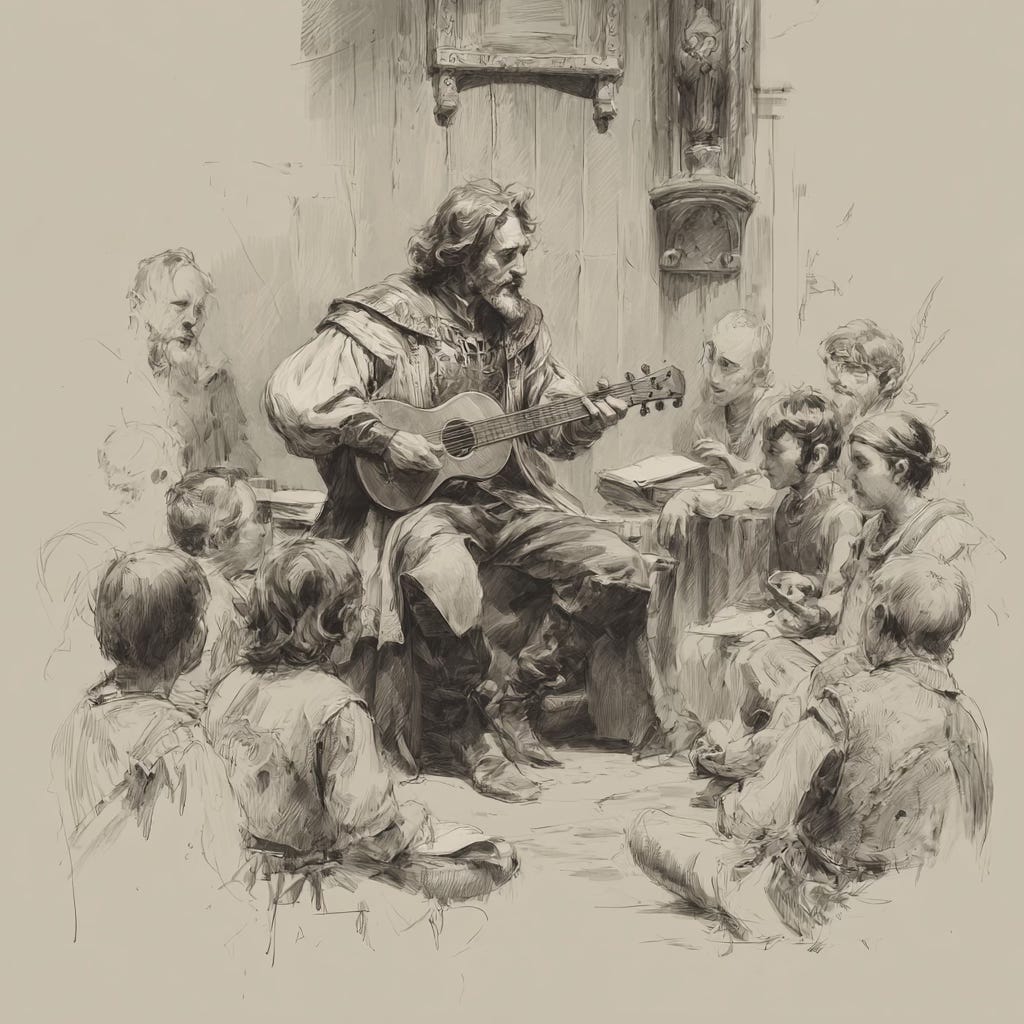
Let’s back way up. What are we fiction writers doing here? (Okay, you nonfictionites can come along too.) Why are we here? Are we not cut from the same cloth as jesters in the king’s court, as storytellers standing around a fire, as bards traveling to far-off lands to share their latest tale? You’re damn right we are. We are entertainers!
Drowning in Words is a reader-supported publication. To receive new posts and support my work, consider becoming a free or paid subscriber.
Yes, our novels need all the components: a killer first sentence, a beginning, middle, and end, intriguing characters with believable arcs, solid grammar and diction, a satisfying climax, and on and on.
But there’s one piece that we must not forget: we share the same DNA as prehistoric fire-tellers who wove their tales around campfires and along migration routes tens of thousands of years before the existence of the written word.
I heard Liz Pelletier of Entangled Publishing speak at the NINC conference in Florida one year, and she offered a piece of advice that’s now on an index card on my whiteboard. “Tell a story as if you’re trying to keep your spouse on the couch from picking up the TV remote.”
One effective way to push your book in that direction is to read it aloud and make sure it’s singing. Yes, I always do a final read-through toward the end of my edits, but I’m constantly speaking passages aloud, even during early drafts.
There must be a rhythm to our words, a rise and fall. Lines have to land with perfect timing. There should be a poetic sense to how the syllables leap from our tongue, a lyrical essence as if we’re songwriters. If you spin your tale as though an audience is facing you, you’ll know in an instant when a clunky passage trips you up. And to Liz’s point, you’ll know if you’re droning along unnecessarily and losing your audience’s attention, because if you’re bored, they will be too.
This practice also slows you down, forces you to experience every word. Makes you live the story in real time and allows you to live it the same way your reader will.
Sometimes, if you’re like me, you have a lot going on in life, a ton of tasks and distractions pulling you away from hitting your word count, a gremlin whispering about all the easier things to do than face the computer screen and slap the keyboard around. In those cases, orate! Speak your words! Slowing it down to that level will pull you right into flow.
Hemingway advised we focus on sculpting one true sentence when we’re feeling stuck. Write that sentence, then read it aloud and see if it rings true. Forget the overwhelm of your grandiose project and fall back in love with the sound of words puzzled together, the wondrous auditory delight of a line of prose.
Regarding dialogue, it’s true that we don’t want to mimic everyday banter. “Hello, how are you?” “I’m great, you?” None of that belongs in our pages. We don't want to waste a reader’s time with what can be implied. Our dialogue should capture the essence of a real-life exchange, but it should hover above reality, speech that carries heavier weight, as if each character had a moment to think before they spoke, knowing they might be recorded.
Once you’ve done that, jump in and have fun. Put voices to your characters and read as if you’re recording your own audiobook. You’ll hear and feel what’s not working. It doesn’t matter if you’re awful. You ought to hear my 19th-century Hampshire, England accent as was deployed during the writing of An Echo in Time.
I’m wrapping up developmental edits for The English Bookstore in Bologna, and I’m drained. I’ve pounded away at my work-in-progress every day all year, and I’m in that place where I never want to see another line. I’m super proud, of course, and I’ll miss these characters, but God, I’ve read and re-read and changed and edited this story to pieces, to the point where I could almost recite it, so I’m just done. It’s not a new feeling. I’m this way with every book once it’s close to leaving the nest. If you’re not feeling zapped, then you didn’t give it your all.
But I refuse to let my birdie fly till after I read it through one last time. Out loud, with pizzazz. (Can you imagine what my wife endures in this house of ours?) I’ve fixed most of the issues. The plot is there. I’ve zapped the inconsistencies. With help from my beta readers, agents, and dev editor, I’ve smoothed out character arcs, killed the fluff, and tended to each description till I’m happy.
Now it’s time for the thing that matters most: making it a tale that transcends its medium. I’m now Aesop or Homer standing before a crowd, an orator from the days of old. My author voice must be perfectly clear. My words must flow and vibrate. My characters must come alive.
So as much as you don’t want to, as tired as you are of this story, do not go lazy now and avoid that final read. Give yourself one last push. After all the work you’ve put in from seed to here, you owe it to yourself. This is the dress rehearsal the night before the big show, your chance to see if there are any pieces that need a final tweak. If you skip it, you’re robbing yourself and the reader of the best version of your work, and you’re forgetting who we really are and why we’re here.
Now go forth, you entertainers—give our fellow humans a break from the woes of their reality. Draw them into your imagination and cast your spell.
Drowning in Words is a reader-supported publication. To receive new posts and support my work, consider becoming a free or paid subscriber.