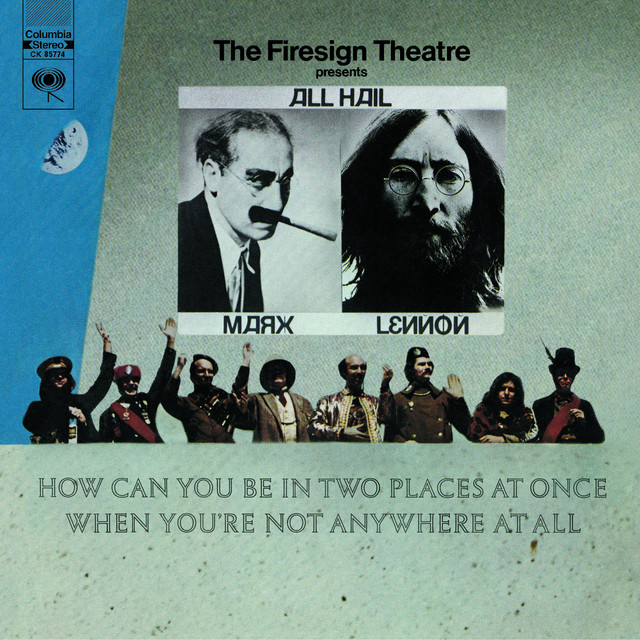
On September 10, I’ll be giving a talk from my Firesign book at the Cornell University Library (you can watch it remotely: pre-register here). Since I’m being hosted by the Library, I decided to present the part of the book that’s most about information (or, more explicitly, propaganda). That comes in the chapter on the Firesign Theatre’s 1969 album How Can You Be in Two Places at Once When You’re Not Anywhere at All — which is also the album on which they are thinking hardest about the history and future of radio.
I won’t be able to get to everything, but I thought that leading up to the talk I would post several of the sources that seem clear inspirations for How Can You Be’s two sides: the title track and “The Further Adventures of Nick Danger.” Up first: Lucille Fletcher’s magisterial radio play “The Hitch-Hiker.”
For the first five years of their tenure at Columbia Records, Firesign cut their records at Columbia Square, a lavish recording studio at the corner of Sunset and Gower in Hollywood. Everyone from the Byrds to the Percy Faith Singers recorded at Columbia Square; the Beach Boys were signed to Capitol Records, but Brian Wilson nevertheless insisted on going to Columbia Square to track the vocals for Pet Sounds and “Good Vibrations.”
Part of the reason Columbia Square sounded the way it did was that it had not originally been built for recording. Opening its doors in 1938, Columbia Square was for more than two decades the world’s premier studio for radio broadcasting, and was home to such legendary shows as The Jack Benny Show and Suspense, as well as the most canonical antifascist propaganda broadcasts of the Second World War. Increasingly aware of the possibilities and implications, the Firesign Theatre remediated the studio’s history for the age of multitrack recording and the Vietnam War crisis.
Although How Can You Be in Two Places at Once cites other sources more directly, it is hard to believe that Firesign was not using Lucille Fletcher’s “The Hitch-Hiker” as a model as they recorded Peter Bergman’s “Babe” driving off of Ralph Spoilsport’s used car lot in his “beautiful new home.”
That car ride will get increasingly psychedelic, as the climate control conjures new environments — from the “tropical paradise” of Vietnam to a hotel in a American pyramid (twenty years before the Luxor in Vegas) — and then seems to forget that there has ever even been a car. Though “The Hitch-Hiker” is not as ostentatiously surreal as How Can You Be, the experience of hearing it — even today — is to enter a space that becomes increasingly psychological and less real, all the way to the fantastic twist at the end. (Pay attention to each time the bell rings!)
Written for and starring Orson Welles, “The Hitch-Hiker” was broadcast live on CBS radio four times in the 1940s, and at least three of those performances originated at Columbia Square, as the Firesign Theatre probably knew. It seems important to remember this history, and we’ll remember it again, in the context of that network’s more recent disgrace.
The version of the play I’m posting here is from September 2, 1942, when it was broadcast from Columbia Square as an episode of Suspense.
Thanks for reading Giant Slide 19 Holes Underground Parking! Subscribe for free to receive new posts and support my work.