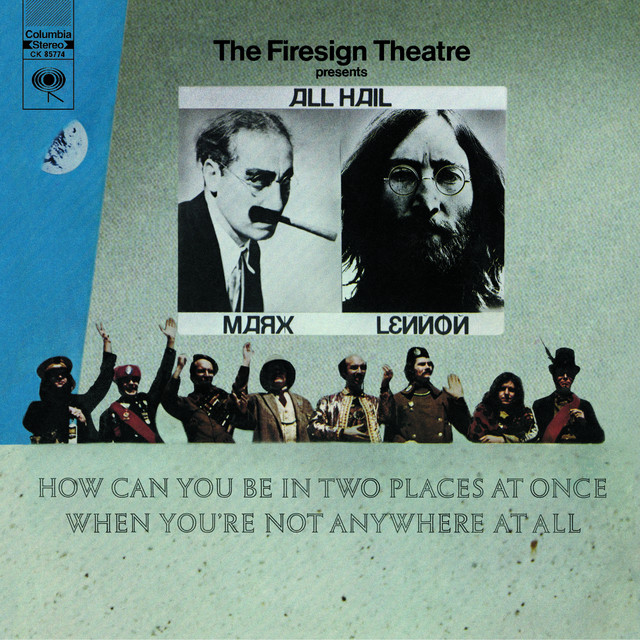
The second in this series of the radio sources for Firesign’s How Can You Be in Two Places at Once is “On a Note of Triumph,” Norman Corwin’s dramatic celebration of the Allies’ World War II victory over Nazi Germany, which broadcast on CBS live from Columbia Square in Los Angeles on VE Day, May 8 1945. (Like this post if you’d like to see CBS recommit to pro-democracy practices!)
Firesign knew that they were recording in the studio Corwin had used for “On a Note of Triumph” and many other pro-democracy propaganda broadcasts, and they (especially David Ossman) were fans of his work even as they were now drawing on Corwin’s techniques to criticize the culture of information now promoting the Vietnam War. Ossman — who would later collaborate with Corwin on an anniversary broadcast of the latter’s Bill of Rights play “We Hold These Truths” (1941) — told me how they read Corwin’s collected scripts avidly, learning not only from the way Corwin handled dialogue and exposition but also from his garrulous notes for production and sound design.Firesign clearly cite the sound and the rhetoric of “On a Note of Triumph” in the “American Pageant” sequence of How Can You Be. In the short excerpts I’m sharing above and below here, you’ll hear Firesign repurposing Corwin’s archetypal “Little Guy” and “far-flung ordinary men” (now the far-flung Isles of Langerhans), as well as Woody Guthrie’s “Round and Round Hitler’s Grave” which on How Can You Be is replaced by Phil Austin’s rousing “This Land is made of mountains/This Land is made of mud/This Land has lots of everything/ For me and Elmer Fudd.”
Firesign also expertly mimic what Neil Verma has called Corwin’s “kaleidosonic” style: “a shifting sonic world that is accessed through a central point that is itself static. [….] Kaleidosonic plays leap from one mike to another, ‘objectively’ arraying the world before us […] across two dimensions.” That is less audible in the passage excerpted here, but is a hallmark of “On a Note of Triumph” and of Corwin’s oeuvre as a whole, which wanted to be “spanning the nation and binding it together.”Revisiting this work two decades later, Firesign’s point was to show how Corwin’s mystical view of democratic citizenship had come to be exploited by the violent inequality of the draft, and was belied by postwar scrutiny of American imperialism. I discuss this further in Firesign: The Electromagnetic History of Everything as Told on Nine Comedy Albums.
For Fair Use considerations, I’m giving a very short excerpt of the Corwin here. The 1945 “On a Note of Triumph” broadcast can be heard in its entirety on the NPR website.
Here’s a link to the first in the radio sources series:
Thanks for reading Giant Slide 19 Holes Underground Parking! Subscribe for free to receive new posts and support my work.