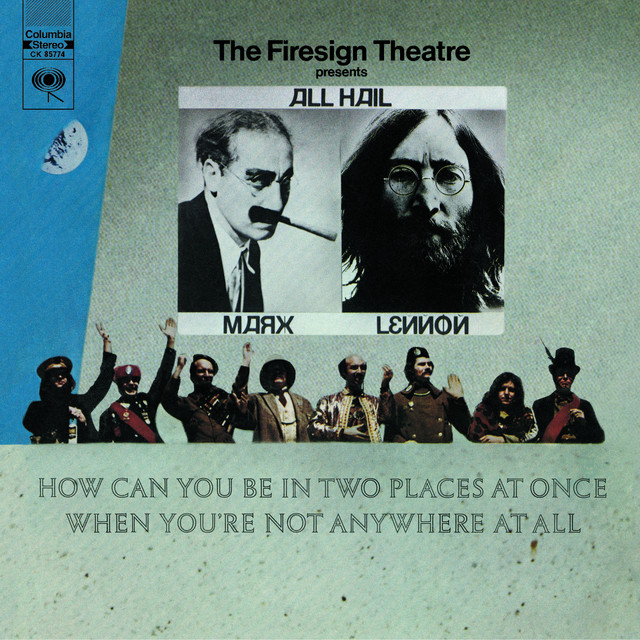
Last week I said I thought that The Adventures of Philip Marlowe was probably the primary model for Firesign’s Nick Danger. I still think that’s right, but you wouldn’t get far into side two of How Can You Be without recognizing another important source: The Maltese Falcon. Phil Proctor’s Rocky Rococo is clearly modeled on Peter Lorre’s performance as Joel Cairo in the famous 1941 Warner Bros. film, and if the vocal impression is not enough, the script gives further cues (which must be dry by now): “you may have seen me around the drugstore drinking chocolate malted falcons,” “I’ve been killed! This hasn’t happened to me since M!,” and so on.
Because it’s most famous as a film, I thought The Maltese Falcon would be outside my purview — I’m also resisting posting the late-night used car ads Proctor used for side A’s Ralph Spoilsport (oh ALL RIGHT — here!). But then I returned to the multipart Firesign precis I’d discoveredin the 1970s London zine Trailing Clouds of Glory. As I read that freewheeling piece of citizen scholarship (whereof more later) I was reminded that there were also several radio versions of The Maltese Falcon, each of which would have been understood as a radio adaptation of John Huston’s film adaptation (for Warner) of the original Dashiell Hammett novel, which had first been serialized in the pulp magazine Black Mask in 1929, published as a book in 1930, and had even seen a previous film version in 1931.
The first radio adaptation — an hour-long broadcast starring Edward G. Robinson as Sam Spade — aired in February 1943 on CBS’s Lux Radio Theatre, a program that specialized in radio versions of recent Broadway plays and films. The other two broadcasts featured Humphrey Bogart (Spade), Mary Astor (Brigid O’Shaughnessy), and Sydney Greenstreet (Caspar Gutman), all reprising their roles from the 1941 film. The version I’ve posted here — a compressed thirty-minute version broadcast on CBS’s Lady Esther Screen Guild Theater in September 1943 — is the only one that includes Peter Lorre’s Joel Cairo alongside the other three principals.
Though Phil Austin’s Nick Danger is much closer to radio’s Philip Marlowe (Gerald Mohr) than he is to Bogart’s Sam Spade, Firesign’s famous gag about the female lead’s many aliases — Melanie Haber? Audrey Farber? Susan Underhill? What about Betty Jo Bialoski! — seems a fairly straight lift from The Maltese Falcon where “Ruth Wonderly” poses as “Miss LeBlanc” before finally copping to the name Brigid O’Shaughnessy. They could have pulled that from any iteration of Hammett’s story, of course. But since they were the last generation to have been children before television, I think they were as likely to have heard The Maltese Falcon rebroadcast on the radio as they were to have seen the film on TV.
The Screen Guild Players’ version is loose and fun in a way that is typical of many live broadcasts, and Firesign appreciatively represent that style throughout “Nick Danger.” At one point, during an ostensibly tense exchange, Bogart (in character as Spade) teases Greenstreet for missing a line. The audience understands what is happening and can be heard laughing as Greenstreet adapts (20:10).
Spade: Ok, so I get millions later. How’s about fifteen thousand now?
Gutman: Frankly and candidly and upon my word of honor as a gentleman, the ten thousand I gave you is all I can raise right now.
Spade (Bogart): But you didn’t say positively.
Gutman (Greenstreet): [LAUGHING] Positively. [AUDIENCE LAUGHS]
“The Further Adventures of Nick Danger” pays homage to, and explodes, these features of live radio in its numerous metafictional gags:
Catherwood: Come in out of the cornstarch and dry your mukluks by the fire. [DOOR SLAMS. FIREPLACE EFFECT] Let me introduce myself. I am Nick Danger.
Nick: No let me introduce myself. I am Nick Danger.
Catherwood: If you’re so smart, why don’t you pick up your cues faster?
Nick: Are those my cues?
Catherwood: Yes, and they must be dry by now. Why don’t you pull them out of the cellophane before they scorch!
Or, my favorite:
Catherwood: I assume you’ve come to see my mistress, Mr. Danger.
Anticipating the Korean War announcement that delays the last-discussed Philip Marlowe episode, the Screen Guild Players’ radio adaptation of The Maltese Falcon concludes with an appeal from Humphrey Bogart to purchase war bonds — “each of us must dig deeper into our own pockets.” This is further evidence suggesting that the Firesign Theatre saw the two very different sides of How Can You Be — the hectic, psychedelic, Vietnam-identified propaganda travesty of side one and the hard-boiled detective genre parody of side two — as indissolubly linked.
A final note: there is another Angelino of the late 1960s who thought a great deal about the unfinished business of World War II in the context of Vietnam. Given the fact that his first novel, V. (1963), is a quest narrative that conspicuously travels to Malta, and that a more recent book (as well as one forthcoming) borrows from the genre of the hard-boiled PI, I expect he was well versed in this kind of radio too.
I’ll be talking more about the relationship of the Thomas Pynchon to the Firesign Theatre in the coming weeks.
Thanks for reading Giant Slide 19 Holes Underground Parking! Subscribe for free to receive new posts and support my work.