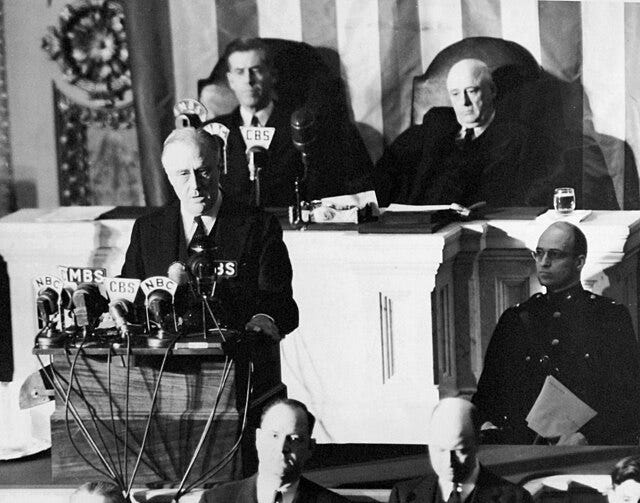
The final entry in this series on the Firesign Theatre’s radio sources has to be FDR’s December 1941 Pearl Harbor address — Firesign’s inspiration for the famous travesty that interrupts “The Further Adventures of Nick Danger” (at 25:20) and concludes the hour-long How Can You Be in Two Places at Once When You’re Not Anywhere at All:
We have reached our rendezvous with destiny! It is our unanimous and irrevocable decision that the United States of America unconditionally surrender!
In Firesign: The Electromagnetic History of Everything, I talk about the “unconditional surrender” broadcast in relation to the Gulf of Tonkin incident, the Munich Accord, and The War of the Worlds (also America First, Python at the BBC, John and Yoko’s Nutopia press conference, and the I Ching). To the album’s first listeners, though, Firesign’s comedic disinformation probably sounded, first and foremost, like a coded message for the desired outcome of the Vietnam War. In December 1969, two months after How Can You Be peaked on the charts, that first audience became subject to the new draft lottery.
It’s worth listening back to FDR’s original announcements (there were two), both to see how Firesign worked with them in early 1969 and also to give us a point of comparison for the way information, misinformation, and disinformation about political violence has been traveling recently.
The first thing you might notice is that Peter Bergman’s FDR impersonation is not very good. It’s not unreasonable to wonder if the badness is intentional. Since the late 1940s, FDR’s December 8 address — the piece that I’ve posted here — had been routinely included on LP compilations of “radio’s greatest broadcasts,” and that practice continued into the Vietnam era. Liberties the Firesign Theatre took elsewhere with both tone and content were likely measures of Firesign’s disgust with the way Second World War nostalgia was being instrumentalized as support for the war in Vietnam.
At least one phrase from FDR’s address is close enough to the version on How Can You Be to suggest that Firesign had a recording or transcript of FDR’s speech to hand, and if that’s the case, it’s possible to notice ways Firesign’s emergency announcement deforms FDR’s original beyond their imposition of an American surrender. Notably, Bergman omits the most famous phrase from the December 8 speech — “a date which will live in infamy” — including instead another signature FDR phrase, one whose resonance had recently become significantly volatile.
“A rendezvous with destiny” was a slogan first coined in the speech FDR gave as he was accepting his presidential renomination at the 1936 Democratic National Convention in Philadelphia. Coming three years before the German invasion of Poland, the speech was meant to rally American citizens against what Roosevelt called the “new industrial dictatorship” that he found to be promoted both by fascist states abroad and by the “royalists of the economic order” at home. Having majored in what he would call “labor economics” (he wrote undergraduate thesis on the IWW), Peter Bergman likely knew that the “rendezvous with destiny” motto had its origins FDR’s left-wing economic populism.
If so, Bergman would have been doubly aware of the irony of Ronald Reagan’s more recent appropriation of the “rendezvous with destiny” phrase, which he used to conclude his pivotal 1964 speech endorsing Republican presidential candidate Barry Goldwater, a militant anticommunist and opponent of New Deal policies and institutions. Two years later, Reagan would win a first term as governor of California, running specifically against the burgeoning student movement. For Firesign to use FDR’s phrase a third time, this time as parodic counterfactual history (or political disinformation), was to ask if Reagan’s co-optation of the phrase was equal parts put-on and propaganda.
The December 8 address to congress lasted a very short seven minutes, concluding with a request that congress authorize a declaration of war on Japan. Congress obliged with a positive vote thirty-three minutes later. The following night, December 9, Roosevelt addressed US citizens directly (as Firesign’s FDR pretends to do) in a twenty-seven minute “fireside chat” that was heard by an estimated 81% of the country. The broadcast begins by situating the Pearl Harbor attack as the “climax of a decade of international immorality” perpetrated by Germany, Italy, Spain, and Japan: “gangsters [who] have banded together to make war on the whole human race.” It concludes by acknowledging and describing the sacrifices American citizens will be obliged to make, to successfully wage the war against the fascist states.
Neither of those statements is surprising to hear today. What might be surprising — particularly given the relative absence of similar statements today — is the sequence between them, where Roosevelt addresses the information environment of 1941. Other than an interesting admonishment against rumor-mongering — emphasizing the importance of word-of-mouth as well as mass-mediated communication — Roosevelt is primarily talking about the radio waves, which he understands to be the common medium both for military communications and for public entertainment (Friedrich Kittler would agree!). The latter (general/public), he implies, quietly becomes a version of the former (military/political) when it is seeded with mis- or disinformation, with the aim of “spread[ing] fear and confusion among us”. To this point, Roosevelt includes advice for how to listen to the news:
When you hear statements that are attributed to what they call an “authoritative source” you can be reasonably sure from now on that under these war circumstances the “authoritative source” is not any person in authority. Many rumors and reports which we now hear originate, of course, with enemy sources.
If you’ve read the second of the Philip Marlowe episodes in this series, you might notice that what FDR warns against in 1941 literally describes the 1950 announcement of imminent hostilities in Korea (CBS reporting that the AP has heard from an “authoritative source”). The story of what happened between 1941 and 1950 is too long to take up here. Instead, let’s take a moment to reflect on a moment when the US government — albeit in a propaganda broadcast of its own — took time to describe the methods and techniques of wartime propaganda, in a time (today) when the people in authority are perhaps the least authoritative sources.
Thanks for reading Giant Slide 19 Holes Underground Parking! Subscribe for free to receive new posts and support my work.