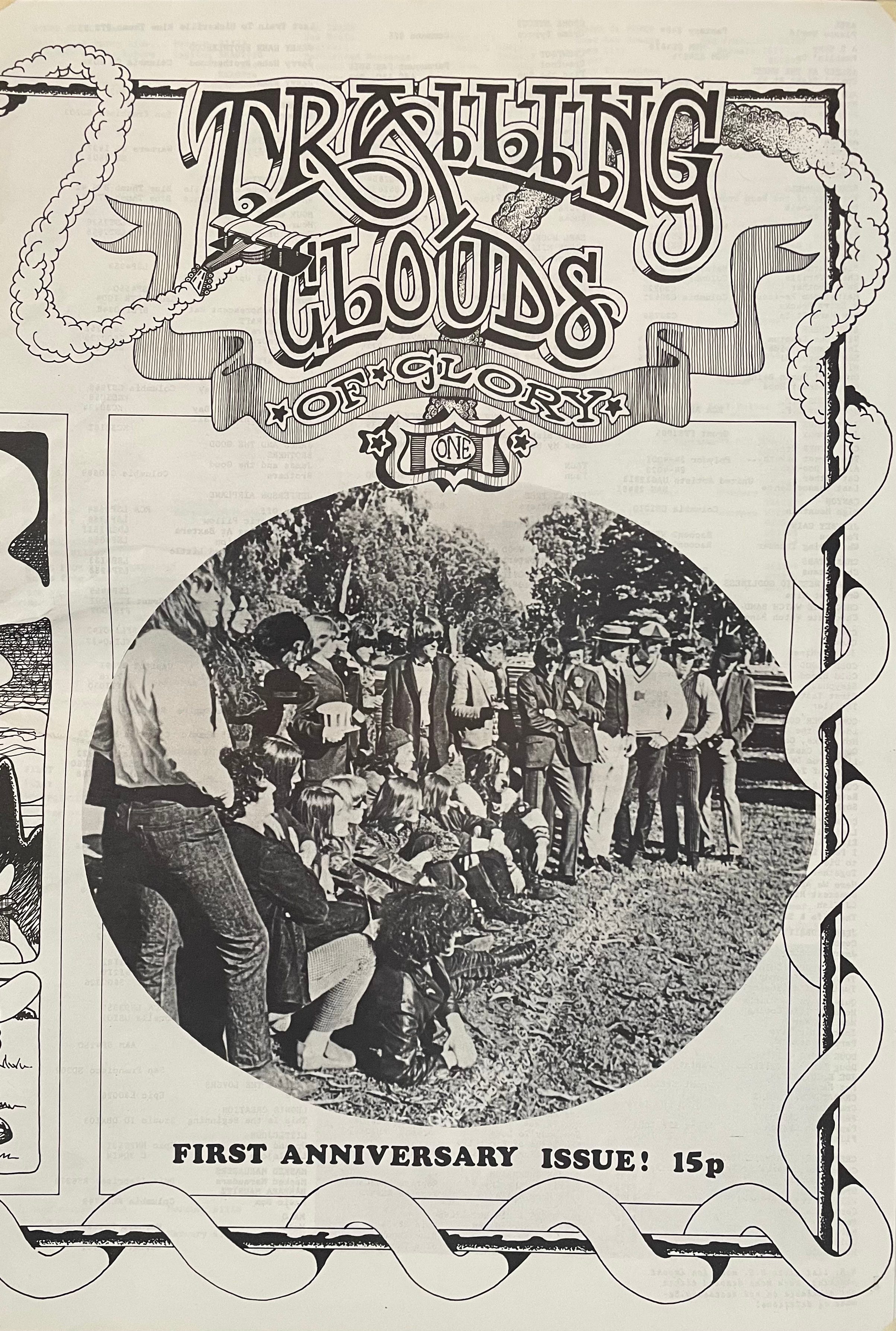
Hi everyone. I hope you all enjoy this conversation with Phil Vellender, one of the five minds behind the London fanzine Trailing Clouds of Glory. I shared their fantastic 1974 multipart Firesign Theatre piece last week (linked here in case you missed it). A transcript of our conversation follows below.
One other piece of Firesign news this week: a four-hour compilation of Nick Danger pieces is now available on Bandcamp, courtesy of the heroic Taylor Jessen. This is every Nick Danger piece not released on Columbia (those are all on the streaming services). The 1984 album The Three Faces of Al is especially great.
Jeremy Braddock: I am talking here with Phil Vellender, editor of Trailing Clouds of Glory, dateline London 1974. One of the most interesting publications, fan-generated or otherwise, about Firesign Theatre that I discovered while I was doing the research for my Firesign book. And I discovered it really late, but it confirmed to me that I was on the right track. I was super psyched to be able to meet Phil, and we’ve had a number of conversations over the years and he’s agreed to meet up with us and answer a few questions about Trailing Clouds of Glory. Hi, Phil.
Phil Vellender: Hi, delighted to be here, thank you.
Jeremy: Excellent, I’m delighted to have you here. I’m wondering if you could tell us a bit about the history of Trailing Clouds of Glory.
Phil: Well, there were a number of fanzines in Britain at the time, but none of them seemed to satisfy our liking for literature and art and all that sort of thing, which we wanted to try and roll together. And there were five of us who were involved with this, of which three were heavily into Firesign Theatre. And so we came together and decided we’d do a fanzine, but we wouldn’t do a fanzine like, you know, “band mania” fanzine, but it would be more to do with the culture and the politics of contemporary America.
We’d all (well three of us) gone to university so we did have an academic background but we didn’t want to make it too obscure. So we tried to not patronize our audience in the Firesign article but actually inform. That was our goal, so that’s hopefully what you found.
Jeremy: I think you really did that. Do want to give us the names of the five and briefly tell us what they did?
Phil: Well, I went to school with one Steve [Burgess], who did a lot of the artwork in the magazine (and I hope everyone will have an opportunity at some point to see the other pages because they’re rather nice). But I went to school with Steve and he was an incredible know-all about West Coast American music. A band didn’t leave the studio in San Francisco without him knowing all about it. So he was a great guy to be around.
And then there was a guy called Richard Kinnoy, who was very keen on Shelley, and he wrote experimental writing, probably would have done creative writing courses now. So I met him in a squat in London in 1975.
And then Chrissie Toubkin was my big pal. Chrissie was reading philosophy at the Polytechnic where I was doing my study of history. And we hooked up through humor, really — a few taglines from the Goons and so on. But we then discovered that we both heard of Firesign Theatre. Steve had introduced me to them. He played the Nick Danger side of All Hail [How Can You Be in Two Places at Once When You’re Not Anywhere at All], as I shall short-hand it, first, which I thought was very funny because, I’d been doing all-nighters at the local cinema with Chrissie, and we’d done most of the film noir things, so we picked it up. We’d seen The Maltese Falcon and so on. So that was that.
And Chrissie and I said, well, look, we don’t really want to do music. We’d interviewed Steve Miller, which was the centerpiece of the magazine — the Steve Miller Band — and we’d done enough of that, so we wanted to do something more to do with humor. And we all were modestly quite funny people so it seemed fitting that we should tackle a bunch of funny people from America.
And that’s precisely what Chrissie and I set out to do really. We found Firesign Theatre, we stumbled on it through luck. And once we got one, we traced [Don’t Crush That] Dwarf, which came out a bit later on. But we all had All Hail. Some of us had [Waiting for the] Electrician. And it was just intellectually challenging. It wasn’t the sort of thing that you listen to it once, like Cheech and Chong, and you’ve forgotten it.
Jeremy: And Chrissie did the “Quick Short Circuit Round the Firesign Theatre,” which is one of the things that really blew my mind.
Phil: It is mind-blowing, it is.
Jeremy: And you kindly allowed me to include it in my book. And so I think we have Steve [Burgess], Phil Vellender, Christina Toubkin, [and] Hamish Orr did the fake advertisements, is that right?
Phil: Hamish did the fake advertising. Peter Wynn-Owen, who was a friend of my brother’s, went to art school in London, [and] he offered to do the Firesign Theatre logo [that] we had, which was a battery connected to neon lighting. We modestly thought [it] was better than anything they had on their album sleeves but unfortunately Columbia weren’t interested.
Jeremy: Some of their album covers are better than others, that’s for sure.
Phil: Oh yeah, but don’t let’s quibble about that. They are generally very funny.
Jeremy: So how did you discover Firesign Theatre? I understand the records would only have been available on import in London in the 70s, right?
Phil: Well, we were habitués, is the trendy word in the ’68 days, habitués of certain shops in London. Now, quickly to explain to your listeners or viewers, the majority of American music of the psychedelic variety arrived in London in two or three record stores. And unlike in America, where you had to live in Chicago to get Chicago and you had to go to L.A. to get L.A., it was all collected together in one place in those days, which was quite rare. I mean, I want you to think Tower Records kind of thing. They were all there. But we had a marvelously cliquey, elitist view of this. And we would go there. And we would spend our ill-gotten student money from the government on imports. And we all discovered this Firesign Theatre. And I said, do you know what? Let’s do an evening of Firesign. So we did. We got together. And I won’t go into the detail of how the evening progressed, but let’s put it this way: there was a lot of laughter and some of it hysterical.
And the Firesign Theatre albums we actually decided to do that evening were All Hail and Dwarf. And Dwarf, we had to play it twice because we just couldn’t believe how good it was. And it reminded us very much of music by the Beatles, like Sgt. Pepper or those kind of multi-tracked albums, which one discovered were only done on four-track stereo (though I did find out fairly early on that the Firesign were using, later on anyway, much more sophisticated recording than that). But anyway, we all got absolutely hooked on Firesign at that point.
And Steve said, look, I’m not going to be able to hang out with you guys often enough to do this. So why don’t you go ahead and do it? So he never gave up on Firesign, but he pulled out of that particular angle and left it to us. So Chrissie and I would get together every Saturday night, every weekend. I’d go to her bedsit in Notting Hill, in west London, and we would listen to the albums. And then we started to create this article. And Chrissie said, I think we need a diagram. And that’s what that was. And I left that to her because she had it in her head. And it was like, you know, it was like peeling a glass onion, if you like. She just got it out on paper.
Hamish didn’t come in on that. He would have done a lovely graphic job on it because he was a professional graphic artist, but he wasn’t around to do it. So we did it. And that became the kind of key to what we were going to do. And then we decided to split it in two. We’d do a political kind of overview and then we’d look at the albums individually. And then we definitely decided to do our own reading list where we would insert one-liners of our own choice, you know, some funnier than others. But we wanted to show that we could hold our own with Firesign, albeit from the other side of the pond.
Jeremy: Right. And so that’s why I remember I asked you, why did you call it Trailing Clouds of Glory — were you quoting Firesign or Wordsworth? And you said, “Oh, we were really interested in the radical republican Wordsworth.” So you said you’re quoting [Wordsworth’s] Intimations Ode. But I think that probably the more accurate answer is that it was as if you were telling Firesign that you knew the reference.
Phil: Oh, we love the Firesign line, you know, that “trailing clouds of glory, I’m down, I’m down,” you know, “powerful windshield” and all that. I mean, the whole Korean War stuff just cracked us up. And we obviously had seen a lot of those movies, those black-and-white war movies. So that came in. But the thing about that was that Chrissie had studied the Romantics at A-level, which was pre-university. And Richard was mad on Shelley, so he was saying, you know, “trailing clouds of glory,” isn’t there a Shelley quote?” And I said “No, let’s go with this one” and then Hamish walked in with the mandolin biplane logo [the cover image] and so we thought well that’s it really. I must say I think it was a sensible title. Lots of people asked about it, that’s what was good. And we were all [politically]republicans [i.e. they all opposed the British monarchy and Crown] and we all liked the younger Romantics so that was how that came about.
Jeremy: I want to get back to that question of politics in a second. It occurs to me to ask, since you were especially drawn to Dwarf, I’m wondering what the representation of television sounded like to you. And like, did you own TVs?
Phil: Oh, yeah we had … well, no, we were radio people. “UTV for you, the viewer.” We didn’t have, you know [American television]. We couldn’t believe how many channels American TV had. My cousins are from Boston, so they would send us little notelets about life in America.
Jeremy: …because, you know, the thing that’s interesting [to me] is that 1974 is also the year of Raymond Williams’ book, Television, right? His “American” book — he writes it after spending a year in the U.S.
Phil: Yes.
Jeremy: So listening to Dwarf, were you thinking “this is what American TV sounds like”? Or was it like “finally somebody knows how to represent television as television?”
Phil: Well, we knew — a great line a friend of mine came up with, he said “Americans are only superficial on the surface.” And we knew that American TV was, no disrespect, but that’s what, you know, with our BBC, which is “so important,” so “well made” and everything, so internationally lauded. A lot of us had already seen through that myth. And in fact, we liked the kind of fast cut and thrust of American TV. I mean, we all had, you know, all the American cop film things we had. We were all Columbo fans. You know, that sort of thing. So we were suckers for that stuff.
But what I think was lovely about Dwarf was [that] we just realized it’s a collection of ads. Everything is sewn together, you know khhh! khhh! [channel changes], and then you go on to another one. And, you know, this marvelous thing about “why do they never come up into the hills?” And you get this lingering feeling. What the hell is going on? Has Nixon pulled off a coup or something? You know, because we’re all following Watergate very avidly. And Principal Poop’s speech on Dear Friends.
So Firesign to us were really on the money politically. We just thought they were so sharp that we couldn’t help but fall for that whole album. Because the thing about it was, it was an entity. It made sense as an entity. It wasn’t tracks like, you know, Cheech and Chong: this sketch, that sketch. It just went through one after the other.
And this idea that you could recycle [Don’t Crush That Dwarf’s George] Tirebiter in so many different settings. And we love that thing where he’s running, he hears the ice cream van at the end and his voice changes and goes higher. That just blew our mind. We thought that was such an attention to detail. These guys must be really professional. That’s when we decided to write about Dwarf, about Firesign in the fanzine
Jeremy: Right. And I remember the first time we spoke, you said something just sort of off the cuff that struck me as really apt. You said, “We saw that Firesign understood that language was the terrain of combat.” So they really thought seriously — this is how I understood it — about the political and commercial uses of language. And that was something that they wanted to represent and intervene in.
And when I received Trailing Clouds of Glory, the thing that really impressed me is that in your first bibliography, you have a number of books all published — and I love that you include the bibliographical information — all published by Black and Red Press, which is a Detroit-based anarchist press, most famous for being the original US publishers of Guy Debord’s Society of the Spectacle.
Phil: In America, yeah.
Jeremy: And another Situationist text is there as well [Ten Days That Shook the University]. So I know that this is looking way back in the past, but can you tell me how you came to the Situationists and what it meant to be reading that stuff six years after May ’68 in London?
Phil: There were political tensions within the five of us because Richard was a bit of an individualist and we didn’t really talk a lot about political stuff with him so much.
Jeremy: Well, Firesign didn’t all agree on everything all the time either.
Phil: No, I’m sure they didn’t. But Chrissie and I generally did have a coinciding [viewpoint]. The thing is, we weren’t interested in the ideology of Trotskyists. I’d met a lot of them at university and I thought they were going nowhere. It’s a blind alley sort of thing. But the liberating thing about Firesign was that they seemed free of this kind of thing. In fact, they were ripping the nonsense out of the Left as much as they were [the Right] — “you ain’t got no friends on the Left, you’re right!” — You know, that cracked us up because, of course, I didn’t see that as apolitical. I saw it as an ability to read critically stuff on both sides. And, you know, Morse Science High and Commie Martyrs [High School, both from Dwarf]. That whole thing to us was brilliant. You know, the Cold War, East versus West, all that stuff.
And we felt that this language thing was vital because ideology for us was frozen language. It was language that had become ossified, fossilized. And therefore, we were more into this idea of radical theory, this idea that language needed to be constantly examined. And what do Firesign do? They constantly examine language. They restore meanings to words that they’ve lost.
I mean, a simple mistake, people will make is [to] talk about being “disinterested” in something. Well, that’s not correct, it should be “we’re uninterested” in something. Although in the 18th century, disinterested was the correct word to use. So it’s one of those things that Firesign do. They flip you back 100 years and you suddenly realize, oh, that sounds like, oh, they’re right!
We felt that this language thing was vital because ideology for us was frozen language. It was language that had become ossified, fossilized. And therefore, we were more into this idea of radical theory, this idea that language needed to be constantly examined. And what do Firesign do? They constantly examine language.
And so we liked that kind of intellectual attention being paid to detail about language. And the thing we also loved was the use of stress in the sentence: “‘If you don’t answer the question, I’m going to have to gag you.’ ‘What question?’ ‘Gag him!’” You know, that kind of stuff was so clever and “the people’s prosecutor and the persecutor at the same time.”
You know, this idea of duality is always coming through and the language just was brilliant. But then you realize you’re either listening to the outtake of a film, as in “Silverberg here won’t go over Porkchop Hill” which is sort of a Vietnam-Korean sort of reference, or you were listening to Morse Science High and “knowledge for the pupil” and all that stuff. And it just seemed to us to be so far away from the Beach Boys’ surfing stories. You know, we’d always imagined that [American] high school was sort of “Surfer Girl.” But this wasn’t, this was something else.
And actually, it was quite intimidating in some respects because the reality they were putting over was not the reality of psychedelic music and “everything was going to be all right.” It had a hint of Altamont about it. It had that vibe of Nixon and the enemies list and Jane Fonda being hounded and Watergate and stuff. So we felt that their interest in language was actually why you listened again. You wanted to find more connections and the way they put the records together engendered ideas. They were like synapses. So we loved them for that. We loved the fact that they can be replayed hundreds of times.
Jeremy: Yeah, I know. It always struck me that listening to their records is the closest that, at least for me, listening has ever been to reading. So let me ask one more question. When was the first time you came to the United States?
Phil: Me? 2003, just after the Gulf War. And I was visiting my friend Barry Melton from Country Joe and the Fish, who had become a friend of mine back in ’75. And, of course, he was in Zephaniah, the movie.
Jeremy: Yeah, Zachariah[the 1971 acid western script-doctored by the Firesign Theatre].
Phil: Zachariah, sorry, forgive me, Zachariah. [Benjamin] Zephaniah is an unfortunately passed great British Afro-Caribbean poet, very radical and a republican, too. But yes, [Barry Melton] had done Zachariah. And I never discussed Firesign with him, which was a silly thing, really. I should have done because he knew them. Probably still has contacts with those that are remaining. But he was the reason I went to visit.
But the reason for me going to America wasn’t really anything else other than visiting him. I never expected to go to any kind of shows or galleries or things like that. We met and we went around. So my whole impressions of America were gained from movies, books, fanzines, Rolling Stone (I started buying Rolling Stone in ’68 so I had a number of those. And also a great love of comedy, you know, I mean Jackie Mason or you name it we loved everything, really. Chaplin, we loved it all so American comedy was very important to us.
Jeremy: Well, this has been a great conversation. Maybe sometime we can persuade Barry Melton to come talk about Zachariah, but for now, I want to thank you for taking a few minutes to talk. I put the link to the digitized Trailing Clouds of Glory in the show notes [see above].
Phil: Yeah, thank you for doing that because it’s really brought it back to life for me, reading it on the [screen] as opposed to in the mag. It’s a completely different experience.
Jeremy: Well, I’m very happy to have your permission to do it because it really deserves to be read.
Phil: But I think, just may I conclude by saying something that I think it was weird. First, we discovered Situationism as a theory, which is how we couched our article, because we felt it needed something to hold it together. And that’s what we found. And, you know, there’s so many types of theory for literary criticism that we could use, but we just thought this is the way to do it politically and in literary terms.
But secondly, why [would we] be interested in America when America was doing such awful things like Vietnam was going on and stuff. And that’s a contradiction which is terribly hard to explain because when I was having arguments with my more centrist right-wing friends about things, they’d say, well, you know, you love all this American music. And I’d say, well, yeah, but the culture is not condemned by what the government does. It’s not condemned by what the ruling class does. It’s not condemned by those who send the troops. In fact, the Firesign thing is about freeing your mind to look at what’s going on and come to your own critical conclusions. And that is what I like about them as well. It’s like the Situationists say, it’s getting back to the individual. It’s starting to make you think, not in a kind of mindless, anarchic way, but it’s actually making you think, you as an individual: what is your experience in your society? what is it you are going through? And how is that experience mediated through film, books, images, and of course, Firesign Theatre.
Jeremy: And at the end of the day, the liberation of thought, I would say.
Phil: Absolutely. And thank you for your book, by the way. I think it’s really great that you wrote about them because they were prophets that have not really been heard in their own land, so to speak. So I really hope that your book will fire some interest. And any time you want me to come back and talk about a particular angle on it, I’d be more than delighted to do so.
Jeremy: Thanks so much, Phil. And thanks for your kind words about the book, it means a lot to be able to share it with you.
Phil Vellender of Trailing Clouds of Glory, thank you very much. We’ll talk to you next time. Bye.
Phil: Keep ’em flying.
Jeremy: Keep ’em flying.
Thanks for reading Giant Slide 19 Holes Underground Parking! Subscribe for free to receive new posts and support my work.