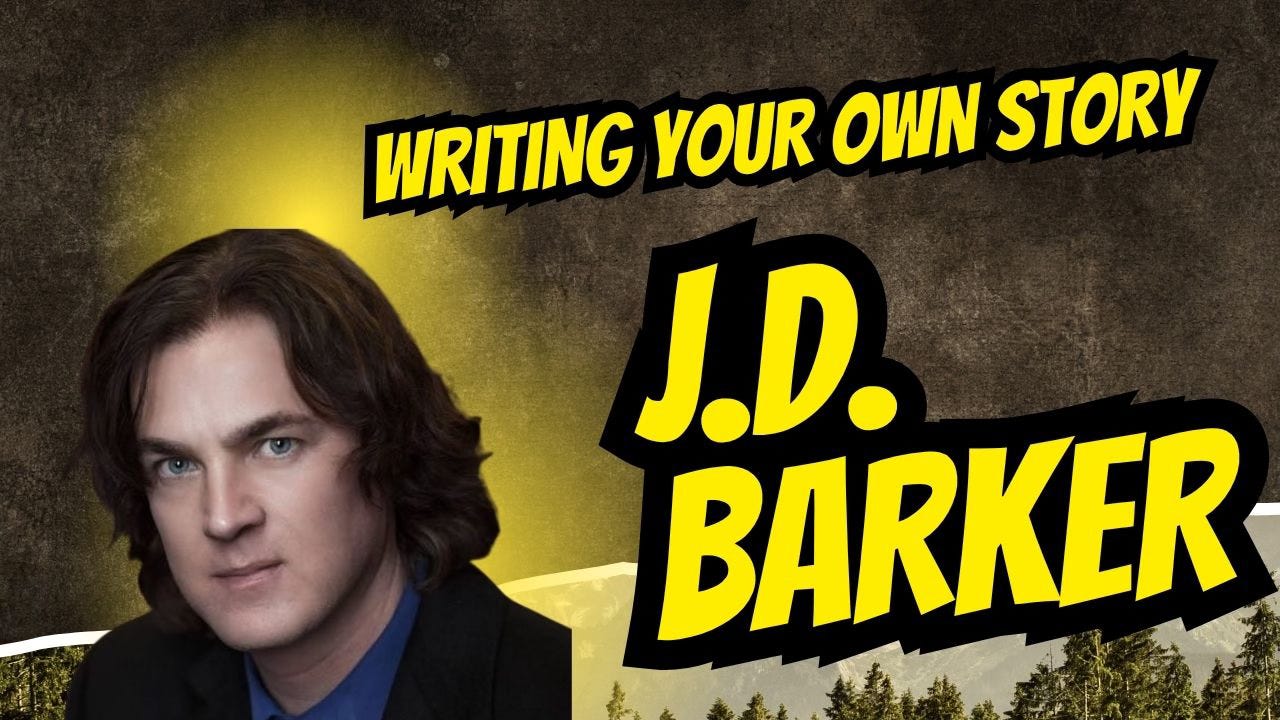
Sometimes strange, auspicious coincidences happen, and you wonder if it’s fate nudging you in the right direction.
Like, for example, when I was sitting down reading Confessions of the Dead, co-written by James Patterson and J.D. Barker, getting really into the dark and twisted tale… and an email popped up in my inbox the next day asking if I’d like to interview J.D. Barker.
I was like, hell yes. But of course, it also felt a little suspicious.
Hadn’t I just been telling my husband how much I loved this book? Was my phone spying on me, feeding information to some scammer? They’re so advanced these days, who knows?
I didn’t fully believe it. But I double-checked with my friend Mark Leslie Lefebvre , who confirmed J.D.’s publicist was real and that he was doing podcasts to help promote a prequel in his 4MK series.
And that, folks, is why we all get to enjoy this amazing interview with horror writer J.D. Barker. His career is enviable, I enjoyed every second of our chat, and I hope you will too.
You can watch the interview on YouTube here.
Or listen to the podcast up above.
Here is a recapped version of the interview below:
Enjoy!
AF: I have to say, when your publicist reached out to me, I thought it was a scam. And what was so surreal — I was reading Confessions of the Dead when the email came in.
JDB: She is fantastic. I’ve worked with a ton of publicists over the years, and my model has completely changed. Early on I hired a firm in New York — Dean Koontz recommended them — and I paid a $20,000 retainer. That first month, they got me two blog reviews, one website mention, and a blurb in a magazine. Nothing for $20,000, and there was no accountability.
Now I’ve got everyone on an à la carte basis. I give them a list of what they can go get and a price point for each — a podcast gets this much, a magazine gets this much. They can work as hard or as little as they want. I pay for actual results. My current publicist is out of the Philippines and she is phenomenal. Every time I’ve got a new release, everybody seems to know about it.
AF: I’m a huge fan. Your connection with Stephen King, your collaborations with James Patterson — you’ve somehow found the zeitgeist.
JDB: I tend to get in front of a lot of people and bug the hell out of them until they either agree to work with me or they issue a restraining order.
I heard a long time ago: if you don’t ask the question, you’re never going to know the answer. I’d rather hear someone say no than not ask at all.
I used to teach at ThrillerFest quite a bit. If you go, you’re eventually going to end up in an elevator with a famous author. You’ve got 15 seconds to either make an introduction or stand there staring at the numbers and watch that person walk away. I am not the kind of guy who ever watched somebody just walk away.
AF: I loved hearing about what you do at cons. You don’t sit behind the table selling books — you give them away for free.
JDB: I’m in a unique situation. I’ve got my own imprint at Simon & Schuster, so my production costs are very low. I can produce a hardcover for a fraction of what I was paying through IngramSpark. And I’ve got books sitting in a warehouse because we tend to overprint — 50, 60, 70,000 copies. Eventually the dust settles, and I’ve got to find something to do with them.
I looked at what indie authors do — they’ve always been ahead of the curve — and for years they’ve given away the first book in a series as an ebook.
You’re basically a glorified drug dealer. You’re hooking them with a taste, hoping they come back for more. I just took it to the next level and started giving away hardcovers.
Think about it from the reader’s perspective. They come to these events and it’s awkward. They’re walking past tables with authors staring at them with that please buy my book look. They’re afraid to approach because they don’t want to commit. So instead I put a book in everybody’s bag for free. They all come to the table, it keeps me busy, they walk away with that taste, and most of them end up buying another book after that.
At Author Nation, I gave away 2,000 or 2,200 books. A good chunk of those people went home and started buying my other titles. That’s how you move the needle. You’ve got to approach everything as a business — how are you going to get people to come back and buy your next widget?
AF: At what point do the cons stop being useful?
JDB: My first big one was the Writer’s Digest conference — the last one I went to before I got a publishing deal. I learned a lot. But everything tends to be geared toward the early author trying to get that first book out there. When I was on the board with ITW, I noticed everything was built for two groups: debut authors and the big names. Everybody else is stuck in the middle. You can only hear how to write a compelling first sentence so many times.
What actually attracted me to Author Nation is that it fills that void. It teaches authors: okay, your first book is out. This is how you get to book two, book three, book four, and steadily raise your profile over time. In the traditional world, they try to hit it out of the park with each book, and if you don’t, you’re kind of written off. The problem is that’s not sustainable. If you’re just slowly building, selling a few more copies with each book, you’re building a very solid base beneath you. That’s what sustains a career.
(Authorial note: If you are interested in learning more about Author Nation, I’ve interviewed Joe Solari . CLICK HERE)
AF: So I have to ask about the TV and film side, because that’s where my heart is. You’re there now with the 4MK series, aren’t you?
JDB: I’ve got eight different projects in what I call various stages of Hollywood hell. Every time my film agent calls, it’s a roller coaster — either really good news or really bad news, no in between. With 4MK specifically, this is actually option number four. The book came out almost ten years ago. Sylvester Stallone’s company, Balboa Productions, just picked it up. And they brought in Channing Powell, who was showrunner for The Walking Dead, as lead writer.
AF: What else do you have on the docket?
JDB: I’ve also got a feature film in the works for Behind a Closed Door — they’re already on the third or fourth draft of the script and talking to directors. A Caller’s Game is at another studio. Dracul keeps getting picked up by different companies. I wrote that one as a prequel to Dracula for Bram Stoker’s family.
AF: At least the option money keeps flowing while all that’s happening.
JDB: Any veteran author will tell you that. The option money — it doesn’t matter if it gets made or not. Those checks are real and they keep coming. And here’s something I’ve noticed: when something gets optioned once, the second it’s available again, everybody jumps on it. Producers see it as a hot commodity because someone else just had it. So if you keep making a little noise, they keep coming back. Sooner or later something is going to make it to the screen. It’s a numbers game at this point.
But as an author, all I do is put my head down and write the next book. That’s the only thing you can control. The written word, whatever ends up in that final book — that’s 100% you. Nobody can take that away from you.
AF: How did you start your career?
JDB: I was told at a very early age that you can’t make a living as a writer and I needed to get a real job. So I went off to college, got multiple degrees, and ended up working in finance. But when I was in school I worked for RCA Records and BMG Distribution. I chauffeured some very famous people around for a couple of days at a time.
And I realized I could interview these people and sell those interviews to offset the cost of college. That’s how I broke into writing. When you work for magazines, everybody around you has a half-finished novel in a desk drawer somewhere. I became the person they’d show those to because I was strong with grammar, punctuation, and developmental editing. That turned into a side hustle as a book doctor and ghostwriter. While I was in finance, I was helping other people rewrite their books and get them published. Over 23 years, I had six different books hit the New York Times list — with other people’s names on the cover. That gets old after a while, and that’s when my wife and I decided to pull the trigger on becoming a full-time author. That was eleven years ago.
AF: How does someone get to work with you?
JDB: Honestly, all you have to do is ask. Most people are too hesitant. Nobody asks the question. Typically if someone reaches out, I look at a writing sample, see if there’s something I can work with, figure out where they are career-wise. It has to be someone I genuinely feel I can take to another level. And they’ve got to come to me with a decent foundation, something that may or may not be working but can be fixed — and an idea I haven’t heard before. That’s the hard part.
AF: How does one break through in an increasingly fractured publishing industry?
JDB: Making your own path is the key. When I was in the music business, I drove Madonna around for about a week during the Vogue tour. She told me that whenever she had a new album coming out, she would make a list of everything everybody else was doing to sell their albums — and then come up with something brand new that wasn’t on that list. That’s what she would do. I’ve kept that in my head ever since.
My last book was Something I Keep Upstairs, a haunted house story. The house in the book is real — it’s right off the coast of the island where I live in New England. To promote it, I came up with a contest: I gave away an overnight stay in the haunted house to one reader, who could bring three friends. We put out a press release, and I got a ton of press — television, radio, podcasts, print. People were talking about it all over the internet. And all of that was essentially free buzz. It sold a ridiculous number of books.
Here’s the thing — somebody else could come along and give away an overnight stay in a haunted house, but it’s not going to hit as hard because I’ve already done it. You’ve got to come up with something nobody has done before. A lot of authors chase what other authors are already doing, buy the same Facebook and Amazon ads, run the same promotions. And if you’re doing the same thing as someone else, you’re never going to excel beyond them. You need a catalyst that takes you off into the stratosphere.
Learn more about J.D. Barker at jdbarker.com