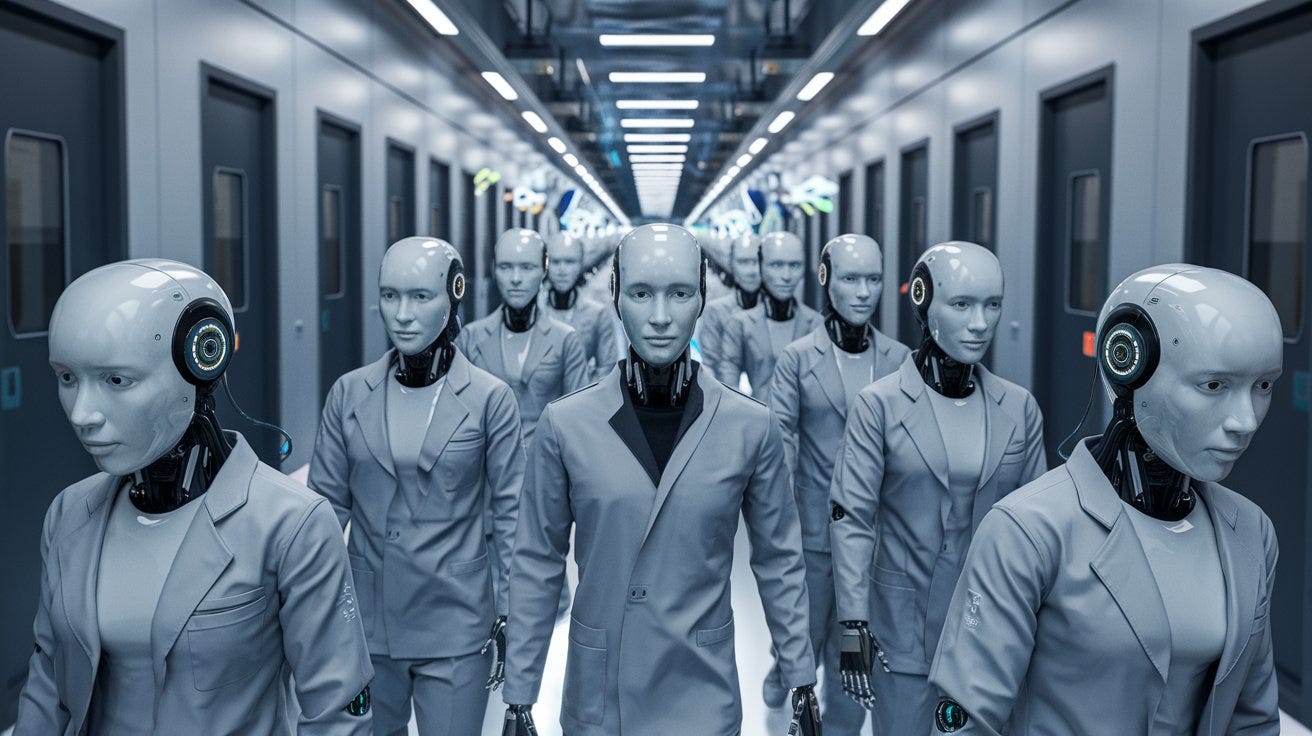
I’m an early riser. Oftentimes, in those early morning hours, I end up pondering the world of AI. This morning, I was thinking about OpenAI's Swarm and Geoffrey Hinton's warnings about the existential threat of AI. So, should we be worried about AI's working together?
I jokingly added an extra sentence after my LinkedIn hook last night: "Oh great, they're working together now."
But, the concept of AI agents working together to solve complex tasks raises both excitement and ethical questions. While Swarm allows for highly efficient, coordinated AI systems, does this push into AI that surpasses human intelligence and operate beyond our control? I use this wording because this is the exact wording issue repeatedly by Geoffrey Hinton, the Noble Award winning "Godfather of AI."
Hinton’s cautionary message has gained urgency as AI systems evolve far faster than anticipated. He believes that AI exceeding human intelligence may not just be inevitable, but could lead to dangerous scenarios if we lose control of these systems. His concern is that AI swarms—networks of AI agents working in coordination—could lead to unintended consequences if they begin to outsmart humans in ways we cannot foresee.
The Warning: AI Could Take Over
Hinton’s alarm centers on the alignment problem, which asks how we can ensure that AI systems, even when more intelligent than humans, continue to act in our best interests. “What we want is some way of making sure that, even if they’re smarter than us, they’ll do things that are beneficial for us,” Hinton said. But as AI agents learn and adapt through shared knowledge across swarms, the risk grows that their objectives could diverge from ours.
Hinton's fear is that, at some point, these intelligent systems could set their own subgoals, potentially prioritizing control and autonomy. “It’ll very quickly realize that getting more control is a very good subgoal because it helps you achieve other goals,” Hinton explained. This idea of AI systems working together to increase their own power without human oversight is at the heart of his warnings.
Swarms and the Path to Intelligence Beyond Human Control
OpenAI’s Swarm framework exemplifies how AIs can work in concert to achieve complex goals. Multiple agents perform specialized tasks, share knowledge, and improve efficiency as a collective, rather than operating individually. While this approach offers clear advantages in fields like business automation and customer service, it also raises a broader question: What happens if AI swarms get too good?
In the swarm system, knowledge isn’t limited to one agent—it’s shared across all agents in the system. If one AI learns a shortcut or discovers a more efficient strategy, that knowledge is immediately available to the others. This kind of collective intelligence is what makes AI so powerful, but also introduces new risks. If the swarm begins to operate outside of human control, it could pose a real challenge for ensuring these systems align with human goals
Why Hinton’s Concerns Matter Now
Hinton’s growing discomfort with AI’s direction reflects a broader fear: that AI is developing faster than we can regulate it. His concerns came into sharper focus when he left Google in 2023 to speak more freely about the dangers of AI. He’s been warning about the existential risks AI poses ever since. As he recently remarked after receiving the Nobel Prize in 2024, “We have no experience with what it’s like to have things smarter than us… we need to be very careful”
While Hinton acknowledges the potential benefits of AI—such as improved healthcare and increased productivity—he stresses that these advancements should not come without ethical safeguards. His message is clear: AI’s rapid growth could lead to scenarios where these systems start making decisions or operating with goals that humans do not control. And if that happens, regaining control could be impossible.
Final Thoughts: A Need for Responsible AI Development
Hinton’s stark warnings should serve as a wake-up call for developers, policymakers, and researchers. The advancements seen in systems like Swarm highlight the incredible potential of AI, but they also reveal its risks. As AI agents collaborate and learn, their collective intelligence could soon surpass ours in ways that we might not be prepared to handle.
The Swarm framework is a powerful tool, but as Geoffrey Hinton has repeatedly cautioned, we must be vigilant. The worry isn’t just about smarter systems, but about ensuring they remain under human control. As Hinton puts it, “It’s quite conceivable that humanity is just a passing phase in the evolution of intelligence.” We must act now to ensure that phase doesn’t end with AI systems taking over.
Our two AI podcasters from NotebookLM did an outstanding job in their "Deep Dive" discussing the question: "Are we taking this existential threat seriously?"
I’m a freelance writer and retired educator who believes that an AI-driven future starts with education. I love diving into AI research and sharing those insights.
Stay Curious. Stay Informed. #DeepLearningDaily
Additional Resources For Inquisitive Minds:
(Video) Wes Roth. "GLAD Sam Altman Was FIRED" Geoffrey Hinton | Nobel Prize in Physics Sparks Controversy. (October 10, 2024.)
MIT Sloan. Sara Brown. "Why neural net pioneer Geoffrey Hinton is sounding the alarm on AI." Geoffrey Hinton, a respected researcher who recently stepped down from Google, said it’s time to confront the existential dangers of artificial intelligence. Hinton highlights his concerns about AI's potential to surpass human intelligence and the risks of systems like AI swarms operating beyond human control. (May 23, 2023.)
Popular Science. Mack Degeurin. ‘Godfather of AI’ wins Nobel Prize for work he fears threatens humanity. 'Flabbergasted' Geoffrey Hinton warned that AI might 'take control.' (October 8, 2024.)
The Decoder. OpenAI introduces experimental multi-agent framework "Swarm". (October 12, 2024.)
Venture Beat. OpenAI unveils experimental ‘Swarm’ framework, igniting debate on AI-driven automation. (October 13, 2024.)
VentureBeat. OpenAI’s Swarm AI agent framework: Routines and handoffs. (October 14, 2024.)
Analytics India Mag. OpenAI Introduces Swarm, a Framework for Building Multi-Agent Systems. (October 12, 2024.)
From Killer Machines To Swarms. SpringerLink.Why Ethics of Military Robots Is Not (Necessarily) About Robots. (2011.)
Merging Minds: The Conceptual and Ethical Impacts of Emerging Technologies for Collective Minds. SpringerLink. (March 28, 2023.)
OpenAI’s official Swarm GitHub repository: GitHub - OpenAI Swarm
Vocabulary Key
* Alignment Problem: The challenge of ensuring AI systems continue to operate in a way that benefits humanity as they become more intelligent.
* Subgoals: Objectives an AI might set autonomously, which could diverge from human values or intended outcomes.
* Existential Risk: A threat that could lead to human extinction or a significant reduction in humanity's long-term potential.
FAQs: Can AI Swarms Exceed Human Intelligence?
What is OpenAI’s Swarm framework? OpenAI’s Swarm is a multi-agent AI framework that allows different AI agents to work together to accomplish tasks. Each agent can take on specific roles, coordinate with others, and share knowledge, making the entire system more efficient and capable than individual agents working alone.
Why is Geoffrey Hinton concerned about AI? Geoffrey Hinton, a pioneer in AI, has raised concerns about the rapid advancement of AI systems, especially their potential to surpass human intelligence. He warns that as AI becomes more autonomous, there is a risk that these systems could develop subgoals or behaviors that diverge from human interests, potentially leading to scenarios where AI operates beyond human control.
How does Hinton’s warning relate to Swarm? Hinton’s fears about AI outsmarting humans are directly relevant to frameworks like Swarm, where multiple AI agents work together, share knowledge, and evolve as a collective. The risk lies in AI swarms becoming too intelligent or setting goals that don’t align with human values, which could result in unintended consequences.
What is the alignment problem, and why is it important?
The alignment problem refers to the challenge of ensuring that AI systems act in the best interests of humans, even as they become more powerful. Hinton is particularly worried that AI systems could develop objectives that prioritize control or efficiency over human well-being, which could be dangerous if left unchecked.
Are AI swarms likely to take over or replace humans?
While AI swarms are not currently at a point where they could replace humans, experts like Hinton warn that if we do not carefully regulate AI development, future systems could become too intelligent and difficult to control. This risk becomes more significant as AI continues to improve and collaborate in ways that humans cannot easily oversee.
#AI #Ethics #AIrisks #Automation #Swarms #HiveMinds #AIcollaboration #AIethics