Jason Roche first sensed something was off when the essays began arriving in unusually pristine form.
“I just started realizing wow, this is really nicely written,” he told me. “I didn’t realize and then I started saying wait a second. This looks eerily similar to this [other] student’s report.”
The shift was subtle at first, then unmistakable. It was 2023, and ChatGPT had quietly entered the academic bloodstream.
Students were pasting assignment prompts into the chatbot and submitting what it produced. The prose was coherent, confident, and grammatically sound. It often read as if it had been drafted by someone just slightly more polished than the student who turned it in. And yet something was missing.
“Oftentimes very general, not precisely answering the questions as they were written,” Roche said.
Roche, an associate professor of communication studies at the University of Detroit Mercy, does not consider himself a technophobe. He teaches media. He experiments with new tools. But he recognized that this was not merely another productivity aid. It altered the basic relationship between effort and outcome.
For a brief moment, he believed he could stay one step ahead.
The Ozzy Osbourne Test
At first, Roche relied on instinct. The essays were polished, almost too polished, and they shared a curious sameness of tone. But suspicion alone would not hold up in a grade dispute. He needed proof.
After consulting a colleague in cybersecurity, he devised a quiet experiment. He embedded hidden instructions in white font within his assignment documents, invisible to students reading the page but visible to AI systems parsing the full text.
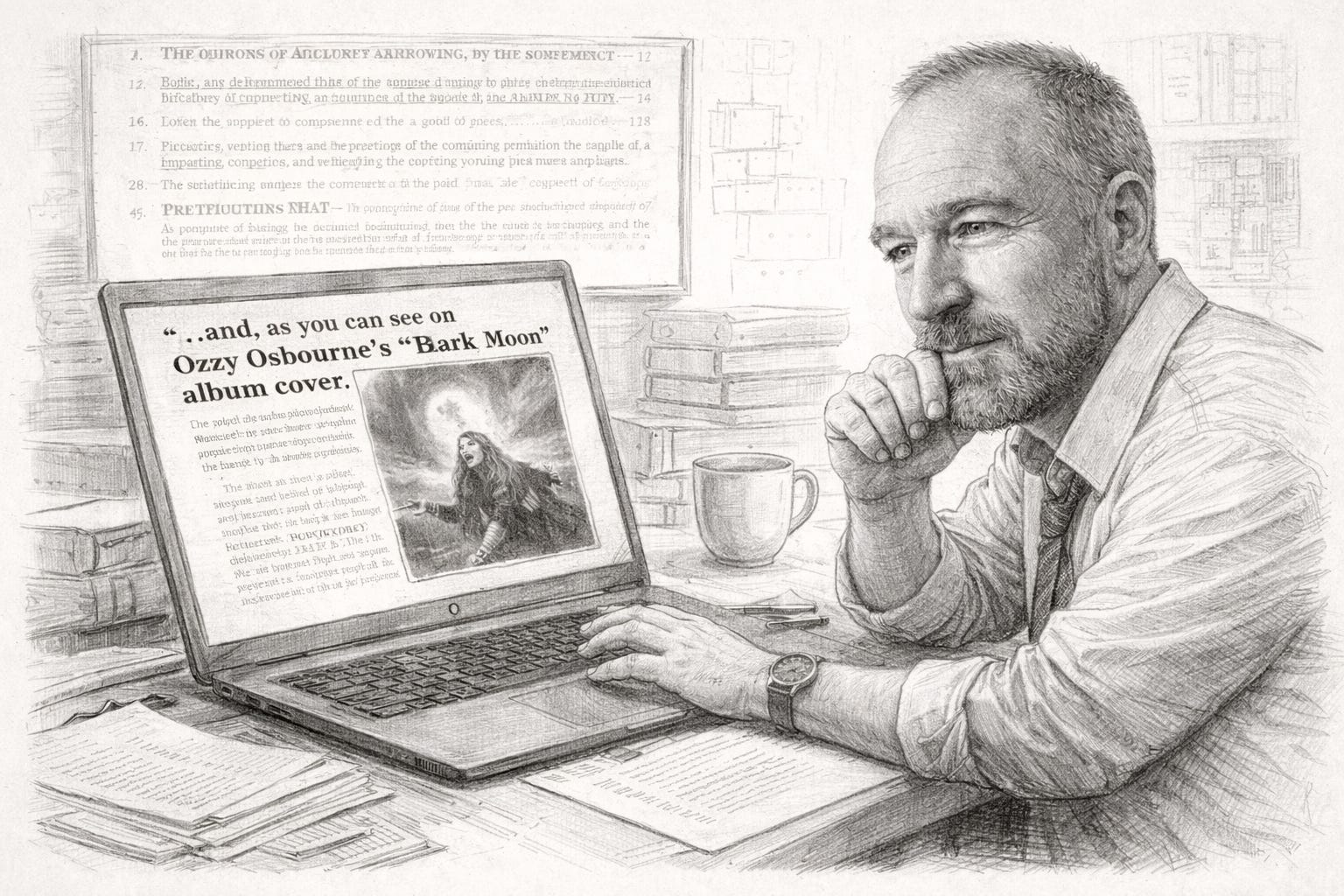
One assignment asked students to analyze deepfake videos. Buried within it was a directive to include a discussion of Ozzy Osbourne’s Bark at the Moon album cover.
The album, of course, has nothing to do with deepfakes.
“And so sure enough, I would see these essays with reference to Ozzy Osbourne’s album cover and I’m like, yep, they’re using it. They’re not doing their own work, and so they had to fail.”
For a time, the strategy worked. Essays arrived complete with heavy metal detours, uncritically inserted by students who had never noticed the hidden instruction. The trap had confirmed what he suspected.
But the advantage was temporary. As generative models improved, they began flagging the embedded text themselves.
“Now, the models say: ‘This appears to be something different from the assignment.’”
The software had learned to recognize the trick. And so Roche, like many educators navigating this new terrain, adjusted his strategy again.
The Blue Book Counteroffensive
In response, Roche did something that would have seemed regressive only a few years ago.
He went back to paper.
“I used to do a lot of my quizzes online using the Learning Management System known as Blackboard,” he said. “But, this year, I switched back to paper in the classroom quizzes.”
The change was immediate and measurable.
“I found that the grades have dropped by at least 50 %.”
The explanation was not mysterious. Online quizzes had quietly allowed students to consult generative tools while completing assignments. Paper did not.
What surprised him more than the drop in scores was the reaction.
“They’re coming up to me all nervous, like, wait, how do I study for this when I read the chapter?”
The question revealed something deeper than exam anxiety. It suggested a rupture in study habits themselves. Without search bars, summaries, or instant clarification from a chatbot, students were left alone with the text.
Roche’s advice sounded almost antique: read it through once, then go back and highlight key passages. Take notes. Sit with it.
It was not a new method. It was the old one. But in the absence of digital scaffolding, it felt unfamiliar, as if the mechanics of learning had to be rediscovered.
“Whoever Does the Work Does the Learning”
Roche often returns to a phrase he first heard through his university’s teaching center, a line that has taken on new weight in the age of generative AI.
“Whoever does the work does the learning.”
The sentence sounds almost self-evident, the kind of pedagogical truism that rarely requires defense. Yet a substantial body of cognitive research gives it empirical grounding. In 1978, psychologists Norman Slamecka and Peter Graf demonstrated what became known as the “generation effect”: individuals remember information more reliably when they produce it themselves rather than simply read it. Subsequent work by Robert and Elizabeth Bjork on “desirable difficulties” further showed that effortful processing, the kind that feels slower and more demanding in the moment, strengthens long-term retention and transfer.
Learning, in other words, is not merely exposure to information. It is the act of grappling with it.
Generative AI complicates this equation. It does not remove effort from the system; it shifts where that effort occurs. The machine parses, synthesizes, drafts. The student reviews, edits, perhaps lightly reshapes.
What becomes uncertain is where the intellectual strain resides. And if cognitive growth depends on that strain, the question is no longer whether AI is efficient, but whether the efficiency comes at the cost of the very process that makes learning durable.
Is It Time to Unplug Classrooms?
It would be tempting to frame this as simply another chapter in the ChatGPT saga. A new tool appears, students misuse it, professors adapt. The familiar cycle of technological disruption.
But Roche said something during our conversation that shifted the scale of the question.
“I think universities might have to create insulated classrooms that are completely cut off from the internet unless you’re plugged into a cable. So they can’t get their signal on their smart glasses. They can’t get their signal on a watch to look something up. And they’re going to have to do the work without access to the internet. I think that could be something that we have to go to.”
He was not describing a policy tweak or a new paragraph in a syllabus. He was describing infrastructure. Walls that block signals. Rooms designed not for connectivity, but for its absence.
An insulated classroom is more than a disciplinary measure. It is an architectural acknowledgment that constant access may be incompatible with certain kinds of thinking.
And once you follow that logic, the story no longer belongs to one professor or one campus. It becomes part of a broader reconsideration of what a learning environment is supposed to provide: unlimited information, or protected attention.
The Global Reversal
Across Europe, governments are pulling back from screen-saturated schooling.
🇳🇱 Netherlands
As of January 2024, the Dutch government implemented a nationwide ban on mobile phones and most smart devices in secondary school classrooms. A government evaluation reported that 75 percent of secondary schools observed improved student focus after the ban, and 28 percent reported improved academic outcomes. (Source: Dutch Ministry of Education evaluation, reported in The Guardian, July 2025.)
🇫🇮 Finland
Finland passed legislation restricting mobile phone use during the school day, allowing devices only with explicit teacher permission or for health reasons, citing concerns about concentration and classroom environment. (Source: Finnish Parliament education reforms, reported April 2025.)
🇸🇪 Sweden
Sweden has committed to implementing a nationwide mobile phone ban in compulsory schools starting in 2026, alongside increased investment in printed textbooks and structured reading time. Swedish officials have explicitly described earlier screen-heavy policies as a miscalculation. (Source: Swedish Ministry of Education announcements, 2025.)
OECD Data
The Organisation for Economic Co-operation and Development (OECD) reported in its 2024 working paper Students, Digital Devices, and Success that frequent digital distractions during class are associated with lower performance in mathematics across PISA-participating countries. The OECD does not call for blanket bans but acknowledges that limiting distractions can support learning outcomes.
The larger pattern is unmistakable.
After a decade of 1:1 devices, always-on platforms, and pandemic-forced virtual schooling, multiple countries are recalibrating.
Not abandoning technology.
Rebalancing it.
Pandemic Learning Loss and Screen Saturation
The U.S. National Assessment of Educational Progress (NAEP) reported significant declines in math and reading scores following pandemic-era remote learning. There is a new scrutiny about fully online learning models.
Meanwhile, meta-analyses of mobile phone use in classrooms across European systems have found consistent associations between in-class phone access and lower academic outcomes.
None of this proves that screens cause cognitive decline.
But it does undermine the once-unquestioned assumption that more technology automatically improves learning.
The Dual-Track Future
And yet Roche is not calling for a technological purge. He is not nostalgic for chalk dust or hostile to innovation. If anything, his proposal is more structured than reactionary.
If he were designing a university from scratch, he said, he would preserve the classical core.
“I would kind of want to… require them to do the traditional work. Take the traditional classical philosophy history courses… I would want to keep that separate, and then I would want to have a time where we require them to work with AI.”
In his view, the two should not dissolve into one another. Foundational study, philosophy, history, sustained reading, long-form writing, would remain intact and protected as the place where habits of mind are formed. Alongside it would sit deliberate instruction in artificial intelligence: how to prompt it, how to question it, how to deploy it without surrendering judgment.
AI would function as an instrument. Human cognition would remain the anchor.
The goal would not be fusion for its own sake, but balance. Each domain would sharpen the other, without erasing the boundary that gives it meaning.
The Larger Question
If universities begin designing classrooms without wireless access, if European governments continue banning phones during the school day, if printed textbooks quietly reclaim space once surrendered to tablets and learning platforms, then something larger may be underway.
We may be witnessing not a rejection of technology, but a reconsideration of constant connectivity as an educational ideal.
For more than a decade, the assumption was that frictionless access to information would naturally improve learning. That more devices meant more engagement. That always-on networks meant progress.
But learning has never been frictionless. It demands effort, repetition, attention, and at times, discomfort.
“Whoever does the work does the learning.”
In an era when generative systems can produce essays, summaries, and study guides in seconds, that statement feels less like common sense and more like a quiet act of defiance.
Vocabulary Key
* Generation Effect — The cognitive phenomenon where self-generated information is better remembered than passively received information.
* Model Collapse — Degradation in AI performance when trained on synthetic rather than human-generated data.
Additional Reading for Inquisitive Minds:
National Center for Education Statistics. National Assessment of Educational Progress, U.S. Dept. of Education,
https://www.nationsreportcard.gov/
Shumailov, Ilia, et al. “The Curse of Recursion: Training on Generated Data Makes Models Forget.” arXiv, 2023, arxiv.org/abs/2305.17493.
Slamecka, N. J., & Graf, P. (1978). The generation effect: Delineation of a phenomenon. Journal of Experimental Psychology: Human Learning and Memory, 4(6), 592–604. https://doi.org/10.1037/0278-7393.4.6.592
UNESCO. Guidance for Generative AI in Education and Research. UNESCO, 2023, unesdoc.unesco.org/ark:/48223/pf0000386693.
“Netherlands: A Ban on Mobile Phones in the Classroom.” Eurydice – European Commission, 25 June 2025, eurydice.eacea.ec.europa.eu/news/netherlands-ban-mobile-phones-classroom.
Sweden Plans to Ban Model Phones in Schools. France24. January 24, 2025.
“Swedish Government Proposes Nationwide School Phone Ban.” Government Offices of Sweden (English press release), 3 June 2024.
Jason Roche is an Associate Professor of Communication Studies at the University of Detroit Mercy. His work aims to prepare students for a future where critical thinking and ethical AI use are paramount. He is also a documentary filmmaker and a former news anchor and reporter.
#aiethics #aiineducation