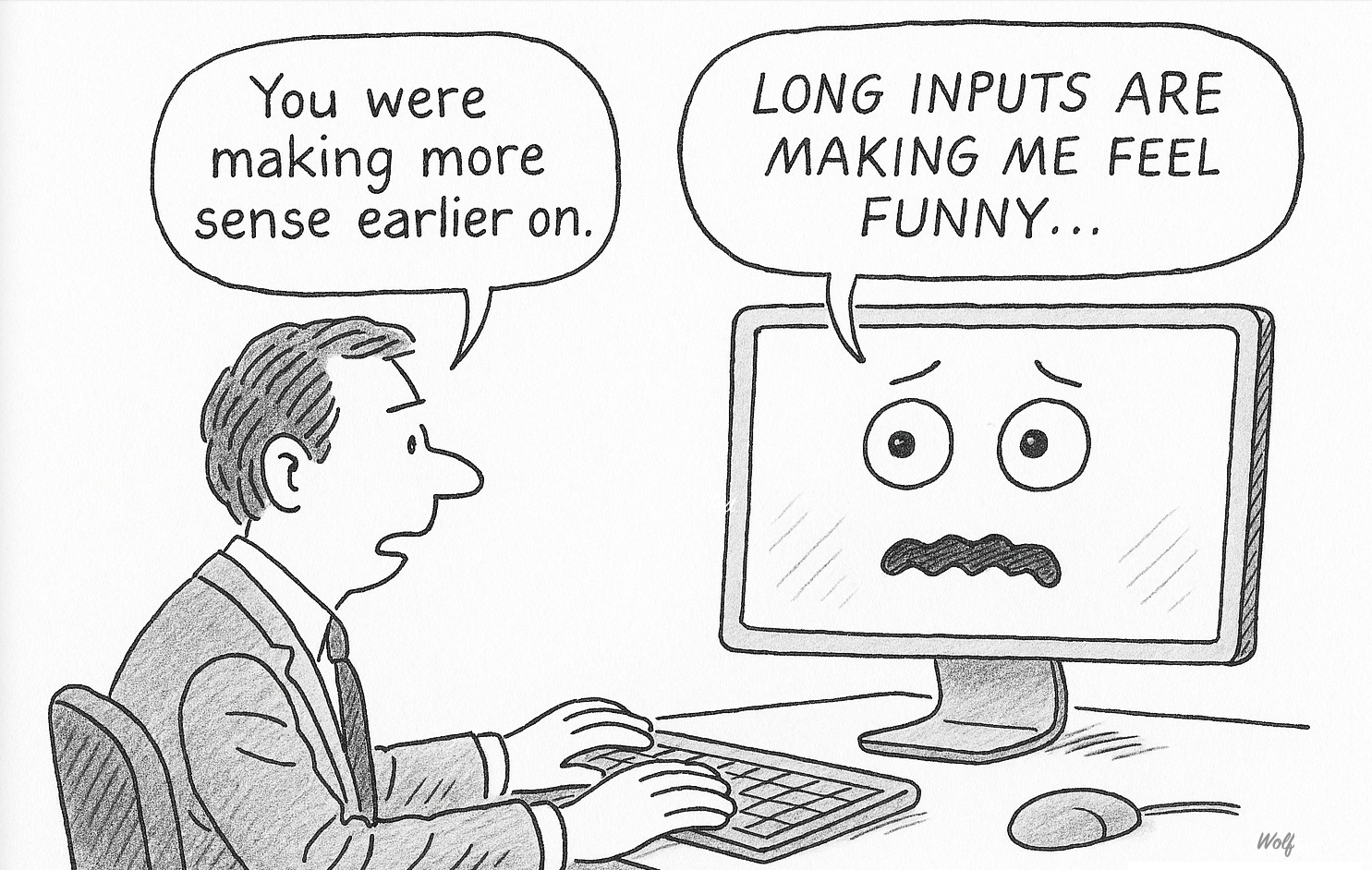
The Honeymoon Phase
You know that feeling when you first open a chat with an AI?
It's magic. You ask something, it nails the answer. You ask for a tweak, it remembers your first request and incorporates it perfectly. You feel like you've found a thinking partner who's tireless, patient, and maybe just a bit witty.
Then… somewhere along the way… it changes.
By message 10, it's forgetting things you said two minutes ago. By message 20, it's making up facts or circling back to ideas you already rejected. By message 30, it's confidently making stuff up.
Welcome to context rot—the AI equivalent of your friend slowly zoning out mid-conversation.
Other Names for the Same Pain
It's not always called "context rot." Depending on who you ask, you might hear:
* Context decay – when details fade like old handwriting
* Lost in the middle – a nod to research showing AI often forgets what's buried in the middle of long inputs
* Token overload – the blunt, engineering way of saying "you fed it too much at once"
* Conversational drift – when the chat slowly wanders off-course
* AI brain fog – the meme version“I may have lost the thread, but I’m still confident.”
Voices from the Wild
I did a quick walk-through Reddit to find some frustrated users feeling this pain. These are all quotes from the past three months, lest you think recent model updates have magically solved this problem.
One user nailed the fundamental problem:
"I feel like maintaining context... is the biggest shortcoming of LLMs right now."
Another described the exact moment things go wrong:
"Context rot. If it's getting confused... start a new chat if the history is adding confusion instead of clarity."
Some treat it like AI exhaustion:
"Just like how you get brain rot, you'll give the poor LLM context rot. Quality over quantity is key."
Some describe the experience vividly:
"It's like explaining something to someone who's slowly falling asleep while you're talking."
Others point to the technical reality:
"Even with large context sizes, there are facts in the middle that can get missed—RAG helps fill the gaps."
And the statistical truth:
"The longer your context becomes, the more statistical confusion it will cause..."
Original source links at the end of this article.
Why the Rot Sets In
Picture the AI's context window—its working memory—like a whiteboard in a busy meeting room.
At first, there's plenty of space for clean, organized notes. But as the conversation grows, the board fills up with overlapping ideas, side comments, and tangents. Even though nothing gets physically erased yet, the important stuff becomes harder to find among the clutter.
Three main culprits drive the decay:
Too much noise Long chats mix relevant facts with small talk, rabbit holes, and random asides. The AI struggles to separate signal from noise.
Middle content amnesia Research confirms what users experience: models focus heavily on the start and end of conversations, while middle content gets fuzzy. It's like remembering the beginning and end of a movie but losing track of the plot in the middle.
Statistical confusion The AI isn't "thinking" like humans—it's predicting the next word based on patterns. Too much competing information clouds those predictions.
As one user explained:
"The longer your context becomes, the more statistical confusion it will cause because there are so many things to remember."
⸻
How to Stop the Rot: A Practical Survival Guide
Break It Up Long, meandering conversations are where performance nosedives fastest. Keep chats focused on a single goal. Example: Instead of one 50-message chat about "improving my website," start separate chats for "homepage copy," "SEO strategy," and "design feedback." Break down your needs into smaller pieces and start new chats for new tasks.
Summarize Before Moving On
When you start a fresh chat, give the AI a concise recap of the essentials:
* The current task
* Key facts or constraints
* Any important decisions already made
Think of it as handing your AI a cheat sheet before the test
Use External Notes
For ongoing projects—stories, codebases, research—store summaries in a separate document. Paste relevant sections into fresh chats instead of forcing the AI to dig through conversational archaeology.
One user's workflow:
"I save lore and characters in a text file. At the end of each session, I have it summarize the storyline and upload it into the new session."
Reset When It Wobbles
The moment it starts repeating mistakes or ignoring clear instructions, restart the chat. Don't try to coach it back on track—fresh context works better than corrections.
"The number one fix is to reset the chat after 3 failed attempts. Fresh context, fresh hope."
5. Use RAG (Retrieval-Augmented Generation)
This is a fancy way of saying: keep important information in a separate database and feed it in only when needed. Instead of stuffing everything into one conversation, the AI retrieves relevant bits at the right moment.
"Even with large context sizes, there are facts in the middle that can get missed—RAG helps fill the gaps."
The Bigger Picture
Context rot isn't just an AI quirk—it's a reminder that more information isn't always better. Whether you're chatting with AI or managing human projects, curation beats overload every time.
The most productive conversations happen when you remember: the AI is a powerful tool, not a patient therapist. It works best when you give it focused problems to solve, not sprawling life stories to unravel.
Next time you find yourself frustrated as your AI drifts off-topic, remember: it's not getting tired or rebellious. It's just lost in the maze of context you built for it.
The solution isn't to give up on AI—it's to become a better conversation architect.
Video version of this article:
Sources:
“I feel like maintaining context … is the biggest shortcoming of LLMs right now.”u/brown2green – r/LocalLLaMA (about 3 months ago)🔗https://www.reddit.com/r/LocalLLaMA/comments/1kotssm/i_believe_were_at_a_point_where_context_is_the
“Context rot. If it’s getting confused… start a new chat if the history is adding confusion…”u/Resident-Rutabaga336 – r/ChatGPT (recent months)🔗 https://www.reddit.com/r/ChatGPT/comments/1meey3b/we_all_can_relate_to_this
“Just like how you get brain rot, you’ll give the poor LLM context rot. Quality over quantity is key.” u/RPWithAI – r/JanitorAI_Official (3 weeks ago) 🔗 https://www.reddit.com/r/JanitorAI_Official/comments/1m7ext5/context_rot_large_context_size_negatively_impacts
“Even with large context sizes, there are facts in the middle that can get missed—RAG helps fill the gaps.” u/SkyFeistyLlama8 – r/LocalLLaMA (3 months ago) 🔗 https://www.reddit.com/r/LocalLLaMA/comments/1kotssm/i_believe_were_at_a_point_where_context_is_the
“The longer your context becomes, the more statistical confusion it will cause…”u/martinerous – r/LocalLLaMA (recent months)🔗 https://www.reddit.com/r/LocalLLaMA/comments/1f057ns/does_model_output_inherently_degrade_as_context
#ai #llms #contextrot #promptengineering #generativeai #rag #machinelearning #futureofwork #aidevelopment #nlp #deeplearningwiththewolf #dianawolftorres