Introductory note: I gave this text as a short talk on October 8, 2022 for the EarthLab’s Playing with Fire: A Hot Symposium at University of California, Santa Cruz. This text is also an excerpt from a full-length talk and chapter-in-process that will likely be in my next book.
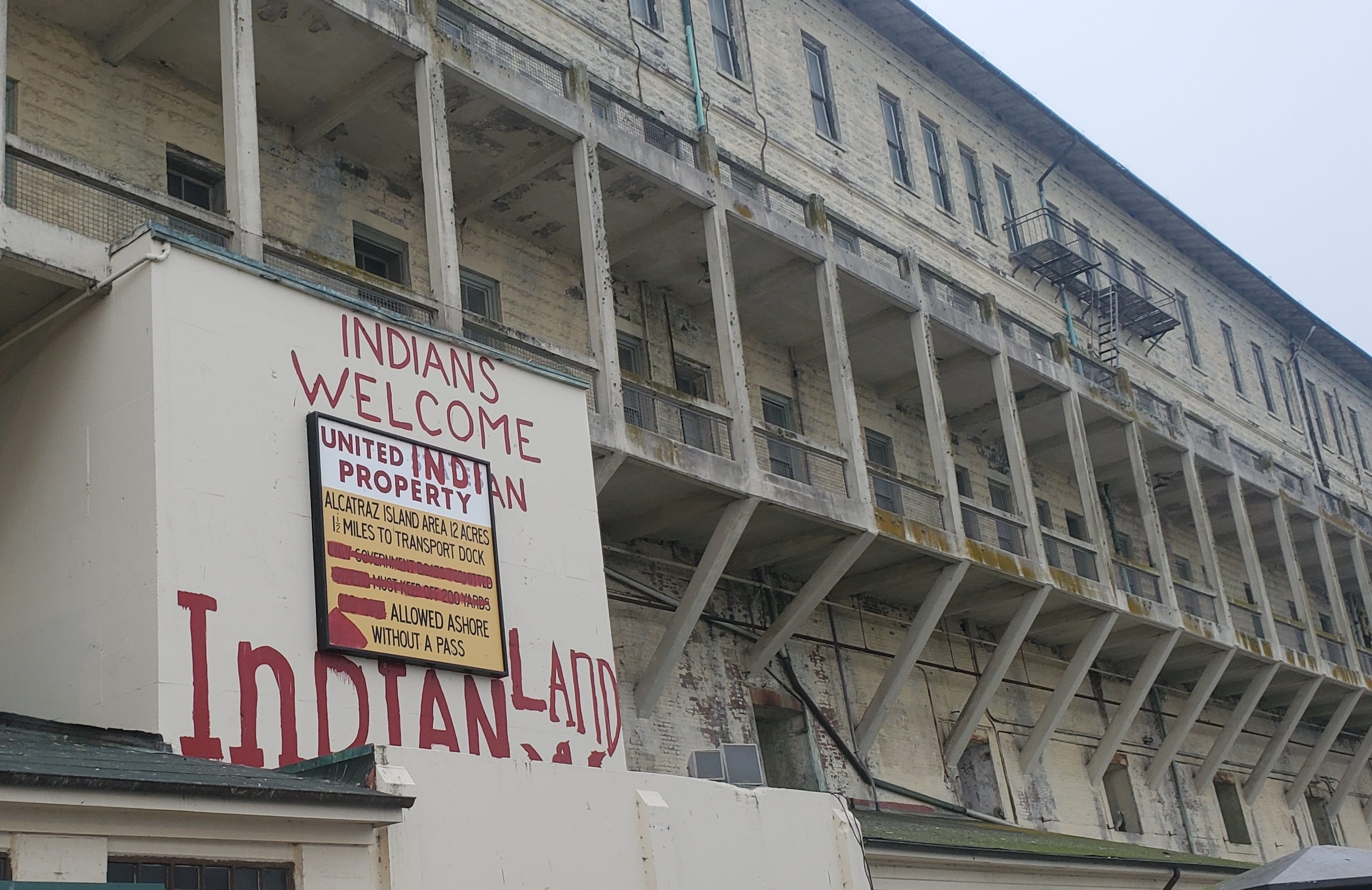
Yesterday, October 10, a friend bought us tickets to the Indigenous Peoples’ Day sunrise ceremony at Alcatraz. While on the island, listening to the morning prayers and commentary, watching dancers, and listening to drums, I thought about the ideas presented in this piece—ideas about whose apocalypse we confront now, and whose framing within which we get told to interpret what we live through.
The annual Alcatraz gathering, occurs on what is now called “Indigenous Peoples Day” (formerly Columbus Day) and is an annual recognition of the “Indians of All Tribes” occupation of Alcatraz that occurred from November 1969 to June 1971, a protest that sought to return federally-controlled property to Native people. I am uncomfortable with large crowds, but I appreciated my friend’s gesture so I hauled myself out of bed at 3:45 am to catch a 5:15 am ferry in the dark to the San Francisco Bay little rock of an island.
I am also not a fan of state-sanctioned recognition efforts like “Indigenous Peoples Day” or “Native American Heritage Month” that blur the differences between Peoples co-constituted with very different places. Such events stretch the terms “Native American” or “Indigenous” beyond their usefulness to us as concepts for political organizing across vast land- and waterscapes. Pan-Native terms get used by the settler state in both programmatic and rhetorical moves that seek to blur Indigenous sovereignties into a settler state rainbow of multicultural inclusion into their nation-building project, which ultimately undermines ours.
When asked to support the celebration of such days or months, my response is always, “My entire life is about supporting “Indigenous” or “Native American” people’s sovereignty. Every day is a day for Indigenous Peoples for me. What does engaging in such a celebration get us?” It’s a genuine and not a rhetorical question. I am willing to support such recognitions, if there are pragmatic (e.g. resource-related) benefits that help ease suffering.
That said, here is the talk text I presented in Santa Cruz on October 8. Happy listening and/or reading.
Art, culture, and media scholar, Heather Davis, and Métis anthropologist, Zoe Todd have written on the importance of decolonizing the Anthropocene, and the need to “open…it up beyond its current Eurocentric framing.”[1] Davis and Todd argue that rather than dating the beginning of the “Anthropocene” to the birth of agriculture, the advent of the steam engine, or to the mid 20th century, the Anthropocene should be dated to the beginning of the colonial period, approximately 1610.[2]
Davis and Todd follow geographers Simon Lewis and Mark Maslin, who proposed 1610 for two historical reasons also reflected in the geologic layer:
1) 1610 marks the massive exchange of plants and animals between the Americas and Europe that “drastically re-shaped the ecosystems of both of these landmasses;” and
2) 1610 also marks a “drop in carbon dioxide levels…that correspond[s] to the genocide of the peoples of the Americas and subsequent re-growth of forests and other plants.”[3] That is how extensively Indigenous peoples managed, and were not only managed by the land.
In their Anthropocene paper, Heather Davis and Zoe Todd “explicitly acknowledge the entangled violences of the Transatlantic slave trade and the genocidal dispossession of Indigenous peoples and territories.” So 1610 also marks an era of violent and massive transfer of human relatives and wealth from Africa to colonial overlords in the Americas and in Europe.[4] Dating the inception of the Anthropocene to this era not only attends to the geological story, but it pushes back against the assumption that humans en masse, rather than certain humans, are implicated in anthropogenic change.
We all experience the devastating effects of Indigenous genocide in the present as well. Increasingly catastrophic fires on the west coast of North America result from Anthropogenic change that includes disappearing, displacing, and disempowering Indigenous peoples, thus suppressing many centuries of Indigenous peoples’ knowledge of how to live carefully with the powerful entity that is fire.
Powerful Entities
Lightening aids fire, and humans are a weak match.
I was in San Francisco for the week of the first lightning strikes in August, 2020. It was shockingly warm. About 3 a.m. the morning of August 14, as I slept soundly with all of the windows open, a sudden gust of wind slammed like a poltergeist every open door in the apartment. I jumped out of bed to witness from the large west facing window hundreds of gorgeous white hot lightning bolts striking down from the skies over the hills of San Francisco, and out over the Pacific.
I lived in Santa Cruz, Mendocino County, and Berkeley on and off from 2001 to 2012. I have never seen anything like the 44C heat we endured that week nor lightning of that intensity. From the 14th to the 16th of August over 2500 lightning strikes were recorded in Northern California. Three massive wildfires burned nearly 1.5 million acres, turned the skies dark, then orange, and rained down ash.
My daughter and I were visiting the Bay Area before we dropped her off at a hilltop farm in Sonoma County for an internship. We delayed her arrival there; with fires nearby, the farm was ready to evacuate at any minute. So Carmen and I decided to leave California and return when it was safer. We crawled on four wheels with many others on I-80 through patches of roadside flames up into so-called Tahoe National Forest, and descended into the desert of what is today called Nevada. As we left the densely built coastal cities behind, we sped toward my Dakota Oyate homelands in Minnesota to escape the ash, smoke, and fire.
Not My Apocalypse
In 2015, I had a conversation on stage at the University of Alberta entitled "Matters of Life and Death." I discussed with Sha LaBare, also a UCSC History of Consciousness graduate and a feminist science studies thinker, “The Future in Question,” and our different individual histories. In response to Sha’s deep ecological grief and sense of urgency, I expressed feelings I still work to describe with clarity.
Dakota people’s apocalyptic grieving has a longer timeline; we are at a different stage of grief. The genocide over hundreds of years of Indigenous peoples in the Americas and the co-decimation of nonhuman relatives and their societies brings us and you to here. It is this world built out of our apocalypse that is now at risk. Dakota people grieve what this world still celebrates in its doctrines, anthems, explosions, and glorious accounts. Sha responded with a quote from speculative fiction writer, William Gibson: “The future is already here. It’s just not evenly distributed yet.”
Since at least 2015 and that conversation, I’ve been trying to figure what it means to live in the fiery end of US empire as a Dakota—as a great-great-great grandchild of a People who suffered 160 years ago their/our own apocalypse in 1862 as this empire was ascendant. Long before Korea, Vietnam, Afghanistan, or Kuwait, my people and other Indigenous peoples from lands now absurdly claimed as US “Homeland,” were casualties of US empire building.
And yet, I am now an aging intellectual with four reliable wheels, English as a first language, and a well-used US passport. I have a relatively high degree of privilege within this settler-colonial structure. I continuously confront the question, where do I individually stand? Where am I able to move? What do I have to lose in declining US empire versus what has been lost by my collective, the Dakota Oyate? And by the Indigenous Peoples co-constituted with these lan…