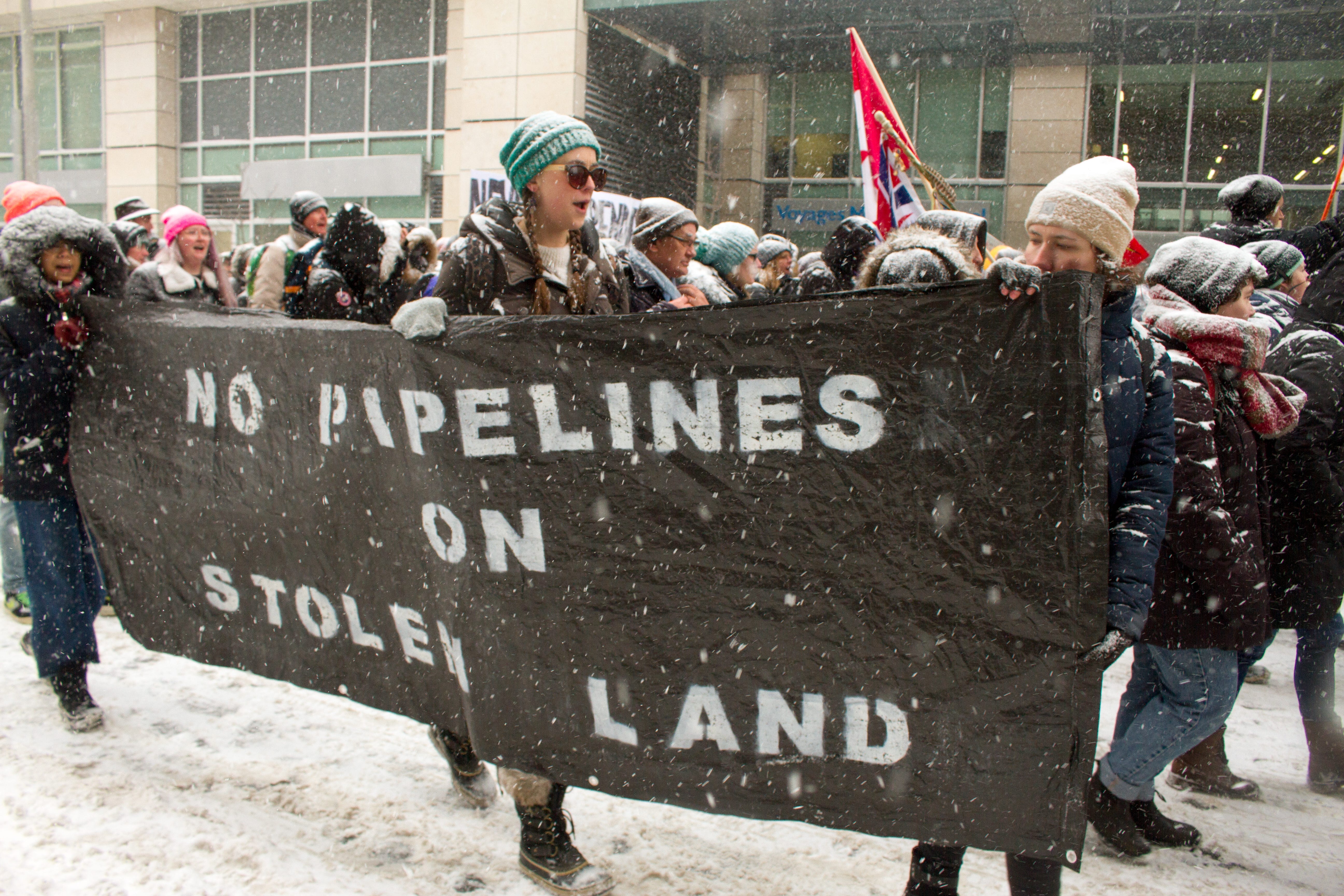
Everything within a settler colonial society strains to destroy or assimilate the Native in order to disappear them from the land - this is how a society can have multiple simultaneous and conflicting messages about Indigenous peoples, such as all Indians are dead, located in faraway reservations, that contemporary Indigenous people are less indigenous than prior generations, and that all Americans are a “little bit Indian.” These desires to erase - to let time do its thing and wait for the older form of living to die out, or to even help speed things along (euthanize) because the death of pre-modern ways of life is thought to be inevitable - these are all desires for another kind of resolve to the colonial situation, resolved through the absolute and total destruction or assimilation of original inhabitants.
Eve Tuck and K. Wayne Yang(2012: 9)
In October 2019, I gave a keynote at the Duke University annual Feminist Theory Workshop. I noticed that there was no land acknowledgement given to open the event, a by-then standard protocol across Canadian universities and many other institutions. I am not judgemental about the lack of land acknowledgements at some institutions, for the simple reason that I think they cannot be written in historically and politically robust language without lengthy consultation with Indigenous communities, and not all institutions have sufficiently extensive or good relations with Indigenous communities. It may be better not to do a land acknowledgment than to do it poorly and before one has built the necessary relationships to undertake the task. That said, there is no non-embarrassing excuse for the erasure of Indigenous-to-the-Americas history/presence in any event held on these lands. But a land acknowledgment is only one narrow strategy for making Indigenous life visible.
Nonetheless, I am sufficiently indoctrinated into everyday and widespread Canadian academic protocols after 6.5 years living here, and I still felt a little uncomfortable without any form of land acknowledgement or Indigenous welcome on stolen land. I quickly found what seemed like a reliable online map of Indigenous peoples whose traditional territory is occupied by the area of North Carolina where we gathered. My feeling at the Duke symposium was that naming those Peoples was an important moment. Such statements may be most powerful when they are surprising.
In an interview with Rosanna Deerchild on CBC Unreservedin January 2019,Hayden King, Anishinaabe from the Beausoleil First Nation in Ontario, Ryerson University professor, and Yellowhead Institute director in Toronto, provided a short history of land acknowledgements in Canada. He noted that the circumstances in which land acknowledgements are given matters:
There is a danger of the acknowledgement just becoming the excuse, through which these institutions provide themselves permission to be on that territory…[If] maybe the acknowledgement is just evolving for the first time, then it does have the power to compel a conversation…I think in settings where it’s an unfamiliar practice or a new practice, I think beginning with that acknowledgement…that’s a good thing.
Of course, the surprise does not last long, and we are left in many cases with pro forma statements or acknowledgements that do very little to change anything. King notes that “the territorial acknowledgement is by and large for non-Native people…It effectively excuses them and offers them an alibi for doing the hard work of learning…about the treaties of the territory and learning about those nations that should have jurisdiction.”
This is effectively the perspective expressed in an opinion piece published on October 7, 2021 in The Conversation by three anthropologists, Elisa Sobo from San Diego State, Michael Lambert (Eastern Band Cherokee) from the University of North Carolina (UNC)-Chapel Hill, and Valerie Lambert (Choctaw Nation) also from UNC. They lament that land acknowledgments commonly given “not only at events but in email signatures, videos, syllabuses, and so on”, can communicate erroneous historical ideas and do not demonstrably “lead to measurable, concrete change.” Rather, the authors assert, such acknowledgements place Indigenous peoples in the past, do not acknowledge the depth of colonial violence used in attempts to conquer Indigenous lands and eliminate Indigenous peoples, nor do they call for land back.
Instead, the implication of most land acknowledgements is, “What was once yours is ours now.” The authors call for acknowledgements that also advocate land back and “a sincere commitment to respecting and enhancing Indigenous sovereignty.”
Even the right-wing media outlet, The Epoch Times published an article on November 8, 2021, “Indigenous Land Acknowledgements Questioned as ‘Land Back’ Movement Grows.” Some non-Indigenous Canadians are apparently a little perturbed about all this #Landback talk. The Epoch Times article cited a CBC news story and leaked memo from mid-October, when “New Brunswick Attorney General Ted Flemming advised government staff to stop issuing land or title acknowledgements in ‘meetings and events, in documents, and in email signatures.’” The Epoch Times paints land back as unrealistic, but their coverage demonstrates the growing visibility of land acknowledgements and Indigenous movements in the US and Canada that call for return of land.
Performing Indigenous: Your Identity is Ours Now
Such worries are contrary to land acknowledgement critiques expressed in The Conversation piece by Sobo, Lambert, and Lambert, pro land back critics of pro forma land acknowledgements. They worry that land acknowledgements reinforce settler state claims to the land: “It’s ours now.” They also worry about who is sometimes called to perform them. They explain that “such rites often feature voices of people who… ‘play at being Indian—that is, those who have no legitimate claim to an Indigenous identity or sovereign nation status but represent themselves as such.”
I assume the authors, in expressing this worry, are referring to individuals thought to be Indigenous community members, who are contracted by universities to give blessings and “traditional” welcomes. My Faculty of Native Studies at the University of Alberta has relations with local elders who we often call on to give such welcomes and blessings. But our faculty is also populated by Indigenous people from this region who have reliable networks that we can draw from. The same is not true of all universities.
As evidence for their worries, the authors cite US census data based on “American Indian and Alaska Native” self-identification, which they compare to federal data on tribal nation citizens. The authors assert that “pretendians” may outnumber actual Indigenous people in the US by 4 to 1. Of course, most of us with tribal nation status have relatives without citizenship, so numbers of people illegitimately claiming to be Native are difficult to get at. Still, the 4 to 1 disparity is high and troubling.
In Canada, we recently suffered the outing of the Scientific Director of the Institute for Indigenous Peoples’ Health at the Canadian Institutes for Health Research (CIHR). Dr. Carrie Bourassa of the University of Saskatchewan claimed to be “Anishinaabe Métis” and to have Tlingit ancestry. On October 27, 2021, CBC broke a story that according to their research, there was no truth at all to Bourassa’s claims to be biologically descended from any of the aforementioned Peoples. You can watch a video of the story here.
After the story broke, Dr. Bourassa began claiming instead that she had been ceremonially adopted by a Métis elder. During the last week of October and the first couple of weeks in November after the story broke, the media was replete with images and a TEDx video of Bourassa adorned in traditional garb and holding a feather. Holding back tears…