Dear followers, many apologies for my absence here for so many months. I appreciate most of you (my few stalkers and trolls excluded). Since August of 2025, I relocated home to Dakota traditional territory, to what is today Minneapolis and St. Paul. It’s been a heavy workload to move back across the settlers’ border and to adjust to a new university system and new courses to teach. And it is good to be home after nearly four decades traveling and living around the world, including ten edifying years in the Faculty of Native Studies at the University of Alberta in Edmonton. It feels especially important in this political moment to be home in the Twin Cities.
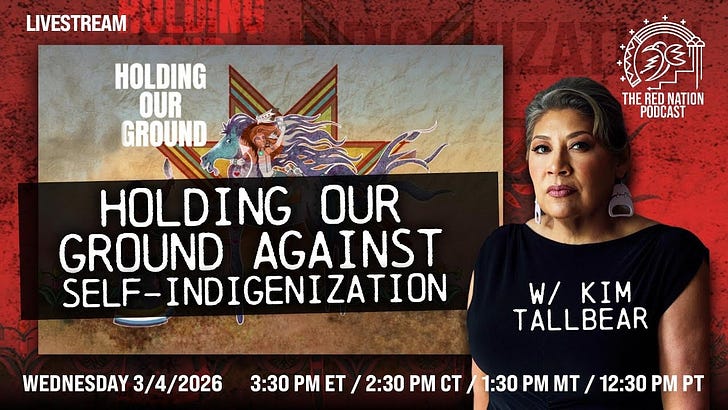
In this post is a YouTube link to an extended interview I did with fellow University of Minnesota American Indian Studies professor, Red Nation’s Nick Estes earlier this week. Nick and I had a wide-ranging conversation on the symposium I am co-organizing with the impressive Qianzi Cong, my University of Minnesota graduate student assistant. The two-day hybrid symposium, Holding our Ground: Voices and Strategies Against Self-indigenization, will convene over three dozen panelists and individual speakers to share research, journalism, activism, and policy-work that confronts the global phenomenon of “self-indigenization.”
From Extermination to Cosplay to Ethnic Fraud to ICE
TheHolding Our Ground symposium will be held in Minneapolis, on the traditional homelands of the Dakota people, who were imprisoned and eventually exiled in 1863 to aid settler appropriation of “Minnesota,” a word also taken from the Dakota. On top of seizing land, US citizens have for centuries “played Indian” via sports mascots and appropriatingNative nation names and iconography in scouting and in industries including the military.
In the twenty-first century, we see ballooning numbers of US citizens make mythological claims to belong to Native lineages and nations. Commonly known as “Indigenous ethnic fraud” or “pretendianism,” this form of self-indigenization involves individuals and groups alleging often scant, distant ancestry (almost always unsubstantiated) and capitalizing on such claims to appropriate resources, opportunities, and public platforms, diverting them away from living Indigenous individuals and historically continuous Indigenous nations. They cosplay us in order to seize governance of institutions where they make standards, policy, and allocate resources to govern our lives.
As multiple forms of self-Indigenization converge, not all are grasped as violent, yet they combine to further colonial extraction. In the past couple of months, another iteration of self-indigenization has been front and center in the North American media, although many of you may not recognize it as such. I refer to the Department of “Homeland Security’s” recent actions in Minnesota. Their agents have seized governance (all over again) of Dakota homelands as they intimidate, imprison, kill, and threaten to exile Indigenous and non-Indigenous relations from Minnesota, and from across these lands. The terror that people in our state have experienced should be understood as part of centuries of actions that converge in this moment to extend colonial extraction and control.
Those of us who study, report on, develop related policy, and advocate against self-indigenization, analyze Indigenous ethnic fraudas one of the most recent colonial structural efforts to appropriate Indigenous resources and authorities, which further undermines Native nationhoods and lives.
From Exposés Toward a Systemic Response
Much of our awareness of this widespread problem comes from more than a decade of mainstream and Indigenous media doing high-profile exposés of Indigenous ethnic fraud. In 2012, outlets around the world covered Massachusetts Senator Elizabeth Warren’s challenged claims to be Cherokee. In 2016, theAboriginal People’s Television Network (APTN) broke the story of Canadian literary darling, Joseph Boyden, making unverifiable claims to Métis, Mi’kmaq, Ojibway and Nipmuc ancestry. And in 2023, CBC presented extensive evidence that award-winning musician, Buffy Sainte-Marie, had for six decades made unsupportable claimsto be Cree and to have other tribal ancestries. Resource-intensive media investigations of such cases have been crucial to raise awareness of this problem. But media alone is not a solution.
The Holding Our Ground symposium will speak to academia and to other institutions about what we can do to curb this problem. Diné/Dakota independent journalist, Jacqueline Keeler, has called academia a “pretendian factory.” As breaking stories show, self-indigenizers also infiltrate literary circles, the media and film industry, the business world, the child adoption industry, and foundations that control resources designed to enhance Indigenous communities.
Self-Indigenization presents a policy challenge for institutions; it affects hiring, resource allocation, and the integrity of Indigenous affiliation. This symposium provides a rigorous space to move beyond the common rule of Indigenous self-identification toward meaningful institutional policies that verify stated Indigenous claims in order to uphold the sovereignty of Native Nations. Symposium speakers will address harms to individuals, the role of media in exposing ethnic fraud, the role of universities to set policy, tribal and First Nation government strategies to push back against self-indigenization, and legal challenges and strategies for settler-state and for tribal courts.
We expect this symposium to attract worldwide attention through in-person and online attendance. Our broad goal is to intensify the conversation both in Minnesota and in the United States about the real harms that result from Indigenous ethnic fraud. We have received interest from Indigenous people overseas who also encounter this type of colonial appropriation in their territories. We hope this symposium helps seed similar conversations and policy agendas globally.
An Opportunity to Tell Your Own Story
Personal accounts are integral to combating a rising tide of cultural theft. Indigenous people bravely telling their stories and sharing their fraught personal experiences will help to illuminate the seriousness of this issue and the toll it is taking on actual Indigenous people.
In that spirit, symposium organizers are partnering with the makers of an upcoming feature documentary on self-indigenization. The symposium will host a private on-site forum where anyone who has been affected personally by this issue can share their stories on camera. We hope to hear from professionals in many fields, students, academics, and community members. Sit with us in a welcoming space and make your voice heard. If you will be on site in Minneapolis, you can make an appointment to be interviewed. Contact co-director Cedar Sherbert at cedarsherbert@gmail.com with questions. Cedar is an enrolled citizen of the Iipay Nation of Santa Ysabel, one of the communities that make up the Kumeyaay Nation of San Diego and northern Baja California, Mexico.
Symposium Registration & Cost
You can register at this link. Online registration is the only option. We cannot process registrations at the door on symposium days. For those with the personal or professional ability to pay, the cost is $200 for in-person registration and $125 for on-line. We have a deeply discounted student rate of $25 USD. Community members can request a complimentary registration code for in-person attendance in Minneapolis or on-line attendance. E-mail selfindig2026@umn.edu. Please tell us a bit about yourself and your specific interest in the symposium. Substack followers, the interested community includes you, so please write with your request if you cannot afford the registration rate.
This two-day symposium will cost about $140K USD to produce, including facility rental, speaker transportation and accommodations, technology fees, catering, security, American Sign Language (ASL) interpretation (by Indigenous interpreters), graduate student and University of Minnesota staff assistance. Thus, we have implemented a tiered pricing scheme to help with fundraising, although paid registrations will finance only a fraction of the symposium costs. The rest is being fundraised from my individual research funds, other university departmental co-sponsorships, and individual and foundation donations.Thank you, as always, for reading or listening.