White Bullies Story #1
In the past six months, I’ve been thinking of an incident that probably happened in the summer of 1979. I was about 10 years old. I am pretty sure it was my summer before sixth-grade. I simultaneously laugh out loud and am filled with embarrassment when I think of that day.
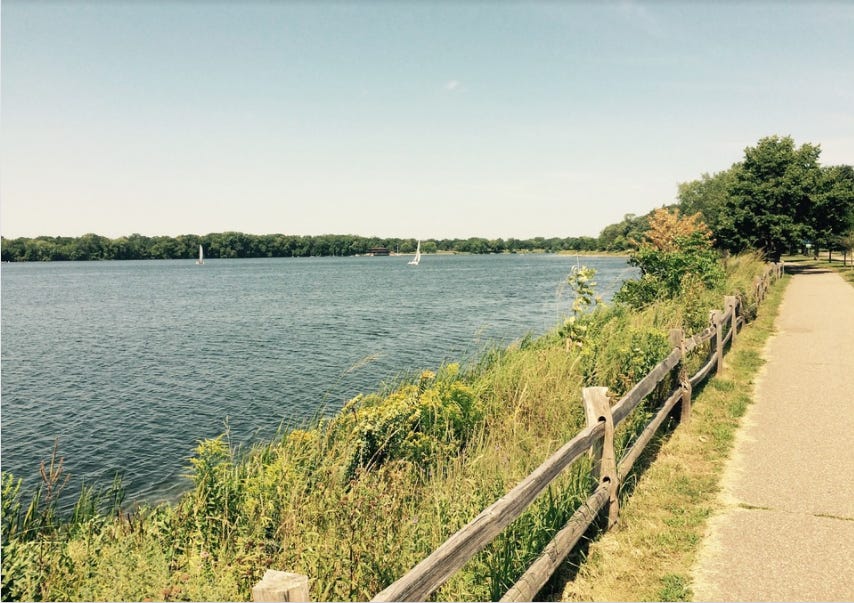
My mom dropped us four kids off at Lake Phalen in St. Paul, Minnesota where we lived—and where I am this month, visiting family. She probably went to work or ran errands. If I was ten, then my sisters were nine and seven, and our brother was six. That was normal in the 1970s and 80s. No helicopter moms for us. I remember a few white kids had moms like that. They tended to wear color-coordinated Dr. Scholl’s wooden bottom sandals with their plain and tidy outfits. They had their hair cut in bobs sometimes with a slight feathering like Princess Diana. They seemed bland, overly-attentive, and mildly oppressive to me. There was a “beach” at Lake Phalen. You know, those half-pebbles and dirt, half-sand beaches at little lakes that dot the north and middle of the so-called USA by the thousands. They usually have lots of weeds that scratch your feet and legs if you swim in them, and the fish that come out of them taste like lake down to their many tiny bones.
We definitely would have swum and my youngest brother and sister probably played in the sand. I don’t remember the details of the day until the embarrassing incident. Our mom was due to pick us up later in the day. Judging by the angles and color of daylight in my memory, the incident happened between 5 and 6 pm. Our mom would have been picking us up just before supper as we called it then.
I don’t remember how the white boy of about 12 years old approached us. I do remember that he looked like Danny Partridge from the TV show about the singing mom and siblings, The Partridge Family. For the next 45 minutes “Danny Partridge” proceeded to gaslight us. I would have said “brainwash” back then.
I recall red-headed Danny ordering all four of us like little ducklings (although I wasn’t much smaller than him) to keep walking in a line around the lake. He said his older brothers were off in the trees watching. Of course, we couldn’t see them. He told us if we didn’t keep walking where he told us to go, his brothers would come running out of the tree grove and beat us up. Lake Phalen is over three miles around and our mother was due any minute to pick us up in the parking lot.
I often laugh when I think of that day. But in that moment, we four siblings were scared. I suppose it had something to do with the fact that when we weren’t living in the country on our Dakota reservation, we lived in the Twin Cities of Minneapolis and St. Paul in sometimes rougher neighborhoods. In the eyes of whites, my mom was a “single mother,” but we had a lot of support from my grandmothers. When we lived off reservation in the Cities, we lived in places like the Little Earth housing project in South Minneapolis. Or we lived in a walk-up on Van Buren Avenue in Frogtown (then a working class, poor white and POC neighborhood) in St. Paul.
We lived above the Native American GED program office that my mother directed. In my childhood, children ran feral through urban neighborhoods along with the dogs, and were regularly subject to the whims of neighborhood bullies. Sometimes that involved physical beatings. I remember frequently crossing a dangerous urban street to get to third grade in order to avoid the cement walking bridge that had dark corners and mean big kids hiding, waiting to chase and beat the younger kids that came by. I was not a fast runner.
To us, this bigger white kid at Lake Phalen with the imaginary brothers was a conceivable threat. I remember feeling so sure that his bravado was an indication of actual danger. I went where he told me to go, and my younger siblings followed. In those days, I didn’t quite understand the male and sometimes white supremacist move of making oneself big and loud and assuming the rightful authority to just order people around. Do they do this in order to compensate for who knows what? A lack of real power? Maybe he was a lonely kid who got beaten on himself. Maybe he was just a mean little jerk. I mostly remember being hot, tired, hungry, and worried that our mother would have the cops out there looking for us. After walking about a mile, it was suddenly time to make a break. We were away from the trees, and we figured if his brothers were there, we might make the parking lot where my mother should be waiting (fingers crossed) before they caught us.
We ran. He didn’t come after us. No one did.
We got to the parking lot out of breath and relieved, and my mother was pissed. “Where the hell have you been!?” We told her the whole story with drama and urgency.
“What the hell’s wrong with you? There are FOUR of you. You could have taken him.” She was not sympathetic, but incredulous that we let some white kid force us to walk one-third of the way around the lake.
White Bullies Story #2
Midway through sixth grade, after Christmas of 1979, I decided I’d had enough of gritty urban life and I asked to once again move back to Granny’s house. My great-grandmother lived on our reservation in southeastern South Dakota in a small two-bedroom house with very few doors, and many books. There were no neighborhood bullies, just the neighborhood dogs who never knew a leash and who would chase extra hard when I rode my bike on small-town streets, my legs on the handlebars to avoid getting bit.
I lived with Granny for the next several years. As luck would have it, I found my white bullies on the junior high playground of the reservation border town. They were three middle-class white girls and all three were cheerleaders. That part cracks me up. It sounds like a 1980s teenager film. Jeanie, Jackie, and Shelby (names changed to protect the not-so-innocent) harassed me daily on the playground after lunch. One spring afternoon when there were still patches of dirty snow on the ground and the prairie wind was blowing as it often does, I was standing off alone for some reason. I did have a core group of friends, but I was apart from them. The three cheerleaders decided to pounce, not physically, but emotionally. They saw me alone and recruited a go-between to give me their message of hate, as if I didn’t already know it. They sent Tina, a girl in their grade, which was one above mine. I don’t remember the details of their message. But I saw red, as they say. Not because of whatever they said, but because they sent Tina. She was a short rocker-looking girl who also looked white, but she hung out with Natives mostly. She could sprint like a rabbit. I never knew if she was Native or white. But I had considered her, if not a friend, then a friendly. I liked her contradictions. And I knew she only came bearing the cheerleaders’ scornful words because she was intimidated by them. That was the final straw for me.
My usual tactic with their mocking was to stoically ignore them. I would summon all of my courage to walk silently past them, refuse to look at them as they huddled in a little group and laughed at me in the hallways or in the lunchroom. Man, my days were stressful. In retrospect, I understand that their derision of me might have been in part due to their confusion and perhaps even jealousy. Or maybe they were just mean girls. I was in many ways a small-town, timid Native kid who often kept quiet so as not to attract negative attention. I lived with my great-grandmother and great-aunt in a humble little house. We didn’t have a car. Granny never learned to drive. But because I occasionally lived in the more urbane Twin …