In the Book of the Jaguar Priests or Chilam Balam it is written that the road from the stars will descend from the sky and the 13 Gods of Heaven, and 9 Gods of Hell will come to earth. The Maya believed that the end was the beginning and the beginning the end, in destruction would come creation and creation destruction. It would happen at the black hole. At the crossroads, an image would appear in the sky.
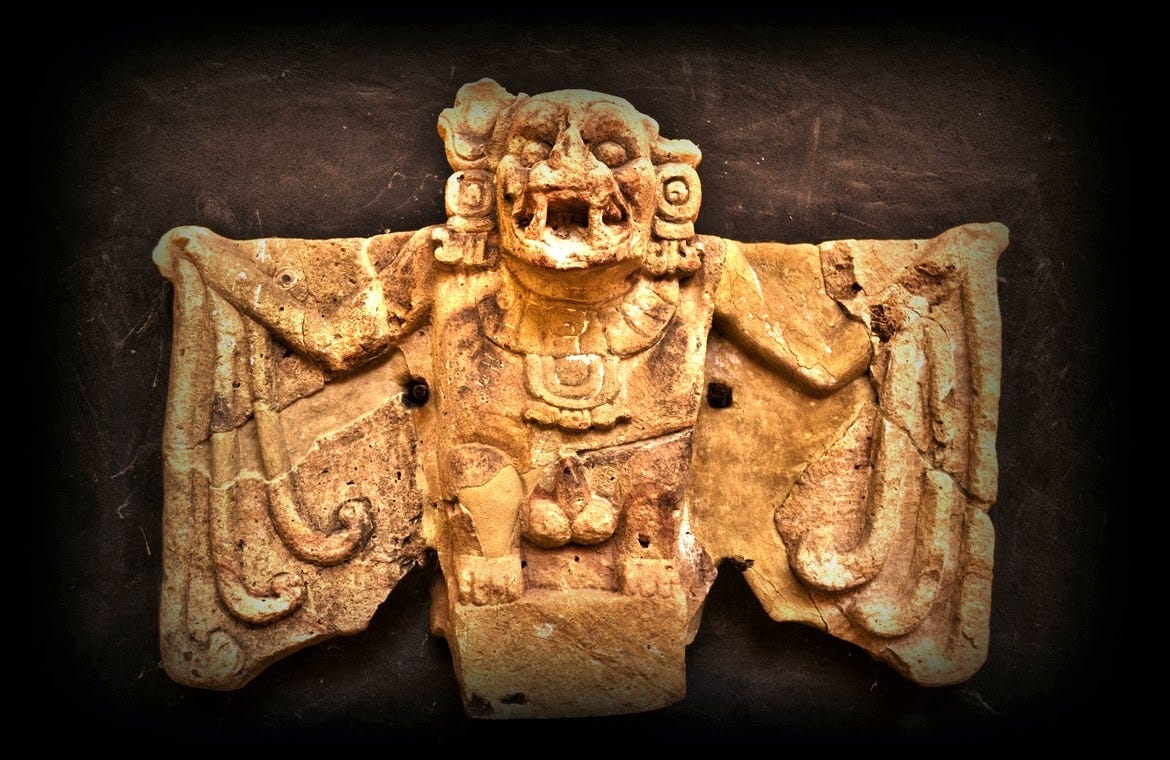
The dark kingdom of Xibalba would manifest upon the earth. Xibalba is inhabited by winged creatures with the body of men and the heads and wings of bats. These creatures are blood drinkers and hostile to man. Most fierce among them is Camacotz or Camalotz which means “Sudden-Bloodletter.” Camalotz, depicted as the figurine above with an erect penus, killed most of the denizens of man’s second creation by ripping off their heads.
The Cthulhu mythos is the nightmarish legacy of H. P. Lovecraft. He wrote the old ones were sleeping in the bottomless depths of the oceans until the time when the right astral alignment will awaken them, and they will once again walk the earth reigning over an unspeakable kingdom of darkness. Their return is awaited by a priesthood of bat winged humanoids who bide their time concealed by darkness in the unknown recesses of the earth’s forgotten caves.
Jack Heart Esoteric Evolution is a reader-supported publication. To receive new posts and support my work, consider becoming a free or paid subscriber.
The Mayans themselves are a people shrouded in darkness. Somewhere in the ninth century Maya civilization suddenly ceased to exist with the city Cancuén, their center of trade in what is now Guatemala, abandoned in an orgy of violence. The aristocracy of Cancuén; thirty-one men, woman and children were recently discovered hacked to pieces and tossed in what was their palace cistern. Eighty yards away in an unmarked shallow grave was buried their great king Kan Maax. The massacre took place around 800 CE. (1)
The Mayan calendar — just like the story of Akakor and the true names of Yahweh — is based on the number 13. The calendar is divided into 13 Baktuns. Each Baktun equals 144,000 days. When all 13 Baktuns are completed the calendar resets to zero and the Mayan doomsday scenario takes place. Mainstream archaeologists say the Mayan calendar began on August 11, 3114 BCE.
Using this genesis date, the destruction of earth should have taken place on December 21, 2012. But in the epilogue of Chronicles of Akakor Karl Brugger states “According to the Chilam Balam, the books of the jaguar priests of the Maya, history begins in 3113 B.C. The German Maya scholar Wolfgang Cordan connects this date with a mysterious historic event of great importance.” (2)
By moving the beginning up one year, the ending is moved up one year and the destruction of earth should have taken place on December 21, 2013. It doesn’t get any more historically important than that; and that is why authorities elected not to share that information with the ignorant masses. They were told Comet Ison was approaching…*
Brugger doesn’t say what the historic event was, but Wolfgang Cordan was the foremost expert on Mayan hieroglyphics. Historical records indicate that he died in 1966 at the age of fifty-six while in the field doing research. They also indicate that his friend and closest colleague was killed six months later. The index cards to Cordan’s until then academically definitive work on Mayan hieroglyphics; a comparative dictionary of Mayan writings, have never been found. It’s as if they never even existed…
Cordan was the lead linguist in a huge expedition composed of some ninety archaeologists from the University of Pennsylvania under the direction of William D. Coe. The dig began in 1956 and finally ended in 1969. The effort, unprecedented to this day in Mesoamerican archeology, unearthed ten square miles of the enigmatic Mayan city: Tikal, with its most imposing structure being Temple 1, the temple of the giant Jaguar.
Almost all but the most superficial information about Cordan seems to have been purged from academic records. Secondary sources are nonexistent and there are no available comparisons of Cordon’s work to the current state of research on Mayan hieroglyphics. Predictably no one has been able to find anything about the circumstances of Cordan’s death, only that his colleague was murdered shortly thereafter.
The Tikal expedition unearthed five step pyramids, three hundred and fifty houses and enough artifacts to stock a museum. Temple 1 rises a hundred and fifty-four feet above the plaza and Tikal itself is situated in the middle of an impenetrable jungle canopied by trees up to a hundred and eighty feet tall. Although the interior of the Tikal temple complex is connected by a finely cobbled network of walkways, there are no roads into the surrounding jungle.
The fresco and artwork found on the site depict only priests in acts ranging from fertility ceremonies to human sacrifice. Craftsman and agricultural workers are conspicuous by their absence of representation. William Coe is on record as remarking how it seemed unfathomable that such an advanced culture could be developed in such an inhospitable place that seemed to be unable to support more than just a few huts. Wolfgang Cordan speculates that although Tikal’s inhabitants made children’s toys with wheels, they must have transported their goods on sleds because no working wheels were found on the site. (3)
About two hundred miles to the west of Tikal is Villahermosa, the capital of the Mexican state of Tabasco. Four of the pieces of the now infamous monument 6 are displayed there in the Carlos Pellicer Museum. Monument 6 is in actuality a well preserved carved wooden box commemorating the death of Tortuguero ruler Bahlam Ajaw or Lord Jaguar.
It consists of seven pieces all together. Another of the pieces is in Metropolitan Museum of New York, but the whereabouts of the other two is unknown. The box was salvaged from Tortuguero, a Mayan site discovered in 1915 not far from the city. Another German Mayan scholar — Professor Berthold Riese of the field-leading Bonn University — describes Tortuguero as the western most emblem province of Palenque.
Emblem Glyphs denote Mayan city states. Dr. Riese goes on to say that although short lived the site was one of the most important for Palenque. He published two scientific papers on the interpretation of monument 6, one in 1978 the other in 1980. They have never been translated from German. In 1981 a cement factory was built on top of Tortuguero destroying the rest of the site...
In the shadow of the cement factory the disciples of Michael D. Coe; White Supremacist, CIA asset since the Korean War and acknowledged by academia as the foremost expert on Mayan hieroglyphs since the untimely death of Wolfgang Cordan, work feverishly to interpret monument 6. Their incoherent products run the gamut, but they all seem to agree that Bolon Yokte “may ‘descend’ ye-ma, y-emal.” Bolon Yokte is a Mayan God usually associated with war and discord but also creation. In Mayan, Bolon means nine, and it is said he will come to crush the nine lords of the night. His calling card is blinding light.
In 2004 yet another of those meddling German Mayan scholars wrote a master thesis Tortuguero, Tabasco, Mexico – History of a Mayan City, depicted by their glyphs. Sven Gronemeyer’s work was however published in English, “updated” of course, in 2006. He translated the monument in six parts.
The first part pays homage to Balham Ajaw’s ascent to the throne. The second describes the Star Wars that the Mayans, particularly Tikal, incessantly waged on each other. Star Wars could only be initiated with the rising of Venus as the Morning Star. Mayan wars would be held in abeyance until this happened. As noted in the monument, these wars were usually culmina…