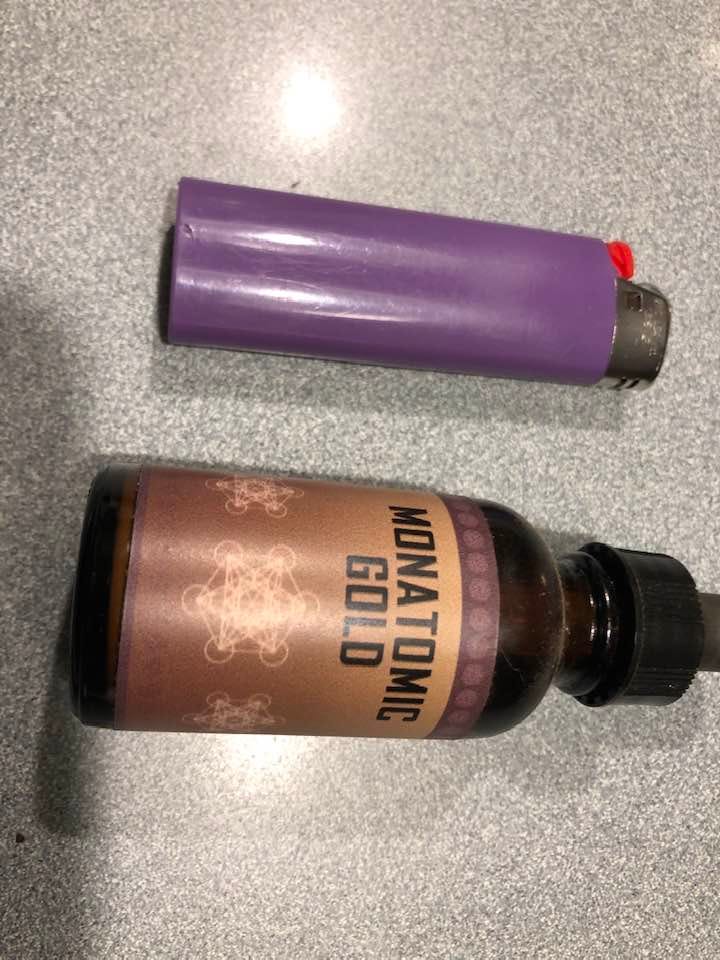
Excerpts From Michael Tellinger
HI y'alls. Going back over some email archives, I discovered the following narrative sent to me, by Michael Tellinger, author of the Slave Species of God. Besides ancient origins theory, are also many orations on electrical power, power plants, ancient batteries, a pre-modern finding of an ancient holocaust (which many researchers opine that we are the survivors of that one, destined to do it a second time), space flight, and several other things of interest.
Rather than get into all of that, I got this article of interest, that may also be of scientific interest to you.
Dear CHARLIE.
We have already discussed the issues around our obsession with gold. During my research I found that gold and slavery are the two common denominators that can be traced back to the earliest of human times. It seems that gold is the first and main obsession of not only humans, but all the ancient gods from all the religions all the way back to Genesis 2 and even further back in the Sumerian tablets. New discoveries are beginning to show some truly mysterious and even miraculous properties of gold. Are we finally revealing the real reasons why the GODS of antiquity were so obsessed by this metal?
Enjoy
Michael.
White Powder of GOLD
The food of the gods – manna from heaven!
In 1994 at the Global Sciences Congress hosted by Dean Stonier in Virginia Beach, David Hudson presented his new findings to an astonished audience. By this time he had spent 17 years researching the strange properties of gold and other Platinum Group Metals or PMGs. Hunter was a successful farmer who saw an opportunity in recovering gold from old mining sites where the sandy leftovers from the refining process were dumped. His idea was simple, to accumulate gold and silver without having to pay taxes and because he had all the farming equipment he began recovering gold using the Heap Leach Cyanide method. The crushed ore is laid out and irrigated with a dilute cyanide solution. The solution percolates through the ore and leaches out the precious metal. This can take several weeks.
The solution containing the precious metals is called the pregnant solution. It continues percolating through the crushed ore until it reaches an impermeable liner at the bottom of the heap where it drains into a storage tank. The precious metals are then separated from the pregnant solution and the dilute cyanide solution now called 'barren solution' is normally re-used in the heap-leach-process or occasionally sent to an industrial water facility where the residual cyanide is treated and residual metals are removed. The water is then discharged back into the environment where it poses possible and obvious ecological threats. But this is all really aside from the remarkable discovery made by Hudson.
During his recovery of gold and silver in this way and then assessing it with a standard fire assay process, he found that he was recovering something else, which was causing losses in the recovered gold and silver. After consulting more knowledgeable experts he realized that nobody knew what this problem material was. It had a specific gravity and it would recover in molten lead just as if it was gold or silver. But when he tried to couple it with the lead, there was nothing.
This is where the mystery deepened when he discovered that people involved in mining and metallurgical work are familiar with this mystery substance. They often call it 'ghost gold'. It is a non-tradable and non-identifiable form of gold.
Hudson was introduced to the Soviet Academy of Sciences, that had a very advanced emission spectroscopy programme. This process involves taking two carbon electrodes and placing your sample on one of them, while running a current between them through your sample. As the current forms an electric arc between the two electrodes, it also burns the sample matter in its path. The elements in the sample will ionize and give off specific light frequencies. This is the basis of spectroscopic analysis or DC Arc Emission Spectroscopy. This process is normally triggered for about 10 to 15 seconds before the carbon electrodes burns away. The interesting thing is that American spectroscopy analysts will tell you that everything that is there will be ionized and will be ident ified in the emission spectroscopy report.
In one such experiment, the material Hudson was testing showed up to be iron, silica and aluminum. It took them three years of trying to actually get rid of those elements, but this could not really be achieved. Because once the known elements were burnt away, they still had 98% of the material left behind. This material on the DC arc did not indicate to be anything. They took the material back to Cornell University, where Hudson worked with others trying to analyze this mystery substance.
They used X-ray analysis with 8 different X-ray heads, tunneling microscopy, diffraction, fluorescent microscopy, all this great technology confirmed the presence of iron, silica and aluminum. So they worked on removing those elements from the sample again. When they no longer showed up on the spectroscopic analysis, it was pronounced that there was nothing left, and yet there was still material present.
So they opted to follow the advice of the Soviet Academy of Sciences who suggested that proper spectroscopic analysis requires a 300-second burn instead of the 15 seconds use in the USA. Within the first 15 seconds they got the standard readings of iron, silica and aluminum and sometimes traces of calcium. After that, nothing else was read until 90 seconds into the burn, where palladium began to read; at 110 seconds platinum began to read; at 130 seconds ruthenium began to read; at 140-150 seconds rhodium began to read; at 190 iridium began to read and at 220 seconds osmium was read. The Russians called this fractional vaporization.
The boiling point of these elements is about 5200 to 5300 degrees centigrade while the maximum temperature of a DC arc is theoretically about 5450 to 5500 centigrade, measured at the center of the arc. So if the material sits on the side of the electrode it can't get to the maximum temperature of the arc so quickly. But during the longer burns the elements burnt off in the sequence of their boiling temperatures; palladium, platinum, ruthenium, rhodium, etc. To put this into perspective for the layman, we must realise that the boiling temperature of iron, is to these elements like the boiling temperature of water is to iro n. You can't get iron hotter than the boiling temperature of water until all the water is gone. The same applies to the carbon arc and the burning away of the iron, silica and aluminum. It's not until all of that is gone, that you can reach the temperatures of the denser elements. They experimented for two years to conclude that about 85% of the reading occurs way out there towards the end of the long burn. In other words, short burn times are incorrect when determining purity standards and so the people buying these precious metal standards are only getting about 15% to 20% of the sample assuming it is everything.
The best deposits in the world are still found in South Africa where they are mining 1/3 of an ounce per ton. Based on their research Hudson believes that they should get about 2400 oz per ton of these precious elements if it is recovered properly. He worked with a chemist in Arizona for over 3 years, replicating the procedures that the Soviet academy recommended. They successfully separated 6-8 oz. per ton of palladium, 12-13 oz. per ton of platinum, 150 oz. per ton of osmium, 200 oz. per ton of ruthenium, 600 oz. per ton of iridium, 1200 oz. per ton of rhodium, the same values as found in spectroscopic analysis.
Hudson proved his point by producing three different samples of rhodium in diff…