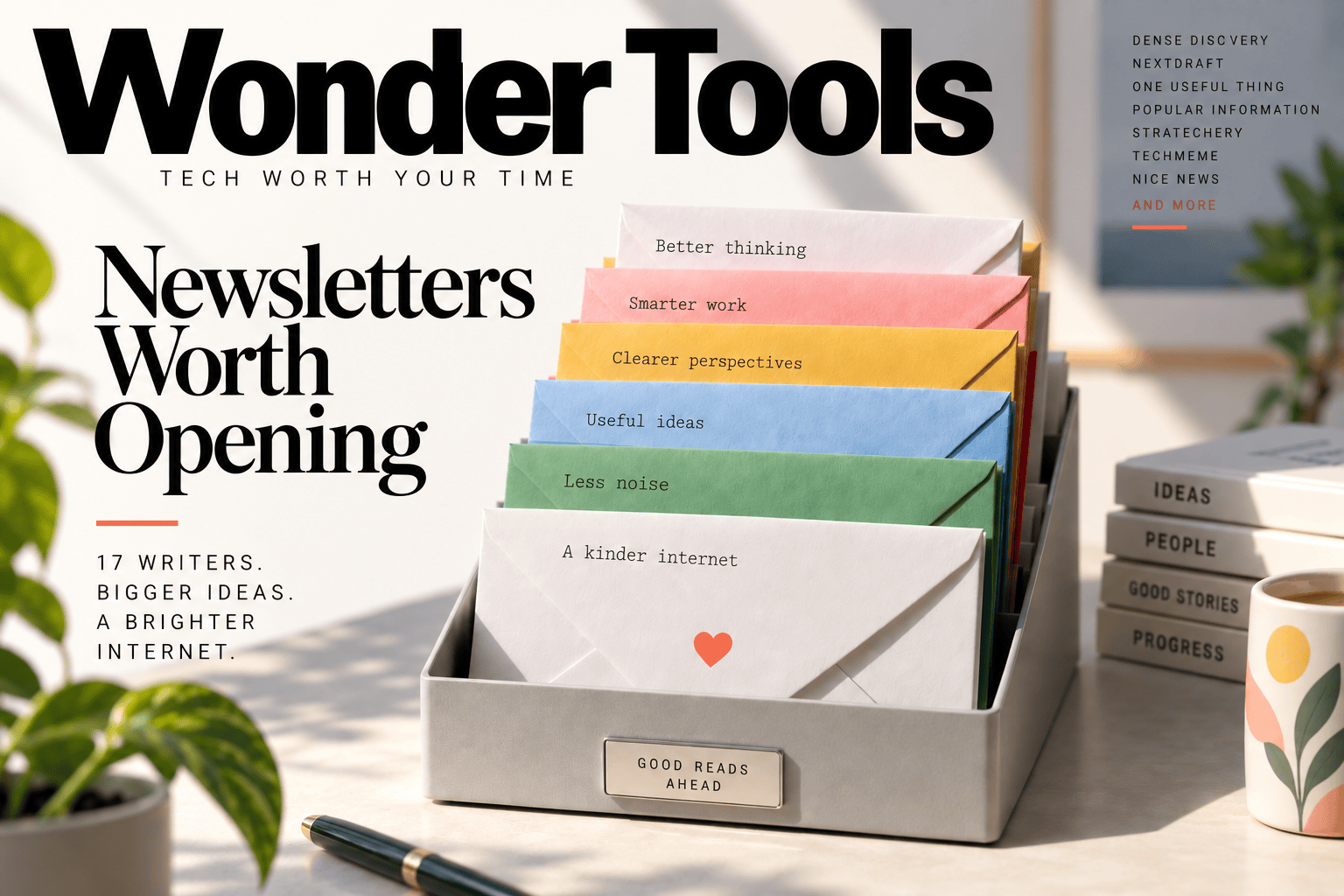
I subscribe to hundreds of newsletters. Most weeks I read only a fraction. These are the dozen free ones I turn to first, all written by humans, plus five bonus picks from two guests. Share your favorites as a comment below.
1. Dense Discoveryby Kai Brach
The best curated email I get. I find interesting sites, stories, and ideas in each post. It’s also gorgeously designed. It has a 63% open rate, roughly double the typical newsletter. For a sample, check out the recent “Cynicism is not a strategy” issue.
I abhor the frenzy of 24-hour news cycles. But it’s a pleasure reading Pell’s daily NextDraft. He summarizes the day’s most interesting stories with a warm sense of humor, avoiding the anxiety-provoking tone of nightly TV news. He always includes at least one offbeat story that’s fun to share. WTF Just Happened Today also serves up a clear, concise take on today’s top U.S. news.
3. Cool Tools by JR Raphael
I always learn something from Raphael’s posts. Instead of chasing tech headlines, he tests and explains useful sites and services. His separate Android Intelligence email catches me up on new apps outside the Apple world.
I also like Recomendo. The three contributors spotlight six useful things in each issue, from a fantastic site, book, or video to an unusual hardware tool or a helpful Reddit community.
4. One Useful Thing by Ethan Mollick
The most insightful AI newsletter I read. Mollick, a Wharton professor, shares practical AI experiments with his 480,000 subscribers, testing what the tools can and can’t do well. Every few months he writes an opinionated guide, like this guide to which AI platforms you should try. His latest post features an elaborate music video he had Claude compose with Suno. His book Co-Intelligence, published in April 2024, remains a helpful AI primer. I’m looking forward to his next book, Co-Existence, coming out October 20.
5. Hulry by Rahul Chowdhury
Chowdhury blends common sense with creativity. His recent post, 21 Productivity Hacks I’ve Picked Up Over the Years, is a good example of his straightforward, practical takes. Like Dense Discovery, his Hulry posts are full of well-chosen finds. Each issue has something handy or quirky that’s fun to read about.
Sponsored Message
If your customer info lives across email, spreadsheets, and sticky notes, you already know the cost: missed follow-ups, forgotten details, wasted time hunting for context.
Capsule pulls it all into one place, and our AI Contact Enrichment fills in the gaps automatically, so nothing’s left half-complete. One more tool that actually earns its spot in your stack. No card required.
6. Popular Informationby Judd Legum
The best example of an independent investigative journalist making the Substack model work. It’s completely free to read, supported by paid subscribers, with no ads. Legum aptly describes his project as “News for people who give a damn.”
His accountability scoops on corruption and injustice lead to change. They’re full of carefully reported details and regularly picked up by major news outlets. One example of his impact: in 2020, after his reporting about Olive Garden, its parent company started providing paid sick leave to about 170,000 employees across 1,779 restaurants.
7. Second Rough Draft by Richard J. Tofel
Read this excellent newsletter if you’re interested in the state of contemporary journalism. Having been ProPublica’s first employee and its president from 2013 until 2021, Tofel brings experience, expertise, and evidence to his posts. He’s warned that many of the nation’s for-profit metro newspapers are “going out of business in slow motion.” His posts show how and why that’s happening, while also offering insight into the nonprofit news world.
8. Dr Phil’s Newsletter by Dr Philippa Hardman
Not that Dr. Phil. Hardman, a Cambridge University scholar, shares research-backed insights about how AI affects learning and teaching. Posts feature clear charts, frameworks, and novel ideas about AI and education. One recent writeup I appreciated explored the research on whether AI-generated videos actually help people learn.
9. The Pink Reportby Daniel Pink
I’ve never met Pink, but I learn from him every week. His weekly pieces work as brief classes in wisdom, like 30 cheat codes for life and six skills humans need in the AI era. I especially enjoy Pink’s reading recommendations, like 11 essential books for 2026 summarized in 12 minutes. He’s as skillful at writing hundreds of pages as he is at drafting short videos. His book When explores the best times to do things. Watch his YouTube videos for short versions of his advice.
I like Clear’s brevity. Three short ideas, two quotes, and one question to ponder. The formula has worked well enough to attract 3 million subscribers, more than any other publication on this list. I wish he’d write another book, given how good Atomic Habits was.
11. Techmeme
I check Techmeme daily to keep up with tech news. Its headlines sum up what’s new with AI and tech and link to multiple takes on top stories. There are many tech portals and aggregators, but this one has remained in my rotation year after year.
Two newer alternatives: Set up custom scheduled reports with Claude or ChatGPT. List your favorite topics, angles or outlets to highlight/avoid, and how often you want it. If you prefer manual curation, use Mailbrew to assemble your own digest. (Read my take).
12. Nice News
When I feel worn down by the news, I turn to this sweeter space. It’s full of hopeful pieces, but not random raccoon GIFs. One recent piece celebrated medical research breakthroughs, while another was titled “‘16,648 Reasons to Live’: Paper Highlights the Power of Small Joys for Suicide Prevention.”
To add to my recommendation list, I invited James Potter to share two of his favorite newsletters. He runs Reletter, which tracks around 7 million newsletters across Substack, Beehiiv, LinkedIn, Ghost, and more.
Potter recently mapped how newsletters cluster based on the links they share (reletter.com/graph). He publishes a weekly ranking of the most-cited links. It’s a superb resource for keeping tabs on what people link to most.
13. Stratechery by Ben Thompson
James: I’ve paid for Stratechery since 2021. If I could only keep one newsletter it would be this one. Thompson writes about the business strategy behind tech news. Whenever something happens, he works out who ends up with power over whom. His main tool is a framework he calls Aggregation Theory, which says that whoever owns the relationship with users gets leverage over everyone supplying them. He’s great at weaving his past analysis into current issues and tying everything together.Recently he wrote an interesting article about the idea of AI agents doing your shopping for you. Walmart was one of the first big retailers to sign up for OpenAI’s Instant Checkout. Walmart pulled out a few months later because orders placed through ChatGPT converted at a third of the rate of its own site and app, and the baskets were smaller too.
14. Benedict Evans
I read Evans’s email every week. It’s how I catch up on anything in tech that I missed. I also like his way of seeing the world. He spent years as an analyst and was a partner at Andreessen Horowitz. Each week he picks the tech stories that mattered and adds a few lines of context to each, often with a dry joke. He’s good at checking hype against the numbers.
When SpaceX filed to go public, for example, Evans wrote about how xAI’s data center provides services to Anthropic for $15 billion a year, more than SpaceX’s entire launch business.
❤️ What newsletter do you like? Leave a comment ↙️
Jeremy: To close, I asked Julia Sherwin to share her favorite newsletters. Julia is an assistant publisher at GlobalPost Media. She’s also executive director of the GlobalPost in the Classroom, a program that offers free subscriptions to faculty and students at high schools and universities worldwide.
I asked for Julia’s take because I love GlobalPost. It’s great for discovering interesting issues in countries around the world. The editors pick fascinating focal points each day beyond the conflicts, natural disasters, and political battles that dominate much of U.S. international coverage.
15. Tangle
Julia: This free newsletter provides insights into the political forces within America, as well as its international activities. The coverage is consistently honest and nonpartisan. Editor Isaac Saul and his writers focus on one major issue each day, giving readers more than the surface view. Tangle also has an accompanying podcast. The newsletter and podcast feature commentary from both the left and right. A recent issue clarified complex elements of the U.S.-Venezuela oil deal.
16. Global Highlights Newsletter from The Conversation
This is a free, twice-weekly selection of articles written by academics and researchers from around the world. It helps readers understand current geopolitics, scientific news, and historical context.
17. GlobalPost
Julia: Finally, a shameless plug. I work here, but I genuinely haven’t found a news source quite like it: GlobalPost is a nonpartisan daily newsletter devoted entirely to international news: four top stories, plus a fifth dedicated to a scientific discovery.
Recent editions have covered everything from ancient Roman firefighters to scientists recreating the primordial “soup” of the Big Bang to a Western Han dynasty site in China where archaeologists uncovered ancient game boards.
A full subscription is $46 a year with a 14-day free trial. But students and faculty at middle schools, high schools, and colleges can sign up to read it for free.