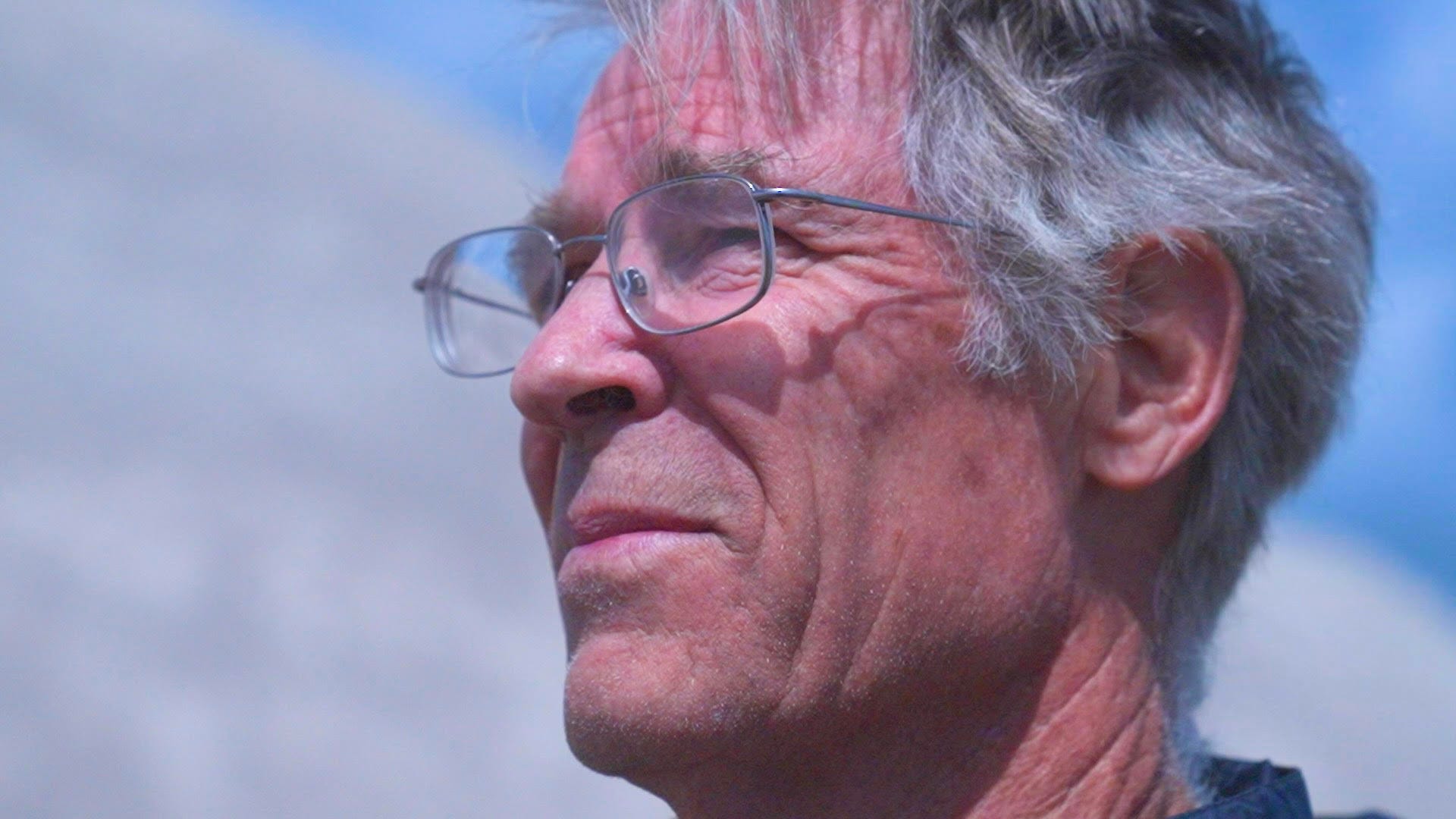
This conversation is part of a series of interviews with various brothers and teachers, including many fellow writers, all of which are part of the body of work surrounding my book-length memoir An Ordinary Disaster—one man's proof that we can all learn to listen to ourselves, and to act upon the inner voice of our self, our sanity and our soul.
Today I'm speaking with Kim Stanley Robinson, a true legend of a writer, and also as an advocate for better stewardship of planet Earth and for sustainable cohabitation with all the species that inhabit this unique gem of a planet. Stan has published more than twenty books including the pioneering Mars Trilogy, 2312, Shaman, The Ministry For the Future, and, most recently, The High Sierra: A Love Story. He has received great recognition for both his creative work, his advocacy—and, although he's quick to qualify it as the work of a novelist, the fact is that he’s made quite a mark with his scientific thinking as well.
Stan and I met through the Long Now Foundation here in San Francisco and reconnected through our mutual love of the high Sierra, in particular through the shared experience of independently coming across Paiute obsidian knapping sites simply by following our intuition in looking for good places to rest while out hiking.
Especially since I'm working on building a third career as a writer, I value very highly Stan's life experience as a working artist who's met with such success—and also as someone who embodies warmth, curiosity, irreverence, adventure, poise, truth, and openness, just to name a few of the values that I see in him.
Topics
Stan and I cover a lot of ground that should be interesting to fans of his writing as well as lovers of the high Sierra of California, including the Cardboard Set Problem, physical places as characters in writing, how he became a writer, poetry, how he feels about formal training in creative writing (and MFA programs in particular), the connection between geography and outdoor sports, intuition and the practice of wayfinding, the difference between micro and macro lost, risk and danger, the spiritual practice of ‘being a dog,’ learning to love the inhuman—and other species of ‘people,’ dualism, escape, and balance, our collective embodiment, moving from a model of masculinity based on dominance to one based on resistance, his relationship with Gary Snyder, civilization and progress as “lose, lose, lose, lose, lose, lose, win,” and the Kingdom of San Francisco.
As you read or listen, you might scan the questions at the bottom of the show notes, or just consider this: what is your relationship with the natural world? How does it feel to be in nature and to be part of nature? And how does that inform you in your daily life, and as you look towards the future?
The Interview with Kim Stanley Robinson
Bowen Dwelle: Stan, welcome to Brothers and Teachers.
Kim Stanley Robinson: My pleasure, Bowen. Good to be with ya.
[00:03:27] The High Sierra
Kim Stanley Robinson: I know that we're here today also to talk about my most recent book, The High Sierra. And that of course is a whole different thing. It's non-fiction. It has a bit of memoir in it. Never have I written directly about myself as much as I have in that book.
And it was kind of uncomfortable to tell you the truth. But in order to express the Sierra properly, I needed to tell my own story. And it would've been crazy not to. So I went ahead and dove in.
Bowen Dwelle: I really felt that, and it was just a lovely surprise and serendipity to come across your book in the little Mono Lake bookshop there in Lee Vining. I was just on my way back from a visit to the high Sierra, and so it just made perfect sense.
It was so striking to me, this relationship between these two very different worlds of backpacking in the high Sierras of California and the futuristic, fictional worlds that you write about.
If they've read the High Sierra, I'm sure other readers can see the places and the scenes directly lifted from there [like] the fell fields and the Terminator, which reminds me of the sunrise coming up over the high Sierras.
How do those relate for you as a writer? I mean, it seems like you began to spend time in the mountains and became a writer around the same time, so how do you inhabit both of those worlds?
Kim Stanley Robinson: Well, let me ponder that aloud. I grew up in Orange County, and it was a period of rapid change from agriculture in that it was orange groves, literally when I was a kid, to the city, a portion of Los Angeles, suburban automotive. It was a dreadful transformation of that landscape, and quite shocking, although when you're young, it was just natural.
[00:05:21] The Cardboard Set Problem
Kim Stanley Robinson: I didn't register it much until I went to college at uc San Diego, and I discovered science fiction at that point. When I ran into it, it felt right to me. I think that my experience of seeing Orange County transform so quickly meant that when I read into science fiction, that literature seemed more expressive of how things really felt than ordinary literature did, which now struck me as a kind of historical fiction no matter what.
So there I was as a science fiction writer, quite excited. At this point I was maybe 20 years old, a sophomore in college. Filled with big ideas and dreams. And at that same time, I started going to the Sierra, inspired by my friend Terry.
We had been friends since junior high school. We went to college together to go body surfing, and then we were going to the mountains together. And what struck me, and this maybe took a few years, was that science fiction has a standing weakness in formal terms in that you know that it's made up, it's set in the year 3000.
It's set in the future. It's maybe on another planet. When you're reading, you know it's made up. And I eventually called this the cardboard set problem. And this comes from Star Trek. The bridge of the USS Enterprise was clearly a cardboard set.
[00:06:39] Physical Places
Bowen Dwelle: It's very clear that you're fascinated with the physical places, and they're huge characters in your work.
Kim Stanley Robinson: Yeah, but this was a conscious choice as a kind of an overcompensation for a structural weakness that is in science fiction itself. So seeing that, that structural weakness, the reader, they know it's made up, the settings tend to be kind of shaky and one's sense that this is more than a dream, that it's reality, which you really want outta literature- that was weaker in science fiction, I felt, and I had experiences that, that were mostly at that point, Sierra based, that would allow me to say, okay, I'm on another planet. And for me that became Mars and the bodies in the solar system that NASA was revealing to us in the late seventies because of Voyager.
Bowen Dwelle: There is something otherworldly about the High Sierra in particular.
Kim Stanley Robinson: Oh yeah. At least to me there's some cheating involved. Like you have to terraform Mars to make it look like the High Sierra. And of course the rocks are different, et cetera. But the American West with its redness and its bare rock aspect, even more than the High Sierra proper, which is a wetter zone than most of the American West.
It looked martian all over and I had spent some time in the Navajo reservation north of Flagstaff and seen what everyone sees as a Southern California that right behind the coastal range, you've got a desert. So, I thought I can do Mars and if I tell the story of terraforming Mars, the more it's terraformed, the more it looks like a place that I really know quite well.
So that was a big driver, and I must say this evolved over decades of work, but it became a habit.
Bowen Dwelle: I see that, the connection between the other worldliness of the mountains and the American West.
[00:08:31] Becoming A Writer
Bowen Dwelle: It leads me back to when did the seed arise in you of the idea of becoming a writer and the idea that you could?
Kim Stanley Robinso…