We often learn at an early age that American heritage is one of shared passion for values like liberty and equality. This idealism is, after all, spelled out in the preamble of the U.S. Constitution. But if you look further back at the Declaration of Independence, you’ll see that the great unifier of Americans is actually skepticism of institutionalized authority. That isn’t nearly as romantic, but it explains a great deal. Americans aren’t the only people to ever doubt establishments, but they are descended from immigrants across generations who were stubborn enough to risk their lives traveling to a strange land rather than yield to an authority they no longer trusted. As for American ancestors brought to the country against their will, free people can only imagine the spirited resistance in their souls that enabled them to live and even thrive in defiance of authorities who dehumanized them daily.
Legend has it Baron Von Steuben remarked that if he gave his Prussian soldiers orders, they obeyed, but if he gave his American soldiers orders, they asked “why?” before they would comply. Status quo is not a sufficient source of legitimacy in the nascent American mind, something Anthony Fauci forgot when he dubbed himself “The Science” during the height of the COVID pandemic.
Healthy skepticism is a valuable trait, but like any good trait, it can be taken to an extreme that does more harm to public discourse than good. What proper role might conspiracy theory play in a self-governing republic, and how should a discerning citizen make use of it?
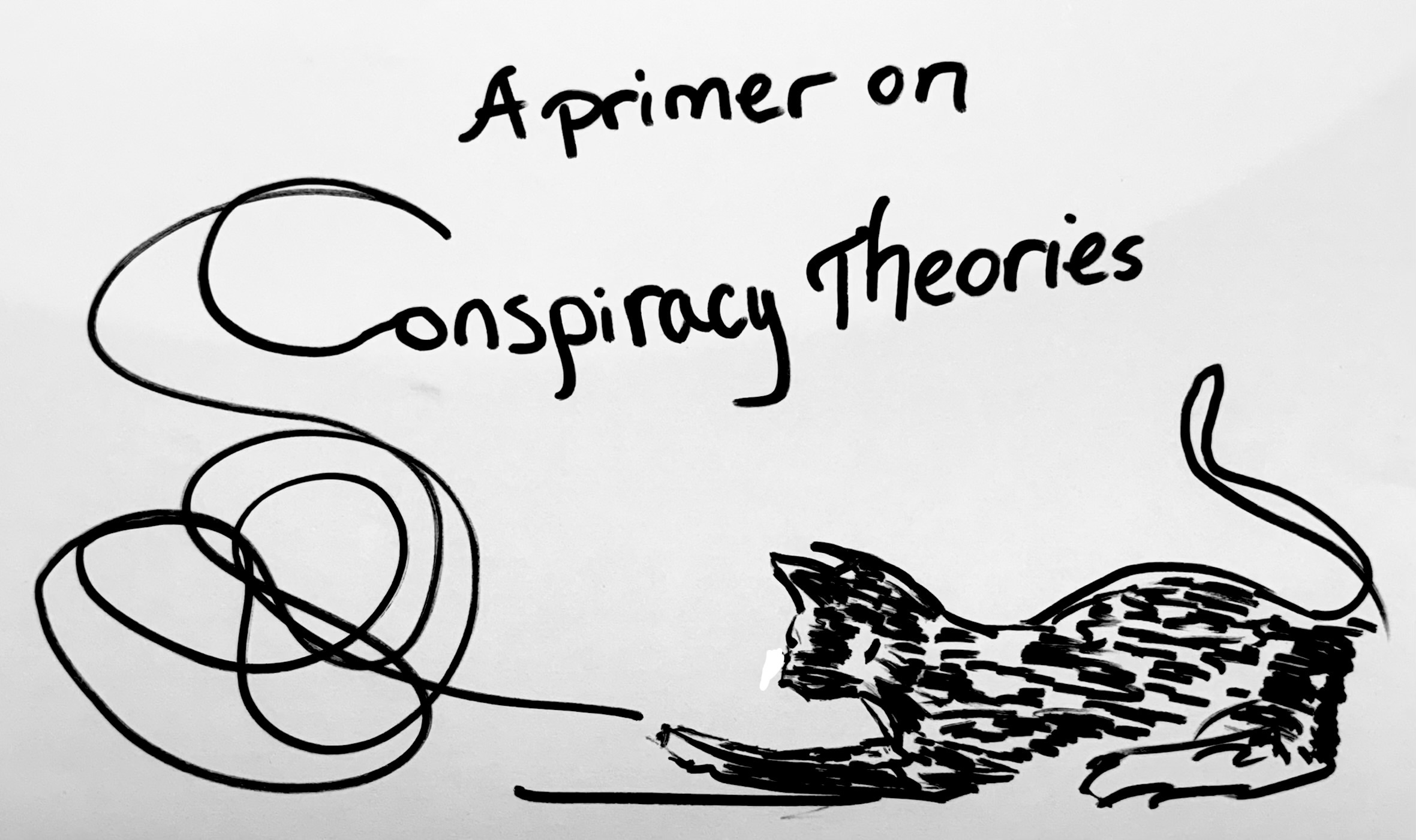
After reflecting on this subject for some time, I have put together a little civic primer of five red flags that should remind us to PAUSE and be sure we haven’t lost grip of the thread of Ariadne while descending the labyrinth of internet-fueled conspiracy theories. These red flags don’t in and of themselves have the power to debunk a theory, but they are good guidelines for identifying thought patterns that actually undermine critical thinking instead of support it.
P - Is the theory very personal?If the “bad guy(s)” in the theory always happen to be the same people with whom the theorist has a beef, that is a red flag. A good cartoon illustration of this comes from a subplot in the Hanna-Barbera series A Pup Named Scooby-Doo, in which Freddie repeatedly assumes that his personal nemesis, town bully Red Herring (aptly named), is the villain behind every mystery. Freddie is so fixated on taking down Red that he erroneously blames him for everything that goes wrong, and he has elaborate theories to make sense of it. Eventually when Red actually is to blame for something, you can see how Freddie’s undisciplined habit of accusation compromises any conviction of Red. The Know-Nothing Party in mid-1800s U.S. similarly fixated on Catholics as a source of corruption. During the Constitutional Convention, some Americans, with King George III fresh on their minds, obsessed over the notion that there was a plot to crown a European prince King of America.
A - Adherents of the theory, is there a lack of dissension amongst them? Watch the followers of a theory. There should be healthy variation of opinion on some details. Even the Gospels have some variance of perspective in written history that indicates authentic observation of actual events. But when everyone is in lockstep repetitive defense of a storyline, posting the same phrases in every comment section, the community of theorists is likely drifting into cult territory.
U - Is it unable to be disproven? A theory that cannot be disproven is not a legitimate theory. To take a lesson from science, whenever dealing with a structured explanation for the workings of the world, you can’t just ask questions. You have to develop clearly defined tests to answer those questions and determine what would falsify your hypotheses. If you keep pivoting every time you don’t get the answer you want, chances are you are not dealing with an intellectually honest theory. Consider the numerous times the end of the world was “predicted” to occur on an exact date, and how quickly the theorists moved on to another date after their first date was demonstrated to be incorrect. Consider analysis of Erika Kirk’s face in the wake of Charlie Kirk’s assassination: her smiles, stares, and tears alike get conflictingly interpreted as suspicious. Anything she does can be interpreted as suspicious retrospectively if someone desperately wants her to be suspicious.
One way of making a theory un-disprovable is to arrange indisputable facts in a fallacious manner. There’s a reason the Bible harshly condemns gossip and prohibits false witness in the Ten Commandments. If somebody can project fictional guilt for a factual crime, it only takes a little conjecture to cause serious damage. The details can be true, while the narrative operates in an intangible space layered over them, forcing them into a pattern that isn’t there. Reflect on various points in your own life - things you’ve said, people you’ve worked with, places you’ve traveled, awkward moments, funny coincidences for which you have no natural explanation - and now imagine someone really wants to make you look evil and conniving. How many dots are just begging to be connected because you can’t deny certain details? This is when conspiracy theory delegitimizes itself. We should handle conspiracy theory like blades and turpentine for scraping away damaged paint. If you keep scraping to the point that you damage everything under it, you’ve gone beyond the tools’ usefulness and are now causing harm.
S - is it serial? “You have to watch it from the beginning to see how it makes sense!” This is something we normally say about narrative fiction. If it requires watching 20 hours of sequential YouTube documentaries to understand, that’s a red flag. That doesn’t necessarily mean the productions have no valuable information or by default are completely wrong, but the more complex something is, the more room there is for error and manipulation. Theatre is dependent upon the audience zoning out of reality and forming a collective mind to consume its narrative. If the same thing is necessary to get hooked on a conspiracy theory, it might be more theatrical than real.
Sometimes drifting down the conspiratorial labyrinth primes a palate for results that are increasingly extreme. We know pornography affects the dopamine system in the brain, making addicts crave increasingly perverted content to maintain arousal. It could be that an addict of conspiracy theories likewise seeks out darker, deeper, and more extreme explanations of the world to maintain mental stimulation, to the point that simple truths are no longer palatable.
E - does the theory allow adherents to evade any responsibility or escape any risk? Conspiracy theories appeal to our fears and desire for control. If Charlie Kirk was murdered by an unhinged LGBTQ supporter, that’s scary for all of us because it’s unpredictable and out of our control. But if it’s because he got caught up in a tangled web of financial support from Zionist Jews, theory adherents can tell themselves that will never happen to them and maintain a false sense of security.
In a free republic, the proper role of conspiracy theory is to test boundaries by asking questions. Conspiracy theory cannot, however, be a reliable source of answers, because in its very nature, conspiracy theory is deconstructionist. It is about tearing down establishments, uprooting traditions, slaughtering sacred cows, and overall indiscriminate destruction of “the world as we know it.” Occasionally outlaws do good things, but that is not the norm for anarchy, and conspiracy theory is to research what anarchy is to government.
A final question worth asking ourselves in this mass media age is,
If True, Then What?
Will it change the way that you live? Will it change the way that you vote? Does the conspiracy theory actually matter, or is it idleness? Are you disciplined enough to let it be a form of entertainment that gets you thinking without losing your mind? The decision before you as a citizen is how you will allow conspiracy theory to inform the way you govern yourself in a constitutional republic rather than burn your country to the ground.