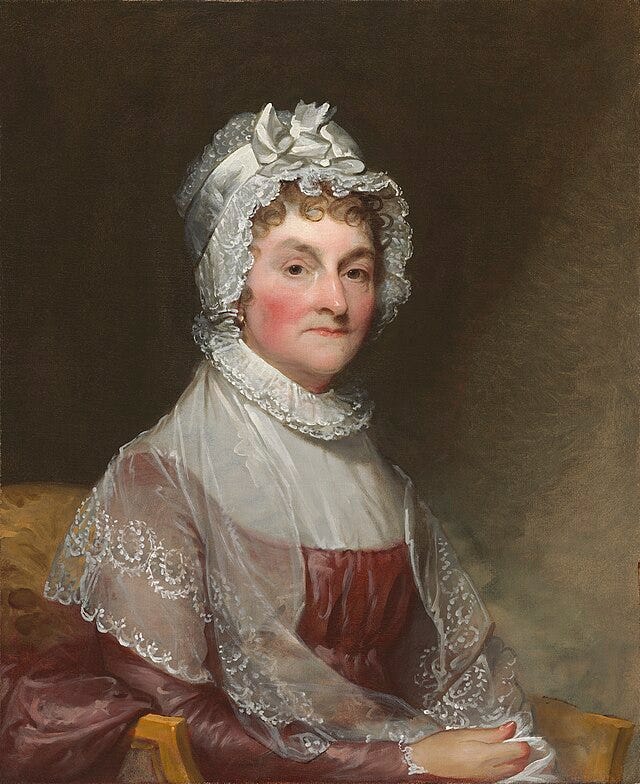
Any discussion of the American founding would be remiss without mention of Abigail Adams, both a wife and mother of U.S. presidents, and respected advocate for liberty, equality, and self-governance. While she and her husband John Adams spent at least a decade of their marriage apart, their resulting correspondence created a valuable tome of primary source observations and political philosophy of the early American republic. Abigail Smith Adams was born November 11, 1744 in Weymouth, MA to Congregational minister Reverend William Smith and his wife Elizabeth Quincy Smith, the second of four children. Abigail was raised in a print rich environment, living in a theologically-minded household that allowed her to become well-educated. The beginning of her love story with John Adams reads a little likea Jane Austen novel, with neither one impressing the other and Abigail’s mother eventually being concerned about her daughter having a country lawyer for a suitor. As their amusing courtship letters reveal, John and Abigail bonded over their equally matched values, classical knowledge, and wit. They were married October 25, 1764 and settled in Braintree (Quincy), MA, moving back and forth between there and Boston over time.
Abigail’s experience as a mother of six children against the backdrop of revolutionary America yields a startling perspective: little one year old Susanna suddenly died in her arms a month before the Boston Massacre, a landmark event in John’s legal career because he controversially defended British soldiers to uphold law and order. Baby Elizabeth was stillborn in 1777 after Abigail suffered an illness while John was away serving in the Second Continental Congress. In letters to her husband, Abigail refers to their children as “the little flock,” and the couple discuss the importance of their education. John saw his wife as very capable of ensuring their development in his absence, and he emphasized building their character as statesmen in their formative years, saying “[i]f we suffer their minds to grovel and creep in infancy, they will grovel all their lives.” Brilliant though she was, Abigail was concerned about the limits of her own education, and argued that especially if early childhood is so important for character, the education of women needs to be taken more seriously. “If we mean to have Heroes, Statesmen and Philosophers, we should have learned women,” she explained.
In addition to that responsibility, Abigail’s business savvy and diligence is credited with sparing John Adams the financial ruin that befell other founders who also sacrificed time away from their livelihoods and households to make American independence a reality. Abigail memorably desired that John “remember the ladies” when creating the new republic, and she reflected on women’s unique role in supporting their countries despite usually having so little to gain and so much to lose in the process. “Deprived of a voice in Legislation, obliged to submit to those Laws which are imposed upon us, is it not sufficient to make us indifferent to the publick Welfare? Yet all History and every age exhibit Instances of patriotick virtue in the female Sex; which considering our situation equals the most Heroick of yours,” she wrote to her husband in 1782. Abigail was a sharp critic of character, often advising John on the men with whom he worked, and she told him in 1775, “a true patriot must be a religious man,” because “he who neglects his duty to his Maker, may well be expected to be deficient and insincere in his duty towards the public.”
As our first second lady and second first lady, Abigail was true to her values, and certainly was not in politics for popularity. In 1797 she permitted James Prince, a young black hired man, to attend school. When a neighbor complained that the white students opposed that, Abigail said this was “attacking the Principle of Liberty and equality upon the only Ground upon which it ought to be supported, an equality of Rights...send the Young Men to me. I think I can convince them that they are wrong. I have not thought it any disgrace to My self to take him into my parlour and teach him both to read & write— tell them mr Faxon that I hope we shall all go to Heaven together.” Abigail opened the newly built White House to the public on New Year’s Day 1801, which was an annual tradition until Eleanor Roosevelt was first lady. Breaking from Martha Washington’s style, Abigail was not afraid to insert herself into political debate – even partisan politics – as first lady, garnering the disparaging moniker “Mrs. President,” but modeling an effective keeper of the republic.
SOURCES & FURTHER READING
Letter from Abigail Adams to John Adams, 9 July 1777 [electronic edition]. Adams Family Papers: An Electronic Archive. Massachusetts Historical Society. http://www.masshist.org/digitaladams/
Letter from Abigail Adams to John Adams, 16 July 1777 [electronic edition]. Adams Family Papers: An Electronic Archive. Massachusetts Historical Society. http://www.masshist.org/digitaladams/
“John Thaxter to John Adams, 13 July 1777,” Founders Online, National Archives, https://founders.archives.gov/documents/Adams/04-02-02-0224. [Original source: The Adams Papers, Adams Family Correspondence, vol. 2, June 1776 – March 1778, ed. L. H. Butterfield. Cambridge, MA: Harvard University Press, 1963, p. 282.]
Letter from John Adams to Abigail Adams, 29 October 1775, “Human nature...” [electronic edition]. Adams Family Papers: An Electronic Archive. Massachusetts Historical Society. http://www.masshist.org/digitaladams/
Katie Woods, “Abigail Adams (1744-1818): First Lady, Advisor, Writer,” Massachusetts Women’s History Center, www.mawomenshistory.org [Last accessed February 3, 2026]
Letter from Abigail Adams to John Adams, 14 August 1776 [electronic edition]. Adams Family Papers: An Electronic Archive. Massachusetts Historical Society. http://www.masshist.org/digitaladams/
Letter from Abigail Adams to John Adams, 17 June 1782, with a List of Articles wanted from Holland [electronic edition]. Adams Family Papers: An Electronic Archive. Massachusetts Historical Society. http://www.masshist.org/digitaladams
Letter from Abigail Adams to John Adams, 5 November 1775 [electronic edition]. Adams Family Papers: An Electronic Archive. Massachusetts Historical Society. http://www.masshist.org/digitaladams/
Letter from Abigail Adams to John Adams, 13 February 1797 [electronic edition]. Adams Family Papers: An Electronic Archive. Massachusetts Historical Society. http://www.masshist.org/digitaladams/
B.B. Caroli, “Abigail Adams,” Encyclopedia Britannica, November 18, 2025. https://www.britannica.com/biography/Abigail-Adams [Last accessed February 3, 2026]