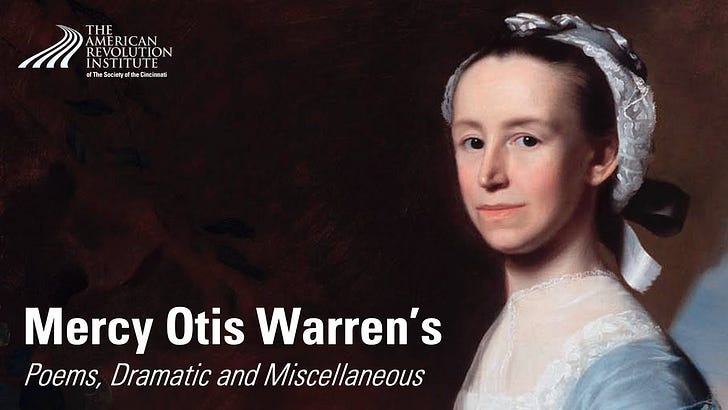
Mercy Otis Warren was an early advocate, critic, and historian of the United States founding. Born September 14, 1728 in Barnstable, MA to Col. James Otis and Mary Allyne Otis, Mercy was the third of their thirteen children. As was typical for girls at that time, Mercy didn’t receive much formal education, but she was allowed to observe her older brothers’ lessons under a private tutor. Her brother James Otis, Jr. attended Harvard College and supported her intellectual growth. Mercy read widely, and the influence of literary giants such as William Shakespeare, John Milton, and Alexander Pope is evident in her own writings. In 1754, Mercy married James Warren, a longtime friend and Harvard colleague of her brother. He worked as a merchant, farmer, and sheriff, and was eventually elected Speaker of the Massachusetts House of Representatives and served as Continental paymaster general in the Continental Army. Mercy and her husband’s correspondence shows us yet another revolutionary era couple equally united in intellect and political concern, and together they raised five sons. Not surprisingly, they became good friends of John and Abigail Adams as well as Samuel Adams, and their home sometimes served as a meeting place for liberty-minded Massachusetts citizens. George and Martha Washington and Thomas Jefferson also counted among their friends and correspondents.
Mercy had a talent for writing (her husband affectionately called her a “scribbler”), and her patriotic influence occurred more so in print than in parlor. At a time when book ownership was challenging to come by, the average American’s literacy was fueled by newspapers, which frequently printed not only current events and bulletins, but installments in a variety of genres. In 1772, Mercy wrote The Adulateur, a satirical drama in blank verse about colonial Massachusetts in a classical Roman setting. Royal Governor Thomas Hutchinson is the antagonist Rapatio, and the hero Brutus is said to be Mercy’s brother James. It was published anonymously in the Massachusetts Spy, and became popular enough to circulate as a pamphlet. In the 1773 sequel The Defeatpublished in the Boston Gazette, Rusticus and Hortensius are said to be portrayals of her husband and John Adams. To the modern reader who has the benefit of hindsight and is not regularly immersed in classical myth and metaphor, these works may seem confusing and not particularly striking. But at the time, war for independence was not a certainty, so Mercy’s work was received as prophetic and inspiring, with such sentiments as “Rather let Servia tumble from her basis / And in one general ruin cover all / Than see her citizens oppress’d with chains / And sweetly slumb’ring in the gilded fetters. / The man who boasts his freedom / Feels solid joy—tho’ poor and low his state / He looks with pity on the honor’d slave.” John Adams thought it was brilliant and requested that Mercy write a poem about the Boston Tea Party. When Adams read it he had it published and wrote her husband that it was “one of the most incontestable Evidences of real Genius, which has yet been exhibited—for to take the Clumsy, indigested Conception of another and work it into so elegant, and classicall a Composition, requires Genius equall to that” of Alexander Pope. Mercy’s range of literary pursuits also included a play requested by one of her sons, The Ladies of Castile, which she set in 16th century Spain to tell a story about widows of patriots and their decisions following tragedy. This one particularly fascinated Alexander Hamilton, who wrote to tell her, “that in the career of dramatic composition at least, female genius in the United States has outstripped the Male.”
But Mercy and James clashed with their Federalist friends over the Constitution. The Warrens were solidly in the Anti-Federalist camp, siding with major critics of the Constitution whose resistance to central government resulted in the addition of a Bill of Rights. When Mercy wrote her History of the Rise, Progress, and Termination of the American Revolution, she prefaced that she omitted military history because that was better suited for a masculine voice, while her perspective of the domestic and ideological aspects of the war was valuable coming from her feminine authorship. Adams was displeased with her anti-federalist perspective that ultimately diminished his role in the story, and decided that women weren’t suited to writing history altogether. They did eventually reconcile prior to Mercy’s death in 1814. Even this glimpse of collaboration and conflict reminds us of the complexities of the American founding. The foundation of our republic consists of ideas that were reformed and refined through study, conflict, and conviction, which can be seen in the life of Mercy Otis Warren.
SOURCES & FURTHER READING
“Biography of Mercy Otis Warren,” https://web.archive.org/web/20080924113620/http://streamer3.lacoe.edu/Americanhistory/enactments/Walters/Walters_biography.htm, [Last accessed 4/21/26]
Celebrate Mercy Otis Warren,
https://www.celebratemercyotiswarren.org/
“John Adams to James Warren, 9 April 1774,” Founders Online, National Archives, https://founders.archives.gov/documents/Adams/06-02-02-0009. [Original source: The Adams Papers, Papers of John Adams, vol. 2, December 1773 – April 1775, ed. Robert J. Taylor. Cambridge, MA: Harvard University Press, 1977, pp. 82–84.]
“Alexander Hamilton to Mercy Warren, 1 July 1791,” Founders Online, National Archives, https://founders.archives.gov/documents/Hamilton/01-08-02-0465. [Original source: The Papers of Alexander Hamilton, vol. 8, February 1791 – July 1791, ed. Harold C. Syrett. New York: Columbia University Press, 1965, pp. 522–523.]
“From John Adams to Elbridge Gerry, 17 April 1813,” Founders Online, National Archives, https://founders.archives.gov/documents/Adams/99-02-02-6000. [This is an Early Access document from The Adams Papers. It is not an authoritative final version.]
“Mercy Otis Warren’s ‘Poems, Dramatic and Miscellaneous’,” American Revolution Institute
“Mercy Otis Warren: The Conscience of the American Revolution”
“Mercy Otis Warren to Abigail Adams, 28 January 1775,” Founders Online, National Archives, https://founders.archives.gov/documents/Adams/04-01-02-0121.