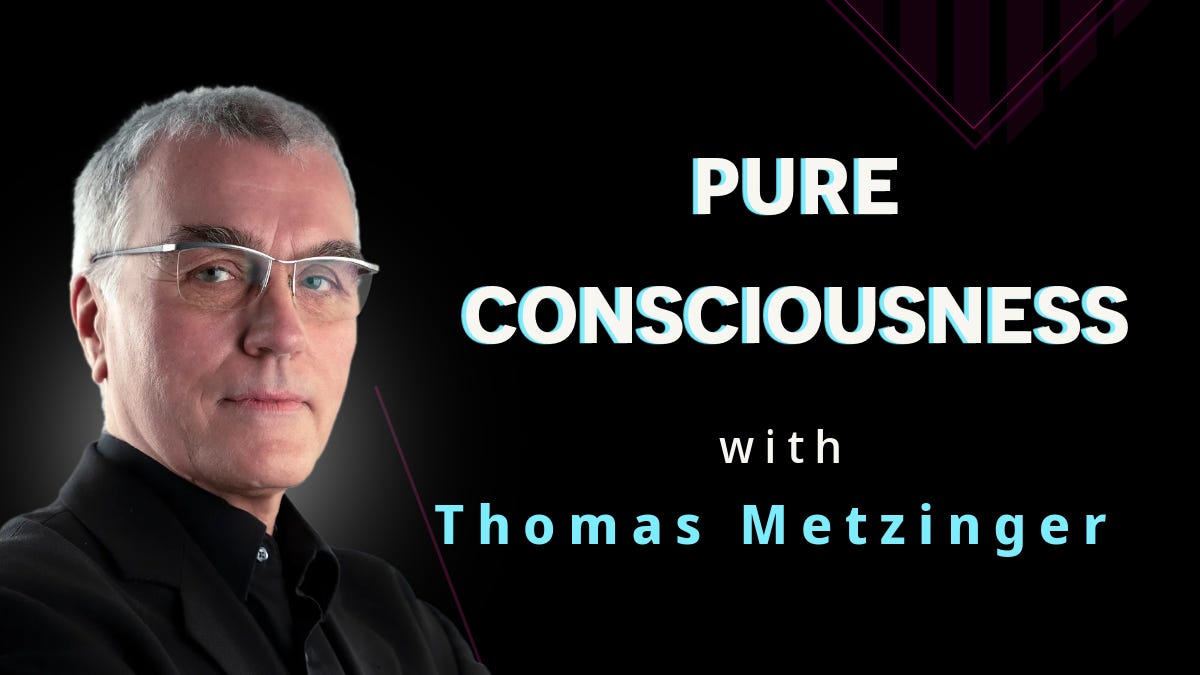
the voluntary suspension of habitual responses into awareness.
AI, Suffering, Remedy and Love as the voluntary suspension of habitual responses into awareness: This episode is with philosopher and cognitive scientist Thomas Metzinger, a Professor Emeritus at Johannes Gutenberg University in Mainz and a member of the German National Academy Leopoldina. He has worked mainly in philosophy of mind, cognitive science, and applied ethics, particularly focusing on neurotechnology, virtual reality, and artificial intelligence.
The conversation explores a wide range of topics including the critical intersection of philosophy, neuroscience, meditation, and artificial intelligence. Metzinger shares his skepticism about separating deep philosophical inquiries from meditation and certain sorts of experience relative to psychedelics, while discussing the impact of AI on human cognition, the concept of suffering in both humans and machines, and the responsibility of philosophers in an age of epistemic crisis. The discussion underscores the need for a balanced and multifaceted approach to understanding consciousness and suggests that new paradigms may emerge from current technological and philosophical shifts. This episode aims to foster an expansive and hopeful outlook as we move into the new year.00:00 Introduction to Fundamental Issues and Meditation00:44 Epistemic Crisis and AI Concerns01:15 Buddhism and Suffering02:09 Philosophical Insights on Suffering and Awareness04:47 Welcome to Love and Philosophy05:43 Introducing Thomas Metzinger07:43 Thomas Metzinger’s Contributions to Philosophy and AI09:53 Exploring Minimal Phenomenal Experience (MPE)13:49 Narrative and Pure Awareness22:09 Philosophical and Scientific Exploration of Consciousness29:30 Thomas Metzinger’s Personal Journey in Philosophy56:11 Criticism and Meditation56:55 Epistemic Authority and Consciousness59:27 Embodiment in AI and Philosophy01:01:52 Challenges in Academia01:05:31 AI, Critical Thinking, and Future Concerns01:15:29 The Nature of Suffering01:22:50 Compassion and Love01:44:12 Closing Thoughts and Reflections01:44:30 A Poetic Farewell
The phenomenology of ‘pure’ consciousness
Link to Elephant and the Blind full book
New book Bewusstseinkultur
MPE discussion mentioned in Intro
Philosophy Babble conversations
Thomas Metzinger (1958 in Frankfurt am Main, Germany) was Full Professor of Theoretical Philosophy at the Johannes Gutenberg-Universität Mainz until 2019. He is past president of the German Cognitive Science Society (2005-2007) and of the Association for the Scientific Study of Consciousness (2009-2011). As of 2011, he is an Adjunct Fellow at the Frankfurt Institute for Advanced Studies, a co-founder of the German Effective Altruism Foundation, president of the Barbara Wengeler Foundation (2019-2024), and on the advisory board of the Giordano Bruno Foundation. From 2008 to 2009 he served as a Fellow at the Berlin Institute for Advanced Study; from 2014 to 2019 he was a Fellow at the Gutenberg Research College; from 2019 to 2021 he was awarded a Senior-Forschungsprofessur by the Ministry of Science, Education and Culture. From 2018 to 2020 Metzinger worked as a member of the European Commission’s High-Level Expert Group on Artificial Intelligence. In 2021 he was awarded the Pufendorf-Medal, in 2022 he was elected into the German National Academy of Science.
In the English language, he has edited two collections on consciousness (“Conscious Experience”, Imprint Academic, 1995; “Neural Correlates of Consciousness”, MIT Press, 2000) and published one major scientific monograph (“Being No One – The Self-Model Theory of Subjectivity”, MIT Press, 2003). In 2009, he published a popular book, which addresses a wider audience and discusses the ethical, cultural and social consequences of consciousness research (“The Ego Tunnel – The Science of the Mind and the Myth of the Self”). Important recent Open Access collections are Open MINDat http://www.open-mind.net (2015, with Jennifer Windt), Philosophy and Predictive Processing at http://predictive-mind.net (2017, with Wanja Wiese), and Radical Disruptions of Self-Consciousness (2020, with Raphaël Millière). In 2024, he published a major OA-monograph with the MIT Press titled The Elephant and the Blind (see also top of page).
Just Now
by W.S. Merwin
In the morning as the storm begins to blow away
the clear sky appears for a moment and it seems to me
that there has been something simpler than I could ever believe
simpler than I could have begun to find words for
not patient not even waiting no more hidden
than the air itself that became part of me for a while
with every breath and remained with me unnoticed
something that was here unnamed unknown in the days
and the nights not separate from them
not separate from them as they came and were gone
it must have been here neither early nor late then
by what name can I address it now holding out my thanks