NEW: There’s a book called AI Everywhere with the amazing SheWritesAI community (and Andrea as co-author) which will be published on Women’s Day, May 8th, in the US. If you’re in the UK, you can also preorder Andrea’s book Holding Paradox: A Navigational Approach to Mind and Consciousness now. It will be available for preorder in the US and elsewhere this summer.
Hi everyone.
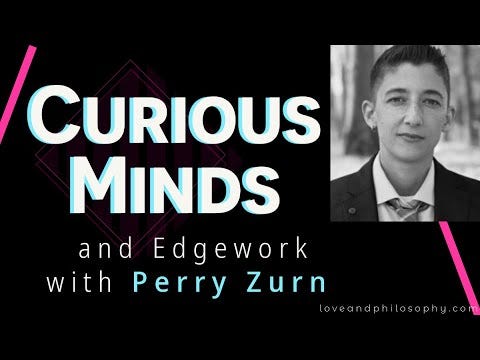
This week we are posting an archive episode of Love and Philosophy featuring Perry Zurn, provost and associate professor of philosophy at American University and coauthor (with twin Dani Bassett) of Curious Minds. Andrea also previews our upcoming season launch with USC philosopher Janet Levin.
In the conversation, Perry Zurn links curiosity to desire and love, arguing love can guide curiosity away from appropriative or objectifying inquiry. Perry reframes curiosity not as an individual desire to fill information gaps but as a social practice and a “capacity to connect,” drawing on network science, complexity, and ecological aesthetics through the idea of “edge work.” Andrea and Perry discuss diverse styles of curiosity (busy body, hunter, dancer), curiosity’s role in shifting knowledge networks and methods, interdisciplinary resistance, and how breaking “edges” and “cracks” can be both destructive and creative, relating curiosity to hope and to more-than-human ecologies. They also describe the book’s beautiful artwork by Poonam Mistry and the dedication to children who ask whether things must be this way.00:00 Archive Season Preview00:56 Why Curiosity Matters03:19 Support And Welcome03:53 Love And Curiosity06:28 Origins Of Curious Minds08:51 Curiosity As Practice11:24 Edge Work Explained15:18 Pioneering And Ethics17:39 Complexity And The Brain21:27 Styles Of Curiosity26:08 Curiosity Across Divides30:12 Walking As Knowing32:31 Methods As Paths36:34 Why New Paths Threaten39:38 Dead Ends And Branching40:33 Connectional Curiosity42:48 More Than Human Curiosity47:29 Cracks Hope And Destruction51:35 Daring To Disturb53:47 Art And Dedication56:45 Closing Reflections
Listen on: Apple Podcasts Spotify
Welcome to an exploration of curiosity from the L&P archive. The show has been going since the end of 2023, so more than two years now! This episode was one of the first public L&P conversations, shared by Andrea in conversation with provost philosopher Perry Zurn. Below we’ll give a brief summary of their discussion on ‘curiosity as a practice’ which comes form the book Perry wrote called Curious Minds (MIT), exploring the multifaceted nature of curiosity and its ties to philosophy, society, and ecological systems.Before the archive episode begins in the audio, you’ll hear Andrea Hiott guide listeners into the dialogue, highlighting an upcoming new episode for the Spring 2026 season of Love and Philosophy which will be with the distinguished USC philosopher Janet Levin, who was there at MIT when Jerry Fodor was developing his LoT and who was a Teaching Assistant for Quine before going on to become the first tenured woman philosopher at the University of Southern California. Andrea reflects on her excitement about exploring profound conversations that shift our understanding of concepts such as the metaphysics of mind.
Here’s a summary of the archived conversation:
Perry Zurn, an associate professor of Philosophy at American University, alongside her twin, the physicist Dani Bassett, co-authored "Curious Minds," a book from MIT Press that interweaves threads of curiosity with interpersonal, ecological, and philosophical landscapes. Perry introduces the concept of edge-work, describing curiosity as a practice that brings forth connections between disparate nodes in both knowledge and society. Through curiosity, paths are created by walking and reaching towards that which is not yet known.Perry challenges traditional views by redefining curiosity. Instead of seeing it solely as an acquisitional or individual endeavor, curiosity is repositioned as a social and relational practice, what Perry describes well here as a networked drive for building connections. This nuanced definition shifts the perception of curiosity from a simple desire to know into a transformative practice of living, learning, and interacting with the world.Drawing parallels with both dancing and walking, the conversation touches on various styles of curiosity, illustrating how curiosity manifests as a busy body, a hunter, or a dancer (in the book, there is a whole ‘bestiary’ of potential curiosity styles). These styles reflect diverse approaches to curiosity, supporting the idea that curiosity can be a playful, creative, and dynamic practice that embraces the ever-changing topographies of knowledge. Per usual, Andrea tries to imagine how these landscapes overlap and what sorts of ‘shapes’ we might imagine of how they connect, or don’t.In the spirit of way-making and navigability, both the literal and metaphorical notion of walking is explored via the geographical and conceptual journey, suggesting ways human beings traverse paths of knowledge, ideas, and existence. Through different walks, individuals carry implicit methodologies in their mental frameworks that influence how they approach and inquire about the world.At some point, the discussion ventures into ecological and non-human realms, exploring the living nature of curiosity among other beings. By expanding curiosity to include more-than-human participants, Perry advocates for recognizing curiosity as an evolutionary and ecological process intertwined with the living world, encouraging a symbiotic relationship with other beings and nature. Andrea imagines humans as growing from that other living curiosity and as a way for that other life to be curious about and explore itself.The notion of cracks as entry points for light and transformation emerges as a powerful symbol of creativity and hope, as it does in the book Curious Minds. In the presence of cracks, ideas and connections are broken and reconstructed, reflecting the paradoxical nature of destruction and creation within curiosity. This thought challenges binary divisions and embraces complexity, envisioning curiosity as a force that disturbs and simultaneously reconstructs the universe.In their conversational journey, Andrea Hiott and Perry Zurn invite us to reconsider curiosity as not merely an individual pursuit but as a connective, ecological flow. By perceiving curiosity as a joint practice with an inherent capacity for connection, there arises an opportunity to foster relationships that honor diversity and participatory interdependence. Through love, philosophy, and curiosity, new pathways are paved, inviting us to rethink how we engage with the world around us.
Recent Posts and events:
If you are interested in embodied and enactive cognition, we also recommend the ENSO Seminar Series: https://www.ensoseminars.com/presentations/past