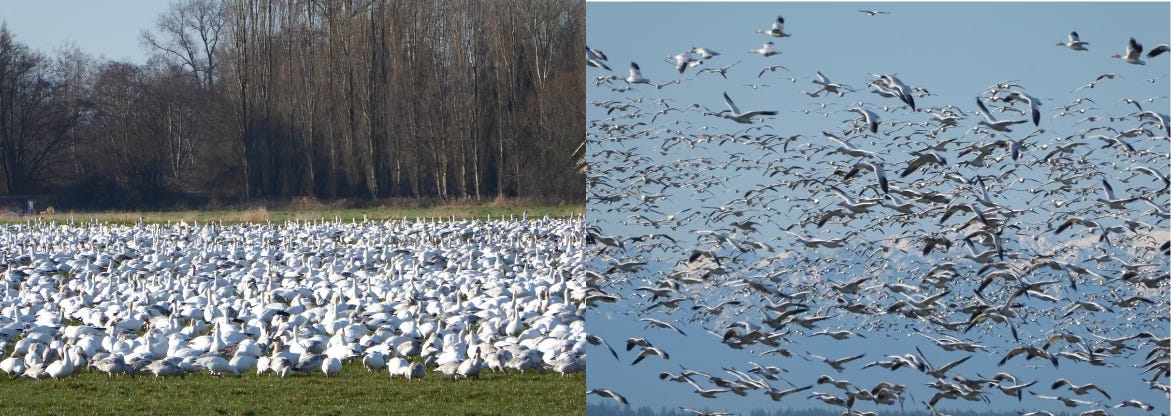
Last week, my wife and I and two pals of ours participated in one of the finer known BBB events, driving around the lower Stillaguamish, Skagit, and Samish river valleys looking for birds. We’ve been doing this regularly for the past half dozen plus years. It’s a pretty simple and satisfying day of sitting in a car, driving around, looking at birds, tallying up the numbers of a few choice species, grabbing a good lunch, and enjoying the beauty of the natural world and good friends. This year was no different.
We generally focus on counting just a handful of species, primarily Bald Eagles and Red-Tailed Hawks. They are easy to see, identify, and count. More challenging, or at least far more numerous, are the big white birds: Trumpeter Swans, Tundra Swans, and Snow Geese. In a good year, they can total in the thousands and grace the sky and land with their brilliant plumage, constant conversations, and sheer abundance.
Our plan was simple, drive along the waterways eight eyes peering intently, fingers pointing, and mouths declaring “Tail” or “Bald.” The birds obliged by sitting high in trees, atop utility poles and driftwood stumps, and on the ground of open fields. We stopped occasionally and got out of the car, but these short interludes didn’t add much except to stretch our glutei maxima and keep them prepped for further sitting and Birding By Butt. Total number of balds was 144 and tails was 18, and I know we missed many.
In addition to our two key species, my highlights, and birds I always seek, were the Short-eared Owl and Northern Harrier. They tend to show up in a field near Edison. They did not disappoint. From my well-warmed BBB perch (whoever put butt warmers in the back seat of cars deserves a MacArthur Fellowship), we watched a short-ear float and butterfly over the low grasses and shrubs. Periodically, he’d (I assumed he was a he given his darker, dirty buff facial plumage) twitch a wing, drop to the ground, and land out of sight; I trust that he got his meal of a mouse. Short-eared Owls certainly have one of the most graceful and elegant of flights, as if they hadn’t a care in the world except to revel in the evolution of winged beasts.
One year we were lucky to be circled numerous times by these handsome owls. We had walked out one of the many dikes that splayed the flats when the bird rose and began to flow low to the ground about 50 feet from us. As he patrolled the marsh, I glassed him with my binoculars, getting an even better view of his yellow-eyes, dark facial disk, and patterned wings. Every time he passed, he looked directly into my eyes, and I felt so inadequate, grounded to the landscape and reliant for movement on my graceless legs.
Northern harriers also tend to flow in the sky though their movement is a bit more tipsy-tilty, as well as seemingly more determined and less floaty. We usually encounter the females of the species, easily identified by their flight pattern and white rump but we also saw the males. We first saw a male several years ago and had no idea who we were watching. The bird had the flight of a harrier but was gray with black wing tips, as opposed to the mottled browns to blacks of females. Finally, we figured out who he was, a bird sometimes described aptly as the gray ghost. Both males and females fly with focused vigilance, coursing low over fields and conducting a thorough survey before a final flip down to surprised meal.
I admit that the goal of the day is pretty basic and banal: to see and count Bald Eagles and Red-tailed Hawks. I also know that what we did was not about the total number except in that it reaffirms essential connections. We have the opportunity to see these birds because our predecessors made the decision to try and right the death sentences passed by their predecessors. Through our polluting, poisoned bait traps, overharvesting, and habitat degradation, we nearly extirpated Bald Eagles, and many other species. But then we began to realize what we had done and began to work to recover and restore the land and her inhabitants. Over time we have slowly started to recognize that we have a responsibility to other species, and to our own. If we want to preserve the beauty and diversity of our little planet, we cannot retreat or rest on our laurels; we still have work to do.
Seeing more than one hundred Bald Eagles, dozens of other raptors, and thousands of waterfowl, plus a host of smaller birds is a legacy of life affirming legislation such as the Endangered Species Act, the Clean Air Act, and Clean Water Act. Sadly, and selfishly, these legacies are threatened by one man and his administration and their venal, short-sighted greed. I can only hope that their misguided ways do not prevail and that future generations will have the delight we had in seeing these magnificent birds. Whether they Bird by Butt is up to them.
Word of the Week - Harrier - A word with Germanic roots. The first definition in the OED is one who ravages or lays waste or harries (which is defined as making predatory raids). Northern harriers have been called Marsh Hawk, Mouse Hawk, Snake Hawk, Frog Hawk, and Bogtrotter. Alas, there is no Southern Harrier.
February 4, 2026 - 5pm - Friends of Lake Sammamish State Park - I will be giving a talk titled Secrets of Lake Sammamish (and Seattle) Geology. It’s free and should be somewhat interesting.
February 12, 2026 - Evening - I am very excited that I will be chatting with my good pal Emily White about my upcoming book on the Cascades, my writing life, and the importance of independent non-profit publishing. I’ll have more information about the event and how to register in next week’s newsletter but wanted to give you a heads up so you can save the date! And, here’s the link to the Name in the Book campaign, which prompted my conversation with Emily, the Acquisitions Editor at Mountaineers Books.