It’s been a while since I wrote a strictly urban newsletter so thought I’d return to that subject this week. Specifically, I’d like to address two features in downtown Seattle. One was something I had long walked by but never thought about why it was there and the other was one I first noticed last year. I’ll start with my recent “discovery.”
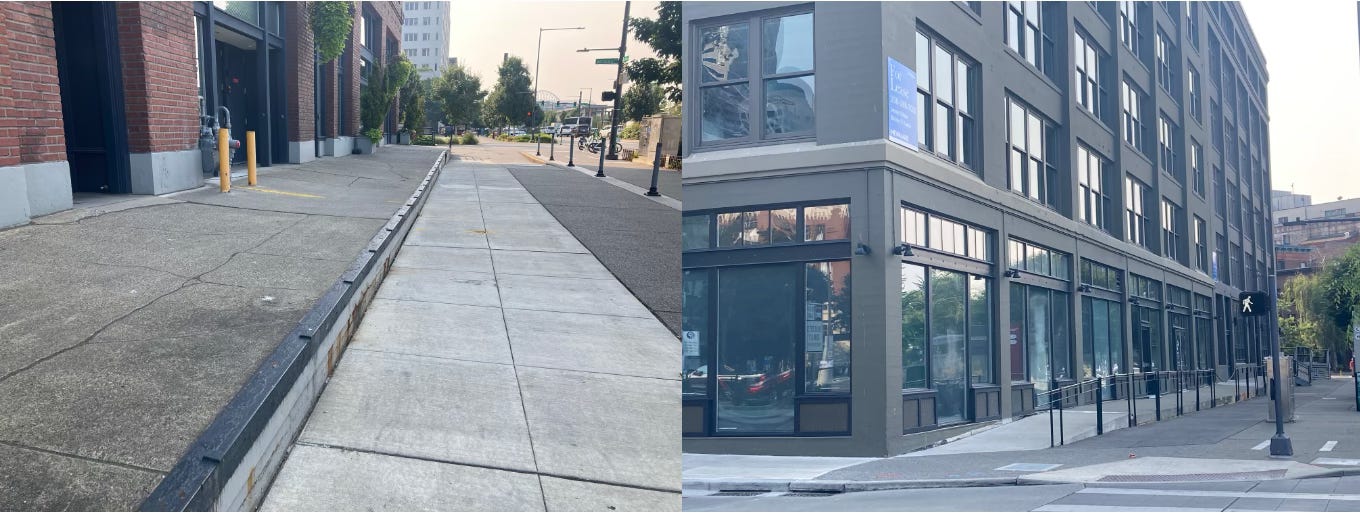
Ghost platforms - I learned of these from my friend Jennifer Ott, Executive Director of HistoryLink.org. Walking with me on Alaskan Way, she pointed out the raised platforms at the base of several buildings, mainly between S. Washington Street and Pike Street. All faced west on the east side of Alaskan Way.
Jen calls the platforms “ghosts of Seattle’s industrial past” from the era when what we now call Alaskan Way was Railroad Avenue. The short story is that Daniel Gilman and Thomas Burke were attempting to built a railroad to the east. Known as the Seattle Lake Short and Eastern, it went north on trestles built over the water along the Seattle shoreline, eventually going through Interbay and around the north ends of Lake Union and Lake Washington. (Of course, Seattleites know it now as the route of the Burke-Gilman Trail.)
After the SLS&E opened in 1887, other railroads followed their lead and built their own trestle-bound rail routes. Within a decade or so, nine train tracks paralleled the shoreline. They carried all manner of goods and dropped and obtained the loads over the water, at the many piers built west of the trestles, and on land, at warehouses that crowded the length of what became known, not surprisingly, as Railroad Avenue. To reach the train cars and facilitate easy loading and unloading, builders built elevated platforms along the lengths of their warehouses.
Quite a few of these warehouses remain, generally repurposed for something not remotely related to their historic use. But, the old ghosts of Seattle’s industrial past, the elevated platforms, remain. As Jen points out, there really isn’t any reason to demolish them. “I love how they are relicts that mark a past use, and they are being repurposed as time goes on,” she says.
Of Wood and Clams - Speaking of relicts, the other feature I want to highlight is the new railing built along the waterfront. I know that handrail is not always the most exciting subject, but I have to credit the designers of Seattle’s new Waterfront Park with making handrails interesting. The reason is simple; they repurposed old wood from Seattle’s previous seawall. The wood comes from a deciduous tree (Lophira alata) native to Central and West Africa and is known as azobé, ekki, or red ironwood. (Unfortunately, the species has long been exploited and is now threatened due to over- harvesting and habitat loss.)
I first noticed the handrails soon after the opening of the waterfront. In particular, I was near the new habitat beach at South Washington Street and Alaskan Way reading interpretive signs attached to the railing. What attracted my attention were the numerous holes and tunnels, ranging from about an eighth inch to half inch in diameter, in the wood. Most holes went straight into the wood, but some paralleled the grain in tunnel cross sections.
They looked to be the borings of Puget Sound’s most infamous marine menace: the shipworm (they are not a worm or even closely related) or teredo clam. Found in salt water, particularly in the middle latitudes of the north hemisphere, the ravenous mollusks begin life as free swimming larvae, land on wood, and burrow deeply. The longest individuals of our local species Bankia setacea can reach six feet long, topped by a shell less than an inch wide. Shaped a bit like a medieval, conical helmet, the shell drills into the wood, weakening it, and causing expensive and extensive damage to ships, piers, piles, and wharves.
The ekki planks used for the railings came from a 1986 project to protect the city’s original seawall. Richard Miller, former director of roadway structures for Seattle, told me that he chose the ekki because it was resistant to marine borers. “It grows in sandy delta areas and has very high silica content. Turns out marine borers don’t like to chew sand!” But he warned, they had to use heartwood and not sapwood, which was prone to shipworm damage. Miller’s team even paid a timber expert to fly to Denmark where the wood was being milled to check each board.
Apparently, not every piece was heartwood, and the teredos quickly figured this out and honeycombed the ekki. The clams were joined by another invertebrate marine borer, a relative of our local roly-polies, or potato bugs, pillbugs, and bibble bugs, as some call them. All our isopods; our marine species is the non-local Limnoria tripunctata, better known as a gribble. (Unknown when they arrived but they were reported in California around 1870 and in Washington in 1962.)
Interestingly, gribbles became the face, if you will, of Seattle seawall damage. For example, here’s a screen shot from a City of Seattle webpage on the Waterfront. Note, no mention of shipworms but they do appear to have correctly identified gribble damage. Their holes tend to be smaller and more densely packed together. Gribbles max out at about quarter inch long. My theory as to why the focus is on gribbles is that the word is a whole lot cuter and more fun to say than shipworm.
Shipworms and gribbles and elevated platforms. Each of these is a ghost of the past, a reference to early Seattle and its dependence on rail and sea traffic bringing and taking out goods. We now live in a world of trucks and cars and planes, and of instant gratification, where goods magically appear in stores and directly at our homes. I think that we tend to forget the interconnected world we inhabit, especially in Seattle where the maritime economy is still important. We cannot separate the story of those who live on land from the sea around us; we are all integrated. Perhaps those gribble- and shipworm-infested wood planks along the waterfront will help remind us of that connection.
Wow, it’s less than one month until In the Range of Fire and Ice will be out in stores. I am rather excited about this! A couple of things.
You can still pre-order the book through Phinney Books, which gets you a discount and my signature.
The book launch is September 3 at Third Place Books in Lake Forest Park. I’ll be in conversation with Lynda Mapes, so it’s bound to be fun. Registration info.
For the rest of the events, which range from Portland to the North Cascades, please go to my walk and talks page on my website.
Thanks to Nancy Treneman, Jim Carlton, and Melissa Frey for help with marine borer info and to Richard Miller for his insights into ekki wood and the seawall.