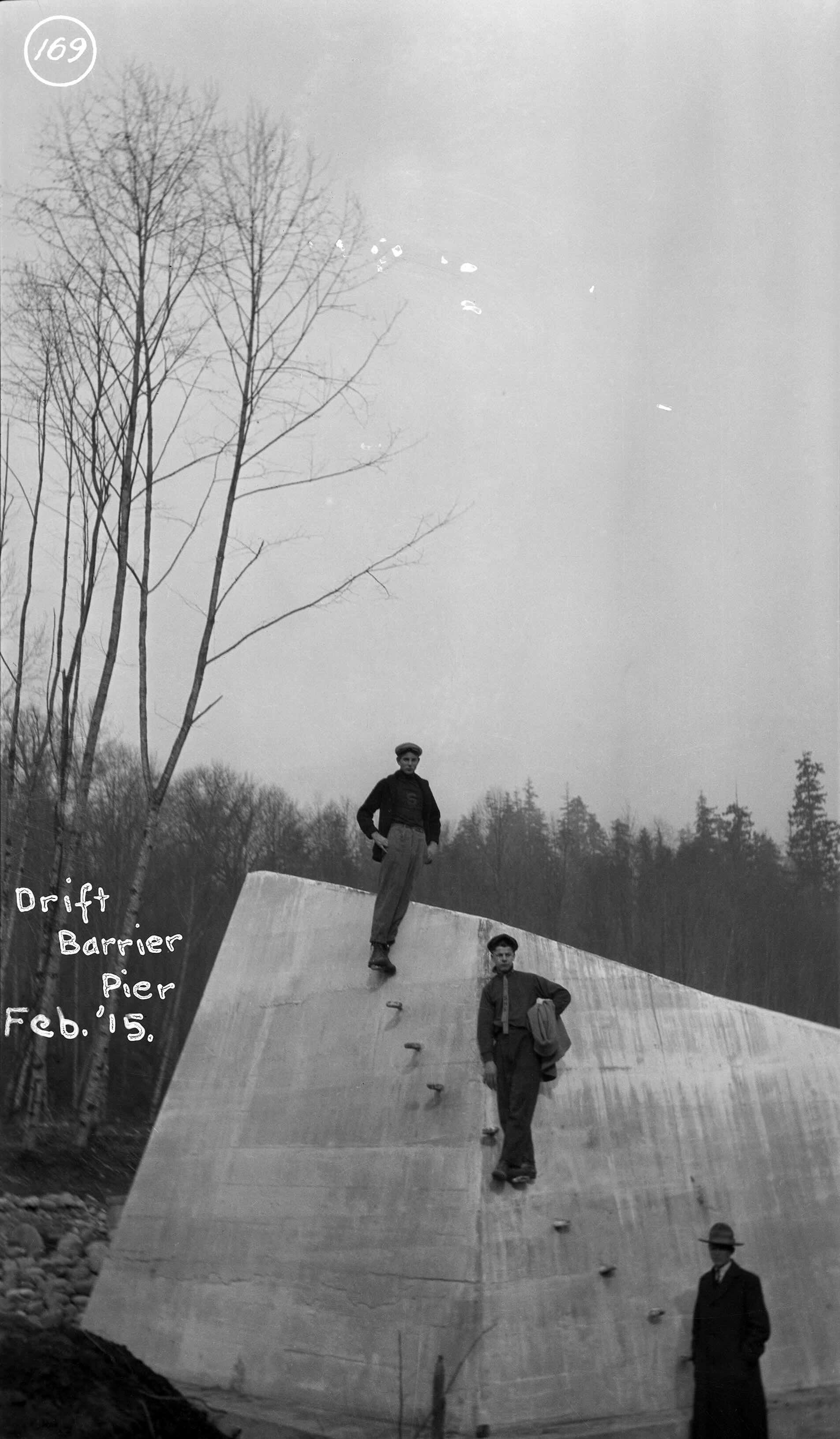
A poured concrete block the size of a Sprinter van is not something one normally finds in a river. Even less likely is finding an additional 21 such blocks strung across the length of a half mile wide flood plain. But such a location exists about four miles southeast of Auburn, Washington, on the White River. Not only do the massive piers, as they were described when built more than a century ago, litter the river valley, but many of them still retain remnants of the ten, one-inch steel cables strung between the blocks.
Known as the Drift Barrier of the White River, the concrete and steel fence was meant to subdue the river by catching woody debris carried by the current, particularly during flooding, which plagued settlers in the White/Duwamish River and Stuck/Puyallup River valleys. In the words of famed engineer, Hiram Chittenden, the river “being impossible of navigation, of little use for irrigation, and too near sea level for power…is thus more of a nuisance than anything else.” The solution to the White River’s unredeeming attributes was to artificially straitjacket the water, control the flow, and flush it through a sort of “storm water surface sewer…harmlessly to the sea,” concluded Chittenden, who knew a bit about controlling water as the designer of Seattle’s locks.
Primary to this plan was the Drift Barrier. It would catch both natural drift, such as trees that fell into the river, as well as logs and other material from the ever expanding logging operations upriver. In Chittenden’s words, drift “constitutes the gravest feature of the flood problem” not only by taking out bridges but also by creating log jams that changed the path of the river; if the drift wasn’t eliminated, it was “almost useless” to make any of the other proposed changes.
Construction of the Drift Barrier began in September 1914. After building a temporary road, workers excavated a 12 foot by 12 foot tunnel 79 feet deep, at the end of which they anchored the cables that would run between the blocks in an infrastructure of massive I-beams, wrought iron pipes, and two blocks of concrete, one 15-feet thick and one 10-feet thick.
The fence would consist of twenty six, diamond-shaped piers, 24 feet wide by 27 feet long and spaced 64 feet apart, center to center. Each pier had an angled top—sloping from 13 feet tall to 11 feet tall—and sat on a concrete foundation that extended an additional 3 to 7 1/2 feet down into the river sediment. Total weight of each pier, about 330 tons. Running between each pier were the steel cables, which would catch the drift. Workers connected the final cables in May 1915.
Visiting the Drift Barrier after the first big storms of 1915, in November and December, project chief engineer William J. Roberts wrote: “It is performing its duty exactly as expected.” The barrier was so successful that he submitted a summary report in 1920, which recommended that similar barriers should be built on other rivers. Within a few years, however, the tone had shifted. The barrier required extensive maintenance, at least five piers had been buried or sunk into the river sediment, floods had severed cables, and drift continued to build massive, unstable piles that required significant money and work to eliminate. By 1933, a new chief engineer was writing “the barrier has already been abandoned.”
I first visited the abandoned Drift Barrier in January 2026. I was lucky to go with Josh Latterell, an ecologist with King County. He had first come across the barriers about a decade ago. Josh had no clue as to why the blocks were there or what function they had though clearly, they had been built in place and clearly for a purpose. He eventually talked to more knowledgeable colleagues who provided some of the background story.
The first pier we found rose about three feet above the White River. (Intriguingly the river has changed sides completely; in 1915, water ran along the west bank and now the channel runs along the east bank.) Mostly submerged, it didn’t look so formidable, as opposed to another block on the river’s edge. When Josh gingerly climbed to the top, he stood about ten feet above me. Down at ground level I was eye level with several eye bolts as big as my hand and the old rusty one-inch steel cables that had formerly stopped woody debris.
Climbing through blackberries and around big logs and interlaced branches that forced careful stepping and diligent observation to avoid getting thwacked in the face, we located twenty-two piers, running in their original line across the valley. Most piers lacked connecting cables, but a few pairs of piers retained theirs. Softened by a jacket of moss, the strands of steel were still taut (see comment below) and embedded into the concrete.
To my twenty-first century mind, trying to fence in a river seems both arrogant and ecologically unsound, but I also understand why people such as Chittenden proposed it and know that it isn’t appropriate to apply my mindset to theirs. For as long as settlers had farmed the bottom lands along the White River, flooding had been a problem. It had destroyed bridges and train tracks; wiped out homes and farms; ripped out telegraph poles; and killed people and livestock. Understandably, residents wanted protection from the regular flooding and the unpredictability of the river. The engineers were simply trying to help and building the Drift Barrier was an obvious solution.
The White River, not surprisingly, did not cotton on to this solution. Like most rivers, the White was unstable, or more accurately, reactionary. When conditions changed, the river responded, constantly meandering and braiding across the flood plain, creating and destroying habitat, as well as the artificial barrier that we built in the hopes of controlling this dynamic ecosystem. It seems that if the Drift Barrier tells us anything, it is that a river does not want to be harnessed or straitjacketed. Rivers are alive and the more we understand this fundamental, the better we can treat rivers with the respect they deserve.
Tonight, May 14 - Barnes and Noble in the U-District - 5pm - I will be chatting with my co-author Jennifer Ott about our book Seattle’s Locks and Ship Canal: A History and Guide. Here’s info to register.
June 16, 2026 - 7pm - Third Place Books, Lake Forest Park - I will be chatting with Kevin Fedarko about his book A Walk in the Park. Here’s a link to register for this here event.
And, if you want to hear an interview with me about Operation Mother Goose, here it is. It ran on KUOW’s Soundside on Wednesday, May 13. Apparently, I am the historian on this subject; it helps that I think I am the only historian, as well.