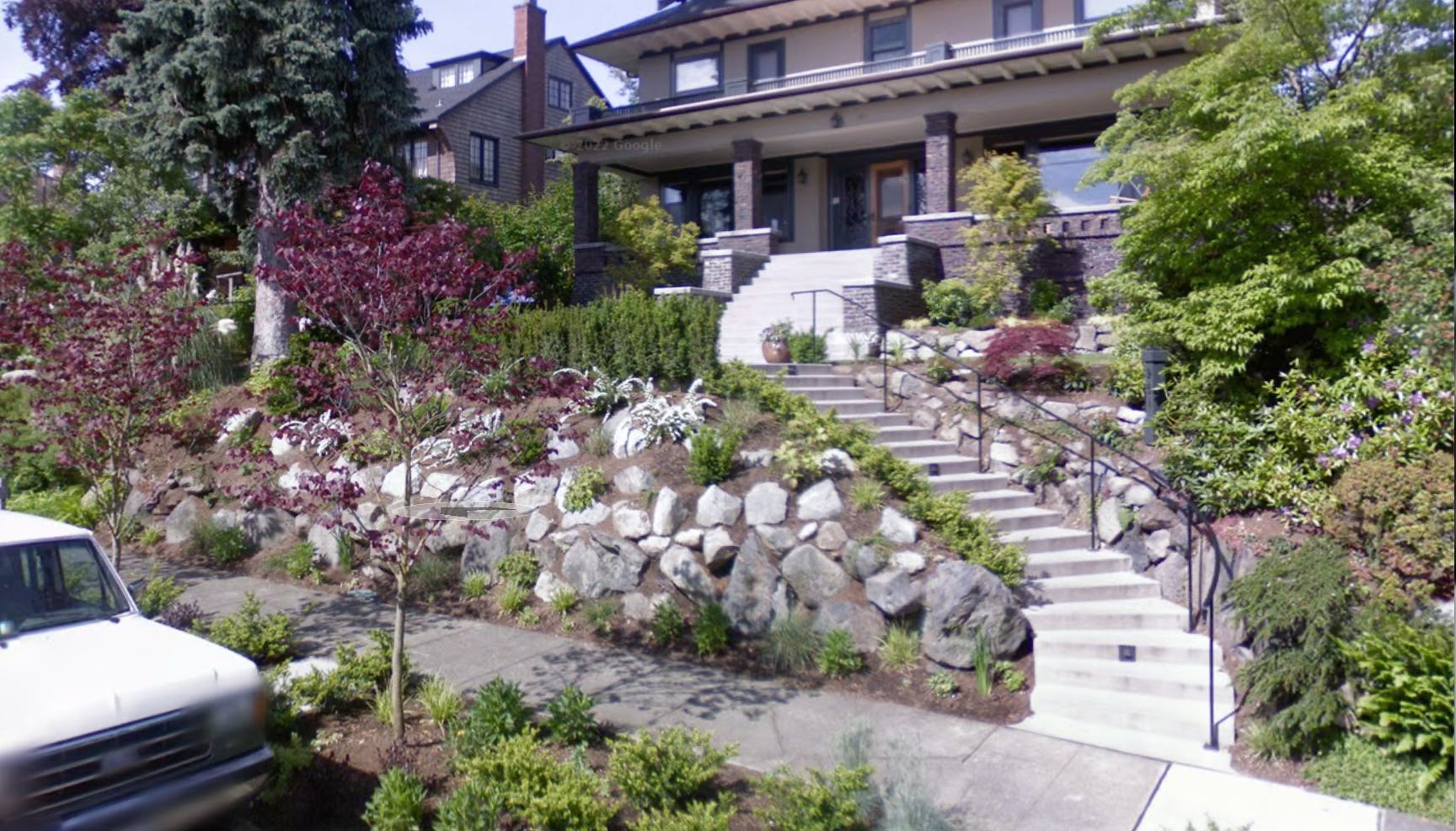
Often when I am out on a run, I like to go through alleys instead of sticking to streets. Mostly I do so to see new areas, plus, I always hope that I’ll see something fun or interesting in a backyard. I rarely do. But the other day, I had an epiphany about a topographic feature.
The alley where I ran had a short rise, whereas the streets to the north and south did not. While I cannot prove this, I think the reason why, is that it probably made sense when the streets were platted to regrade the street and not to alter the alley. Having a level spot in front of a house to park would generally be more important than backyard access, plus, having the house sitting above the street would make the house look more substantial. This seems logical to account for the many situations in Seattle where houses sit high above the street, often fronted by a rockery wall.
I think of these hyperlocal topographic changes as a “lower case r regrade (LCRR),” in contrast to an “upper case R Regrade,” such as the Denny, Jackson Street, and Dearborn Street Regrades. For the LCRRs, the original terrain would have roller-coastered along and development would have led to leveling the undulations. Given our glacially influenced landscape of ravines, ridges, hills, and dales, I suspect that developers were often faced with topographic issues that they felt a need to change. I know that that was the case in downtown Seattle where all of the streets are more level and less steep than they were back in the day. (It’s probably the case in many topographically-rich cities but I could be completely wrong so don’t want to make that claim.)
In case you wondered, Seattle’s first large scale, lower case r regrade began in July 1876. Contractor George Edwards and his crews used picks, shovels, and wheelbarrows to smooth out Front Street (because it was on the waterfront; it’s now First Avenue) and make it a gentle grade from James Street north to Pike Street. Edwards was awarded the project even though his bid was not the lowest; he bid $9,000 or $1,000 higher than Chinese contractor Quon Coon Lung. The reason was racism. For example, throughout the process, the Seattle Post-Intelligencer regularly printed racist rants, which I won’t repeat, condemning Chinese workers.
The city’s work plan required Edwards to create grades ranging from 4 to 7 percent, as Front Street rose from 12 feet to 107 feet above sea level. To keep back Elliott Bay, whose waters washed ashore just below Front, Edwards would have to build log cribbing up to 27 feet high along the western edge of the street. In mid-August, City Surveyor Phillip G. Eastwick estimated that the project would require 26,000 cubic yards of dirt. Excavations along Front Street would provide two thirds of the material, with the rest coming from cutting down, lower case r regrading, the side streets running east from Front.
Edwards employed up to 90 men and used 20 mules and horses. They made their deepest cut of 25 feet at Spring Street and their greatest fill, an addition of eight feet, between Marion and Madison. Their extensive cribbing along the shorefront used cedars harvested from the woods behind Belltown, then more or less a suburb of Seattle. They raised many houses on stilts—some up to 12 feet—which would eventually be supported by fill. Others were left high above the road, which required homeowners, such as Arthur Denny, to build what was described as a “prevent wall,” to prevent their houses from sliding.
To the editors of the P-I and Seattle’s other newspaper at the time, the Daily Pacific Tribune, street grading was essential to what came to be called the “Seattle Spirit,” the city’s striving, pick-itself-up-by-its-bootstraps, can-do attitude. An editorial in the Pacific Tribune noted that “any one with half an eye can see the good already accomplished ... [it is] stamping the growth and business of the city as the most enduring, desirable character.” Said the P-I, the grading “bespeaks enterprise; shows that we mean business; that we mean to stay here.” Just 25 years after its founding, Seattle was a city to reckon with. Nature be damned, if the topography blocked the pursuit of progress then it would be dealt with accordingly.
Once local leaders realized that they could tame the topography, they went at it with a passionate zeal. On Mill Street (now Yesler Way) workers made cuts of up to 20 feet as it climbed east and one block south on Washington Street, the men dug up stumps and burned huge logs to push that road further east. Within a few years, the city council passed ordinances for grading Second, Third, Fourth, Madison, Marion, and Commercial streets.
At present, no matter where you are in Seattle, I assume that the majority of streets were lower case r regraded in some way or another. We may think we live in a natural landscape and love our surrounding nature but sometimes we just gotta mess with it.
Word of the Week - Seattle Spirit - The earliest appearance in print I can find of this phrase comes from the Seattle Post-Intelligencer from July 23, 1884. It was used in reference (“quiet determination and earnestness…that augurs well for the future of Seattle”) to the need to build a railroad to reach new coal fields. In 1907, the P-I asked its readers to define the Seattle Spirit. The answers were rather spirited.