If you have been reading my newsletter for some time, you know that I have a deep and abiding love for Douglas firs. They have appeared as a subject many times, ranging from celebrating them in our backyard to describing their naming history to their use in dendrochronology for dating lahars on Mount Rainier. Well known and well regarded, Douglas firs are the quintessential tree of the Pacific Northwest. They grow from sea level to the subalpine zone and are some of the tallest, ginormousest (seems this should be word) trees on the planet.
Recently, though, I saw Douglas firs in an almost alien environment, one so un-PNW that the trees seemed that they shouldn’t be there. Yet, they were. And they are some of the older Douglas firs growing anywhere. The location even merits a less-than-likely place name, El Malpais National Monument, the bad lands. Located a few miles south of Interstate 40 in New Mexico, El Malpais showcases numerous lava flows younger than 60,000 years old. The youngest is just 3,900 years old; the one we visited erupted about 11,000 years ago.
Geologists refer to the flows as pāhoehoe and ‘a‘ā type rock. Both terms originated in Hawaii, the first in reference to ropy lava, often with browny-like texture, and the second to the sound one makes when walking across the ragged, jagged surface of ‘a‘ā. Fortunately, we were wearing rugged shoes, but I could still feel the sharp, craggy basalt through my soles.
I first heard that ancient Douglas firs grew at El Malpais about 30 years ago. I, of course, had to go see them. Fortunately, my wife worked for a summer camp located nearby so I had a good excuse to seek out the trees. Serendipity was on our side. We ran into two park rangers who gave us directions to the trees: “Cross 3 cattle guards, take the first left, drive 1/2 mile, walk about 25 minutes till the road and lava converge, look for a salt lick, head east from it until the horse head skeleton, then go north up the lava.”
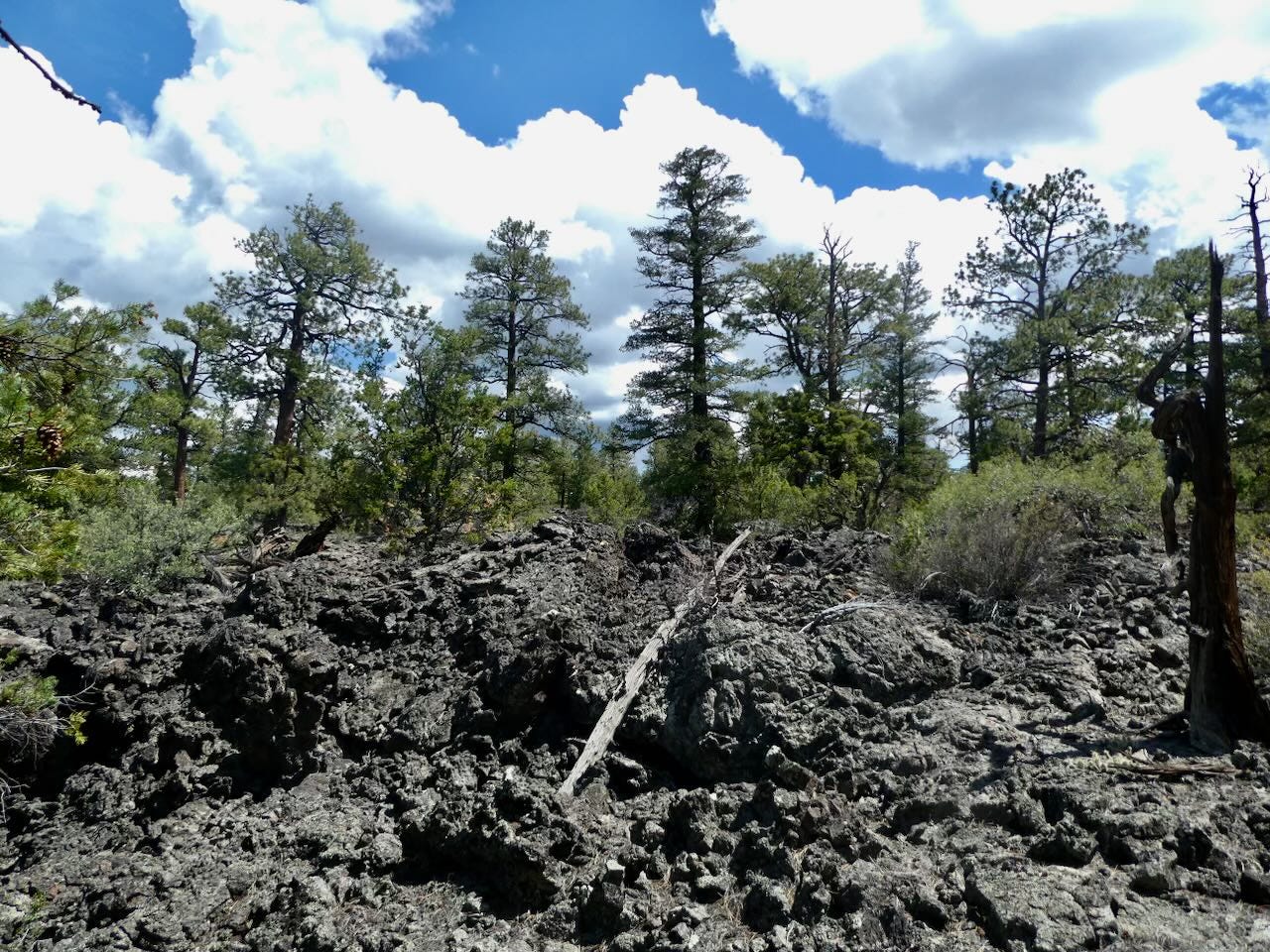
This time we had more specific directions, or actually a specific location: latitude and longitude. We drove as close as we could, parked by the side of the road under a ponderosa pine, and headed onto the basalt, about 200 yards from the car. The surface was classic pāhoehoe and ‘a‘ā, undulating over a mix of the brownie texture and jagged cobbles, boulders, and flows. Never was the route level for more than a few feet; we had to pay constant attention so as not to fall on the unforgiving rocks.
Atop the 40- to 50-foot-high flow were numerous trees: ponderosa pine, Rocky Mountain juniper, and Douglas fir. None were terribly tall; the 20-year-old Douglas fir in our front yard is as big as any tree we encountered. Dotting the surface were many downed trees, some with spiral trunks that looked as if an ancient giant had grabbed the tree in both hands and tried to squeeze out all the moisture.
Eventually we made it to the GPS coordinates I had been given by a researcher. The Douglas firs were tall and straight but still not very big. Many had cones and we also saw several young, or at least small trees; in this environment a tree with a two-inch diameter trunk could be a hundred years old. At one downed tree, we could get a hint of the density of life. Every tree ring was at most a millimeter wide, as if the tree only parsed out enough nutrients to eke out an existence, but what an existence.
In a 1997 report in the New Mexico Bureau of Mines and Mineral Resources, dendrochronologists described numerous Douglas firs with ages “in excess of 600 years,” as well as several over 700 and one 1,274 years old. They hypothesized that this wasn’t the lone tree born ten centuries ago. In addition, they dated the log of a Rocky Mountain juniper at 1,888 years old; it had germinated in 29 BCE and died in 1859. “We are confident that the malpais contains 2,000-year-old living juniper trees, and perhaps even older ones,” wrote the report’s authors.
Although the lava flows look alien and inhospitable to my PNW, temperate, rain-soaked eyes, clearly they are firvana for the firs, pines, and junipers. Or as the researchers say, the environment is protective not stressful. The jagged terrain reduces access to loggers, individual harvesters, and animals; the minimal ground cover inhibits the spread of fire; and the textured surface creates areas where moisture can accumulate.
I have no idea if we saw the 1,303 (1,274 plus 29 years since publication) year old Douglas fir but it was still glorious to be around the ancient trees of El Malpais. Using the tree rings to better understand climate variation, the dendrochronologists were able to reconstruct rainfall patterns covering more than 2,100 years. The trees revealed favorable climate conditions between 1024 and 1398, as well as two periods of drought. These dates correspond well with fundamental changes exhibited by ruins nearby. For example, in the middle 11th century, the great complex at Chaco Canyon (less than 100 miles north) peaked with an extensive road network that stretched for hundreds of miles. Then the first of the two droughts shown in the tree rings hit, causing Chaco to depopulate.
I like to think that some of those early inhabitants or visitors to Chaco passed near some of the trees we saw on our visit. Perhaps they were as intrigued as we were by trees growing on the lava flows. Maybe they even counted the rings on trees that lay on the ground and wondered about the great age of those who came before. Whether they did or didn’t, I find it hard to imagine that anyone who sees these Douglas firs is not amazed by their tenacity and thirst for life. Long live Douglas firs.
Always fun to be interviewed by my friend Feliks Banel for his weekly show Cascade of History. Not surprisingly, we chatted about my new book. Here’s a link.
Tonight is my much awaited, at least by me, book launch of In the Range of Fire and Ice. There’s still time to register and attend the talk tonight at Third Place Books, Lake Forest Park.