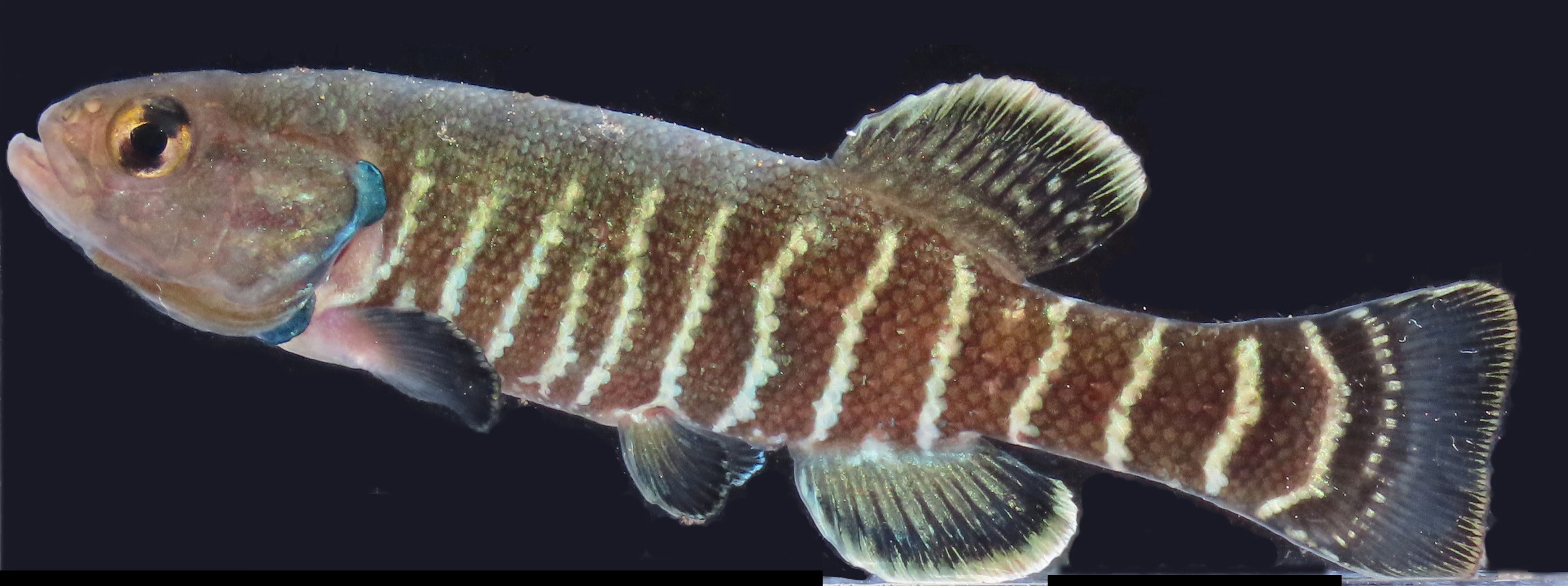
Over the past two weeks I have had the pleasure of visiting some less-than-favorable habitat. The first was a sort of pond under crackling power lines, the second a straightjacketed creek in the middle of a farmer’s field. Both times I was not alone; I was with scientists interested in fish, in particular, some of the most fascinating fish in Washington state. The pond is home to Olympic mudminnows and the creek to western river lampreys.
“My kayak is almost bigger than the pond,” said Lauren Kuehne, a freshwater ecologist with a deep passion for Olympic mudminnows. She had just paddled out in search of the little fish in what felt like an artificial accumulation of water, formed perhaps by the damming effect of the road where we stood. If Lauren had not directed me to this spot of cattails and cedar stumps, I wouldn’t have suspected that it was home to a unique fish; Olympic mudminnows are Washington’s only endemic freshwater fish, meaning they occur no place else in the world.
Sitting in her kayak, Lauren carried a small net, which she periodically dipped into the water under cattails and other aquatic plants. (The generic name of Olympic mudminnows, Novumbra, meaning new shadow, poetically refers to the species’ predilection for lurking in the dark under vegetation.) A few minutes into her search she found her quarry, which she netted and deposited into a white bucket. About an inch and half long, the narrow, brown mudminnows were dwarfed by a robust, six inch salamander. “I think we are in a nursery,” said Lauren, as she netted additional mudminnows, none longer than about two inches. Not that she expected to find any individual much bigger, mudminnows in our part of the world top out at about 4 1/4 inches. Over the next 45 minutes, Lauren continued to probe the vegetation, splitting her time between walking along the road and in her kayak.
Marginal, human-created habitat such as this little wet spot is classic for Olympic mudminnows. In fact, the first scientific discovery of the species was in a ditch. As one scientist has said: “If you pull up to a spot and it’s really a nice place to have a picnic or swim, that is not the place for mudminnows.” They are fish able to survive in ditches and less than ideal conditions. For many years, mudminnowologists thought that the fish didn’t coexist well with other species because they were often isolated. Turns out, however, that mudminnows are not loners, but can probably tolerate environmental conditions that other species can’t.
That they are able to survive in riparian/wetland areas that can preclude other fish makes them extra special and an important component of our local ecosystems. In particular, if they are the lone predator, they can play a role in community structure by preventing species such as biting midges and mosquitoes from becoming too prevalent.
Not only was our location the product of human activity, but the presence of mudminnows wasn’t natural either; early researchers proposed that the fish inhabited only a few drainages on the Olympic Peninsula. They are here, twenty miles east of Puget Sound, because a local landowner introduced them. This person also owns property on the Olympic Peninsula near a population of the fish, collected some, and deposited them here. “Apparently, he felt the world needed more mudminnows. He isn’t wrong,” said Lauren.
Whether one would call my second location a ditch or creek may be in the eye of the beholder. Winding for less than a mile, the yard-wide ribbon of dirty brown water flows in a slightly wider channel through tall grasses and past the occasional tree. For this piscine adventure, I was with Monica Blanchard, a biologist with Washington State Department of Fish and Wildlife, who is both knowledgeable and passionate about lampreys. Joining us were several county and non-profit employees who worked with the fish.
“I could talk all day about lampreys,” said Monica, when all of us were sitting in a classroom prior to our field time. Unfortunately, we had only three hours, but in that time, Monica made it clear that she loved every aspect of them. We learned that lampreys evolved 450 million years ago and have changed very little since then; that they lack bones and jaws; that two species live in the state, the bigger and far better known Pacific lamprey (Entosphenus tridentatus) and western river lampreys (Occidentis ayresii). Both species are born in freshwater, migrate to salt water, and return to freshwater for spawning and death, though western rivers can also leave their birth stream and travel only to a lake (such is the case in Lake Washington), as well as never leave their birth stream. Monica also added: “Never say anything definitive about lampreys. The next day they’ll surprise you.”
After our class session we headed to the ditch, where Monica pulled out a curious backpack. It looked like a 1970s RadioShack kit with knobs, red lights, levers, and warning sign but was actually an ETS Electrofishing Systems ADP-2 electrofisher. Using two paddles attached to the ADP-2 Monica’s plan was to run enough electricity into the water to “tickle” out the lampreys. “We just want them to feel it and be annoyed enough to emerge,” she said. Within a few minutes, Monica had annoyed several. All were western river lamprey larva, brown, eyeless, and less than five inches long. Once again,I would never have seen them without a friendly biologist, Monica.
As with the mudminnows, I had no idea that such a relatively mundane looking body of water contained such a wonderful animal. I shouldn’t have been surprised. After all, I have regularly observed plants and animals inhabiting places we often overlook—the paving stones of our backyard, utility poles, and empty lots—and I am by no means very knowledgeable. It’s when I go out in the field with ecologists that my little mind is blown open by the complexity, diversity, and beauty of the more than human species we co-exist with. I worry though that far too often we take such places and their inhabitants for granted; we tend not to honor these ecosystems for their biodiversity or to recognize the ecosystem contributions of their resident plants and animals. As I regularly state, I hope all of us can take the time to slow down, pay attention, and enjoy the world around us. It really is quite wonderful.
N.B. - In case you are interested, my plan is to return to fuller discussions of Olympic mudminnows and lampreys. Stay tuned.
Thanks to Lauren and Monica and Jeff Jensen for help with this newsletter.
June 16, 2026 - 7pm - Third Place Books, Lake Forest Park - I will be chatting with Kevin Fedarko about his book A Walk in the Park. Here’s a link to register for this here event.
Word of the week - Lamprey - A name that dates back to 1297 and is believed to derive deep in its past from lampetra, which comes from the Latinlambĕre to lick and petra stone, in allusion to the fact that the lamprey attaches itself by a sucker to stones. Some wordsmiths though question this origin, claiming that lampetra “may be merely an etymologizing perversion,” or so opines the OED.