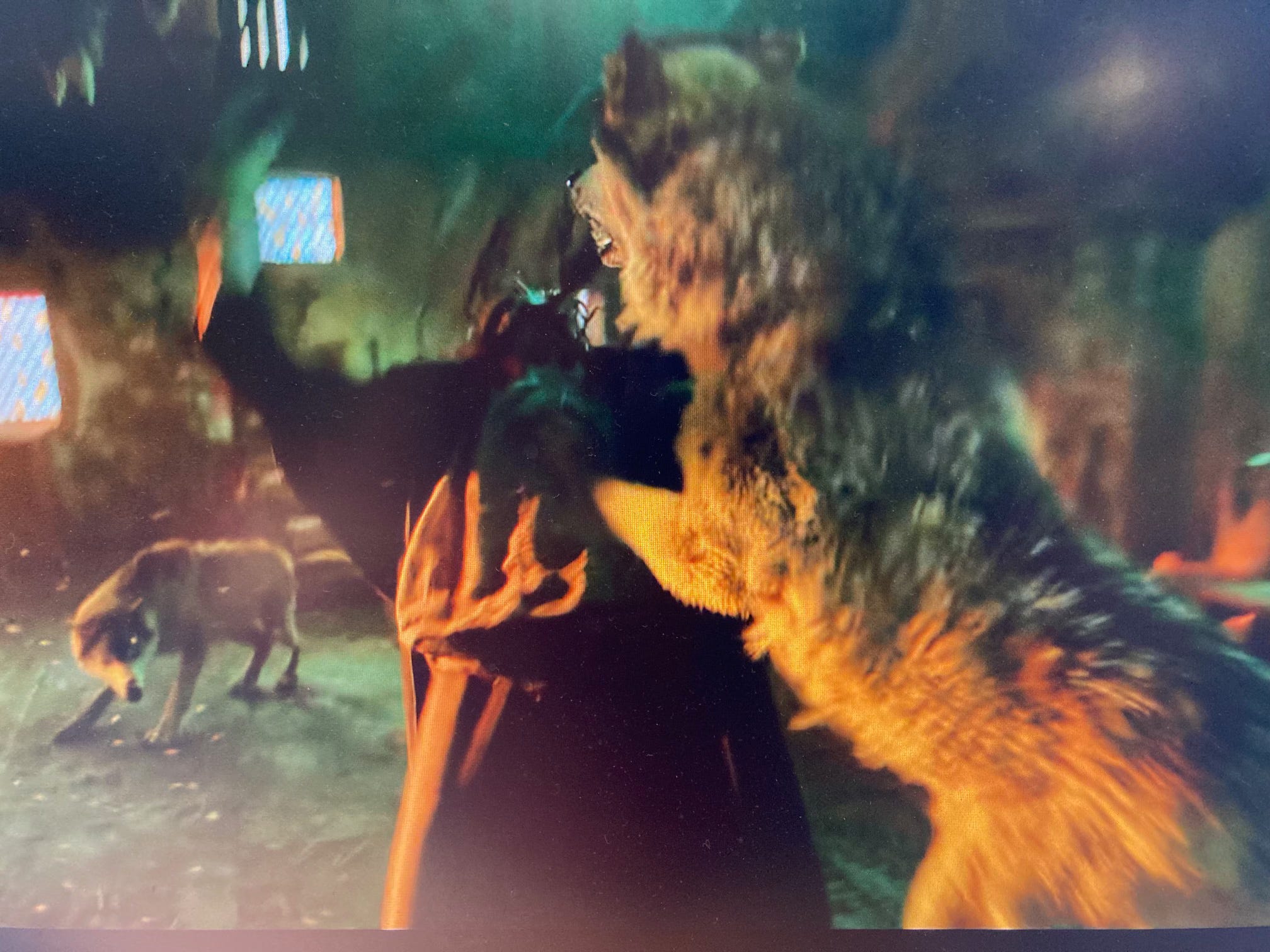
We recently watched Guillermo del Toro’s new film of Frankenstein. Many critics have noted that the movie hews more faithfully to Mary Shelley’s novel than most previous films and that del Toro humanizes the monster in a way seldom seen. Unfortunately, del Toro takes the opposite tack with wolves, which are merely a fantasy of the director as wolves do not appear in the book. In fact, del Toro seems to have gone out his way to paint an unfavorable portrait of wolves.
In the novel, one of the more beautiful parts is how the monster connects with an elderly blind man. “From your lips first have I heard the voice of kindness directed toward me; I shall forever be grateful; and your present humanity assures me of success with those friends who I am on the path of meeting.” Tragically, soon after the monster says these words to the blind man, his family arrives, sees the monster, attacks him, and drives him, and his faith in humanity, away.
In the movie (spoiler alert), we have a similar scene of connection and bonding between the old man and the monster. But del Toro adds an irrelevant and violent scene of wolves (clearly CGI) aggressively attacking the family’s farm and sheep, followed eventually by the wolves attacking the old man. The scenes are gruesome and gratuitous, as well as an unnecessary perpetuation of the long term and false image of wolves as depraved and wanton killers.
No other animal stirs the human imagination like wolves, whether anxiety or excitement, love or loathing, respect or revulsion. In the last several decades, though, as researchers have helped clarify past misunderstandings, wolves have generally risen positively in our collective conscious. But, as Adam Weymouth makes clear in his thoughtful new book Lone Wolf: Walking the Line Between Civilization and Wildness, that new image is being tested as wolves have begun to repopulate areas where they had been extirpated.
This is especially true where Frankenstein takes place; Weymouth writes that Europe’s present wolf population is “north of 21,500” or more than there are in the United States (including Alaska). While following the footsteps of a lone wolf that walked 1,200 miles from Slovenia to Italy, Weymouth has several encounters with farmers who have no compunction to killing any wolf they see, as well as with people who treasure the wolves’ return.
By his ugly portrayal of wolves, del Toro adds nothing to our understanding and sympathy for the monster; it is humanity that is the monster’s judge and jury, and which drives him to his violent actions, not wolves. Surely, del Toro could have taken a more enlightened approach, and simply followed Mary Shelley’s original text.
In contrast to del Toro’s depiction, consider what wolves have been accomplishing in Bella Bella, Haíɫzaqv Territory, in present-day British Columbia. An invasion of European green crabs, which were damaging the coastal ecosystem, led to researchers setting out underwater traps consisting of a rigid frame enclosed by netting and connected to land by a rope. Two years after they placed the traps, researchers noticed that something or someone was damaging the traps.
To determine what was happening, the researchers set up cameras in May 2024. Within 24 hours, the camera recorded a female wolf emerging from the water pulling the rope attached to the trap up to the beach. She soon had pulled the trap, rope, and buoy onshore, where she ripped open the net to obtain her lunch. In the article reporting this novel act, ecologists Kyle Artelle and Paul Paquet write “this sequence appears to demonstrate a sophisticated understanding of the multi-step connection between the floating buoy and the bait within the out-of-sight trap.” Although some scientists question such behavior and whether it indicates intent and/or intelligence, Artelle and Paquet believe that the wolf’s actions suggested intent and understanding of what she was doing and what her reward would be. In other words, the wolf was using a tool to obtain food.
In addition, the pair pose a question as to whether a lack of human persecution allowed the wolves to “develop confidence and devote time to exploring novel behaviors.” We know that wolves are problem solvers and that they learn from and teach each other; perhaps, if we meddled less and paid more attention, we’d see similar types of behavior in more situations. They further add that the “cognitive significance seemingly exhibited here” raises “ethical considerations” that can counter the negative perceptions of wolves. It’s too bad that Artelle’s and Paquet’s research won’t get the publicity that del Toro got with Frankenstein.
Like Mary Shelley’s monster, particularly the image best known through movies, the wolf is a creature created by humans, more fable than reality, more endowed with our feelings than with our understanding, more a product of what we fear than what we know. Unlike the monster, wolves are real and their persecution through the age has been horrible. Let’s hope that Artelle and Paquet are correct, and that when we see actions like a wolf using tools it’s just one of many many reasons that we should respect and admire these beautiful animals instead of persecute them.
Wow, I was rather excited and pleased that librarians at the King County Library System (scroll down to bottom) named Wild in Seattle one of their favorite books of 2025.
Here’s the link to “Potential Tool Use by Wolves (Canis lupus): Crab Trap Pulling in Haíɫzaqv Nation Territory,” by Kyle A. Artelle and Paul C. Paquet, in Ecology and Evolution 15, no. 11, November 2025, e72348.