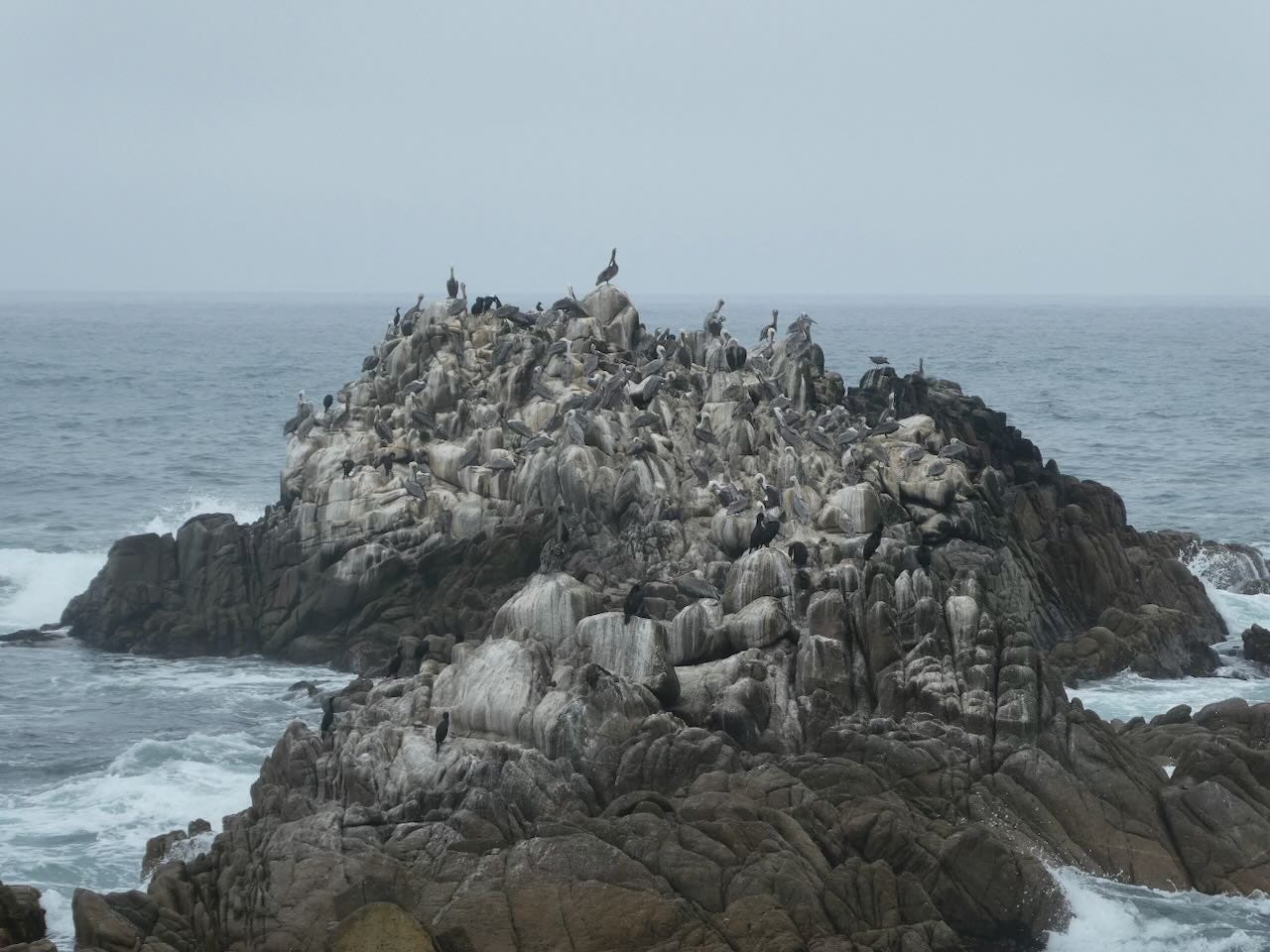
Marjorie reminded me that I hadn’t written about poop in a while. Sadly, that is correct, so I thought I’d remedy the situation. Her comment came when we were walking along an ocean beach and observed a small outcrop of rock covered in generations of deposits by the residents. In this case, the producers were primarily Brown Pelicans and Brandt’s Cormorants though I suspect that various species of gulls and perhaps a crow or two also contributed to the whitewashing of the islet.
I have seen and smelled (particularly below the visitor center at Cape Disappointment where the aroma of fishy poop is quite spectacular), similar guanoified rocks on many, if not, most coasts I have visited. Sometimes the splatters cover rocks such as I saw—merely a simple pimple of land—but at other times, the poop covers islands big enough to merit a name. Perhaps the most common, officially recognized moniker for these seabird-poop-covered locations is Bird Island. The name can refer to the nesters and/or to their coprogenic products, but I have come across other modifiers, or middle names if you will, between the first name and surname. I am sure that you can imagine the terminology and will not belabor the point.
By the way, cairns are another location preferred by birds as landing and depositing points. Birds may rest, preen themselves, stand and scan the terrain, or dine. When birds consistently perch on a cairn, their depositional habits can also have a quite cheery effect on the landscape. Droppings add nutrients that several species of ornithocoprophilous, or bird-dung loving, lichen exploit. The elegant sunburst lichen (Xanthoria elegans), a name derived from their resplendent yellow and orange coloring, is often encountered on cairns at higher elevations and higher latitudes. When you see this sunny patch of color on a cairn, you can feel confident that some bird, or some mammal, such as a marmot or pika, spent some quality time high above his or her surroundings.
I have not read of ornithocoprophilous lichens exploiting bird poop on oceanic rocks but do know of another species that relishes said guano. That species is Homo sapiens, and we have sought out these deposits for thousands of years. Like lichens, we wanted the nutrients, in particular nitrogen to use as a fertilizer. In contrast to humans, who produce water-soluble urea that we pee out to eliminate excess nitrogen, birds produce uric acid, which is insoluble and mixed with feces to generate the white paste found on the rocks I saw.
Few groups of birds are better at creating Bird Islands than cormorants and pelicans. Both birds, of which there are quite a few species, are colonial, gregarious, and piscivorous, a trifecta of attributes that results in them nesting and resting together, sometimes in great quantities, and often generation after generation. As a result, they have created guano sites long utilized by people.
Not surprisingly, our species’ penchant for poop has had significant negative consequences, ecologically and politically. In 2024, Mauricio Betancourt, an environmental sociologist, published a paper titled “Guano and the Rise of the American Empire.” His aim was to “expand on ecological imperialism theory by showing the centrality of guano for the origin and development of the U.S. empire.” Right now, we are in a rising tide of crap, so it seems fitting to discuss the connections between s**t and the United States.
Dr. Betancourt’s focus is the guano on Peru’s Chincha Islands. Some of the best and largest in the world, the islands’ deposits totaled 15 million tons, about as much feces as modern residents of New York city would produce in 37 years. Beginning in 1845, the US started to exploit the poop. Over the next decade “guano mania,” and guano, spread across the country, particularly in states planting tobacco and cotton. In that ten year period, the US imported twice as much guano as coffee and five times more than tea.
So valuable was the white gold that President Franklin Pierce signed the Guano Islands Act in August 1856. The GIA eventually led to the US claiming about 70 islands, mostly in the Pacific Ocean. Still on the books, the law states that “if a U.S. citizen finds guano on a territory not within the jurisdiction of another nation and claims it, it may be considered U.S. soil.” As the demand for guano heated up, it led to warfare, labor exploitation, and abuse of power. (I know, gentle reader, that you are shocked by this.) Extraction also destroyed habitat for birds, prevented uncountable numbers of birds from nesting, removed an important nesting material, and led to the “wanton killing” of birds.
Similar to birds, our species eventually figured out a way to produce tidy packets of nitrogen and we no longer rely on guano. Unfortunately, we now produce so much excess nitrogen that it is causing new environmental problems. But back to the poop. Now that we no longer value the white gold, these guano islands are the domains of birds, who can live their lives and defecate in peace, and naturalists and birders, who can admire the birds. Long may they poop.
Word of the week - Guano - Originally from Quecha huanu, which referred to any form of manure used as agricultural fertilizer. Guano first appeared in English in The Naturall and Morall Historie of the East and West Indies (1604), by Joseph Acosta, Translated by E.G. He wrote in reference to islands off of Peru: “And this dung is so commodious and profitable as it makes the earth yeelde great aboundance of fruite. They cal this dung Guano….”
There are still tickets left for my talk tonight in Edmonds. I will be in conversation with journalist Teresa Wippel at 6:30 PM at the Edmonds Waterfront Center.