On September 2, 1834, naturalist John Kirk Townsend camped near the Umatilla River in eastern Oregon. Joining him were the fellow members of an exploring expedition lead by Nathaniel Wyeth, including the botanist Thomas Nuttall and Joseph Thing, a Boston sea captain, hired to help navigate. Traveling in the arid landscape had been trying. The previous day the men had had no water until nine o’clock at night and on the second, Townsend’s food consisted of rose buds he had found above their camp. Nuttall and Thing, however, had had a more substantial meal.
When Townsend returned from eating the rose buds, he “was surprised to find Mr. N. and Captain T. picking the last bones of a bird which they had cooked,” he wrote in his narrative of the trip. Probing his well-fed companions, Townsend learned that they had just eaten an owl he had killed in the morning. He had planned to preserve it for science but hunger won out and “the bird of wisdom lost the immortality which he might otherwise have acquired,” wrote Townsend. Oops!
(Townsend wrote no further about this owl and we have no information about what it was. People speculate that it must have been a big species, such as a Great Horned Owl, but, as we know, in times of desperation, hunger drives people to extremes, thus, maybe the aviphagic fellows consumed a species as small as a Northern Pygmy Owl. In a subsequent report, Townsend wrote that he had found both of these species, as well as Screech, Snowy, Great Gray, Short-eared, Long-eared, Burrowing, and Boreal owls.)
Perhaps Townsend shouldn’t have been surprised by Nuttall. Although he was a legendary botanist, Nuttall was also a bit scatterbrained. French trappers dubbed him “le fou” for his single-minded devotion to plant collecting, which tended to result in him getting lost. Nuttall was also forever infamous for his dirt-clogged rifle, which he had used as a digging tool, lending new meaning to the phrase “turn guns into plowshares.” Whether the consumption of Townsend’s owl was accidental or purposeful, we do know that Nuttall shared an affinity with Townsend for rose buds, most likely from Crataegus douglasii. Nuttall wrote in as subsequent paper that “every accession of fruit, however meagre, was hailed with delight by our famished party, and the ripe berries of this fine Hawthorn were collected with avidity.”
Nuttall and Thing weren’t the only members of the Wyeth expedition to thwart Townsend’s plans. A couple of weeks later, the expedition’s tailor, Thornburg (no first name exists) had discovered the whiskey that Townsend used to preserve his herpetological specimens. He later wrote in a letter on September 9, 1835: “Almost as bad as ‘tapping the Admiral,’ …the sneaking dogs did not tell me of it for some months afterwards, so that when I looked at the bottles, the lizards, salamanders, and serpents had united into a filthy heap…and I was compelled to toss the whole into the river.” (In this letter, written to Samuel G. Morton and held at the American Philosophical Library, Townsend also refers to stealing sculls and bones from Clickitat and Chinook graves. For more information about Townsend’s racism and grave robbing, here is the story by Matthew Halley.)
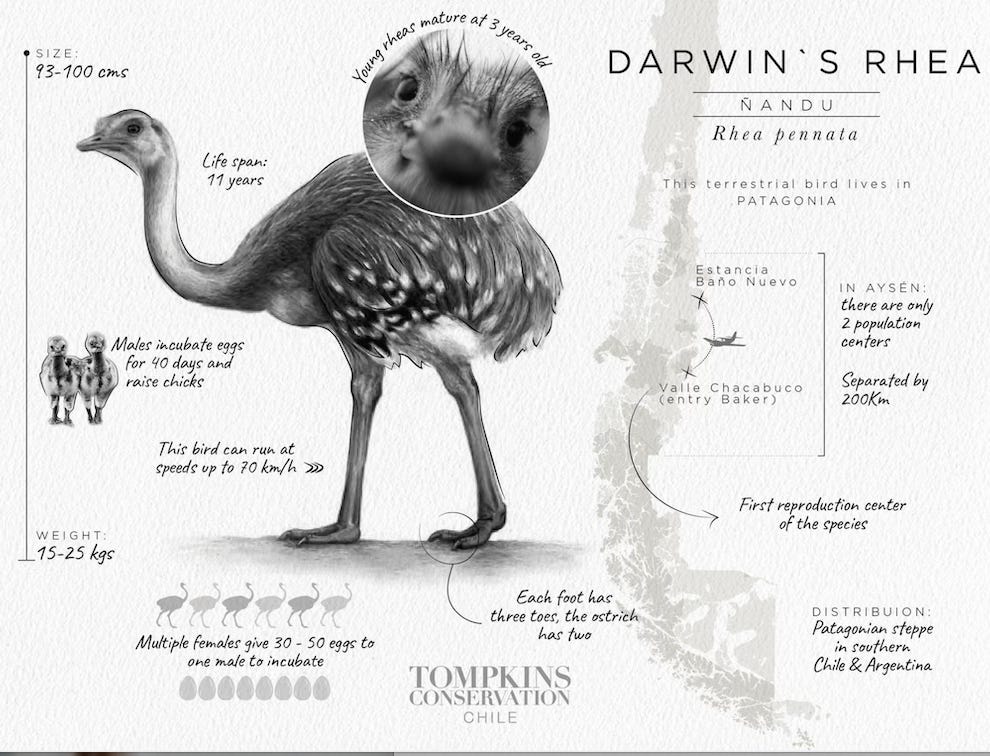
About eight months prior to Townsend’s loss of his owl specimen, a young and little known naturalist in Patagonia, also took advantage of food in the pot. But this time, he did so to preserve the specimen. Throughout his time on the HMS Beagle, Charles Darwin was always on the lookout for interesting plants, animals, and rocks. In particular, he was interested in a bird that writer Lyanda Lynn Haupt characterized as the “largest bird on earth that had not officially been described in the scientific literature.”
Now known as the Lesser Rhea (Rhea pennata), the ostrich-like birds had stirred Darwin’s interests in July 1833. His local guides had described a bird they called Avestrus Petise, in reference to them being smaller than the more common, Greater Rhea. Six months later, while sharing a stew with the Beagle’s officers, Darwin realized that he was looking at the bird he sought. He immediately grabbed what he could—”Head neck legs, one wing & many of the larger feathers”—from the soup pot and trash bin. Darwin eventually took the parts to London where they ended up on display at the Museum of the Zoological Society. “Mr. Gould, who in describing this new species, has done me the honor of calling it after my name,” the tickled young naturalist wrote.
In contrast to Nuttall’s and Thing’s hunger and Darwin’s quest for a unique specimen, John James Audubon seems to have simply relished eating the birds he shot. Describing what is now known (but not for much longer) as Audubon’s Shearwater, he wrote on July 26, 1826, that after four birds had been shot, he ate one: “on tasting it, as is my practice, I found it to resemble that of the porpoises.” He also ate Ruddy Duck (“good eating”), Surf Scoter (“scarcely fit for food”), American Robin (“fat and juicy”), Belted Kingfisher (“disagreeable”), Pileated Woodpecker (“extremely unpalatable”), and Snowy Owl (“very much resembling that of a chicken and not indelicate eating”), as well as many other species. As one bird historian wrote, Audubon probably ate more bird species than anyone, ever.
Finally, there’s the story of Mutton, a dog who, in 1859 ate the head off a mountain goat specimen that had been given to naturalist and ethnographer George Gibbs by another naturalist, Dr. Caleb Kennerly. In response, “Mutton was sheared a short time ago, & as soon as his hair grows out we will make a specimen of him,” wrote Kennerly to the Smithsonian’s Spencer Baird. Kennerly followed through on his promise and Mutton’s remains are now preserved at the Smithsonian. At least he got some immortality, as well as a good meal.
Word of the week - “Tapping the Admiral” – The phrase means to take a small quantity of a drink, often on the sly. Legendarily and apocryphally, it comes from soldiers skimming rum or brandy (I have seen both mentioned) from a cask used to preserve Admiral Nelson’s body, after he died in the Battle of Trafalgar in 1805.