Many years ago, I started a book project about stories buried in Seattle. One of my favorites was the discovery during excavation for Light Rail of Yiddish newspapers, broken ceramics, and other artifacts 40 feet underground. That project eventually morphed into my book Too High and Too Steep, but one part of the story continued to intrigue me: what lies beneath the surface of Lake Union. Last week, I finally had the opportunity to pursue that subject again, when I tagged along with a team that is documenting boats of all sizes and types—canoes to barge, wood and steel craft, advertently and accidentally sunk—that have found their final resting place on the bottom of the lake.
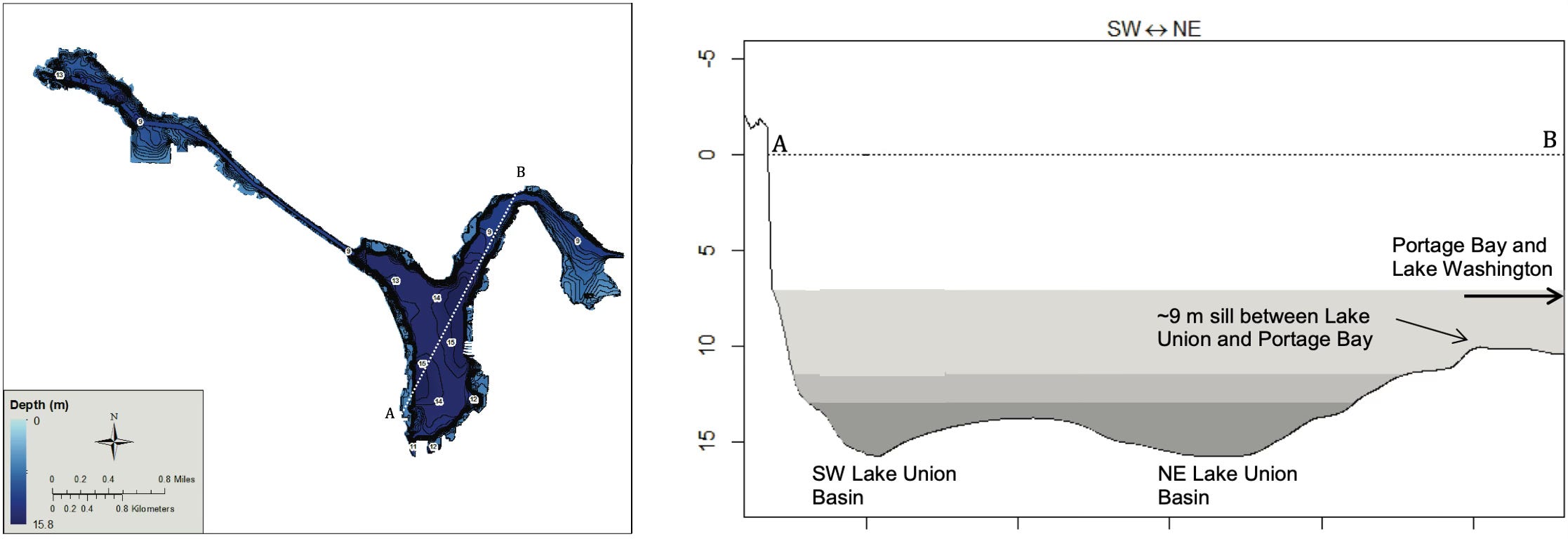
Before diving into the subject, I need to make a quick geology interlude. Lake Union formed during the retreat of the great glacier that covered this region—the Puget lobe of the Cordilleran Ice Sheet—around 16,000 years ago. As the ice retreated back to the north, a chunk broke off, settled in a depression between two ridges, melted, and formed a lake. With its steep sides, which curve down to a maximum depth of about 50 feet, Lake Union has a bowl-shaped profile.
Our day began at 7am on the east side of Lake Union. Four of us, Phil Parisi (project lead of shipwreckcity.org), Libbie Barnes (curator of exhibits and engagement at MOHAI), George Spano (boat owner and maritime aficionado), and I piled into George’s little boat. It had just enough room for the four of us and gear. The plan was to go out to known sites of submerged objects and drop a remotely operated underwater vehicle, or ROV, into the water and pilot it down to see what was there. For equipment, we had Phil’s laptop and his BlueRobotics BlueROV2, equipped with sidescan sonar and a GoPro camera.
After we reached our first spot, LU025, located under the Aurora Bridge, Phil and George dropped (literally) the ROV, which was attached to a yellow tether, into the water. Phil and Libbie then got under a dark blanket (too bright otherwise) to observe realtime footage from the GoPro on Phil’s computer screen. With the GoPro acting as his underwater eyes, Phil used an Xbox controller to take the ROV down to what had been described previously as a pile of logs. “Yes, it’s a log,” said Phil, when Finn, as he calls the ROV, was nearing the bottom, 45 feet down. George and I kept watch for anyone, such as rowers, pleasure boaters, and tugs, who might hit us or get entangled in the tether, which floated on the surface.
Phil found nothing else beyond the logs, which could have come from one of the many log booms that had been moved across the lake to mills in Ballard in the late 1800s and early 1900s. He wasn’t surprised as others had been down to this location but he wanted up-to-date footage, which was one of the goals of the project.
People have long known of and even visited some of the wrecks and other submerged materials in Lake Union. These include DCS Films (Dan Warter, Carl Stieglitz, and Scott Caldwell) and the Maritime Documentation Society and Coastal Sensing Survey. Via divers and sidescan sonar, which is an acoustic imaging method that creates detailed images of the seafloor and objects resting on it, they have produced maps, photos, and videos of what sits on the bottom of Lake Union. Phil’s plan has been to synthesize that data and generate underwater footage of every object.
“Our goal is to create an underwater archive of Lake Union,” says Phil. Like others, me included, he knows that there are many stories hidden beneath the surface, which add additional layers to the maritime connections that have long been important to the residents of this place. As he notes on his website, people have been using these waters for thousands of years to fish and to travel. In a landscape of challenging topography, water would have been the logical means of getting around, a fact that many present day residents also realize. Unfortunately, any sunken Indigenous canoes would have succumbed in the depths long ago.
Non-Native residents have been using the water since they first arrived around 1851 but not until the 1870s did steamships begin to move across Lake Union. The first was the side-wheeler Clara, piloted by Curtis Brownfield to transport coal for the Seattle Coal and Transportation Company. (Lewis and Dryden’s Marine History of the Pacific Northwest, pg. 161 & 192). That company also operated what may be the first vessel to be abandoned in the lake, the large, steam-powered ferryboat Lena C. Gray. In 1878, when the SC&TC failed, the Lena was stripped of her iron. “Her days of usefulness are ended, and she will be allowed to decay at the landing,” wrote an unnamed reporter for the Puget Sound Dispatch. (If this wreck exists, it’s probably buried under fill, as Lake Union used to extend farther south.)
Over the next several hours, we motored to another 11 locations, six of which had wrecks in various states of mouldering. All were made of wood often with some metal ribbing for support and strengthening. We also saw 50-gallon drums, tires, red Solo cups, a sort of fence-like structure, pilings, and a fiberglass boat. We saw only one identified boat, the Kahlenberg, a 50-foot long wooden ship built in 1913 and sunk or abandoned at unknown time. This was my favorite wreck primarily because Phil let me control the ROV; it was quite stunning to drive Finn through the hazy pea green water and suddenly come upon the bow of a ship, 45 feet underwater, an eerie testimonial to a past life.
At present, Phil and his team list 105 known lakebed targets. About 70 are wrecks of some sort of vessel including barges, cabin cruisers, landing craft, and ships. Most of them were probably abandoned or scuttled; it’s a lot easier to simply abandon a ship than pay the disposal fees. Because no official record of wreckage exists, researchers have found very little documentation about any of them. As the team continues to search, more shipwrecks will probably be found. Phil’s goal is to get a better picture, literally and figuratively, of what lies beneath.
I, of course, applaud his and his team’s work to preserve the past. Like every aspect of the city, Lake Union is an evolving landscape where new generations of visitors and residents alter the lake and adapt to it and those who live and work around it. By unearthing (unwatering?) the past, not only can we better understand how those stories continue to shape Lake Union and us, but we can also begin, as Phil puts it, to think about preservation, pollution, and our shared responsibility to care for urban waterways.
If you are interested in helping fund the work of Phil and his team at shipwreckcity.org, here’s a link to do so.
I am tickled to announce that Wild in Seattle was awarded a Gold Medal by Foreword Indies in their Regional category. Thanks to Elizabeth Person for her wonderful drawings, which bring the book to life, and to Mountaineers Books for their support, editing, and design.