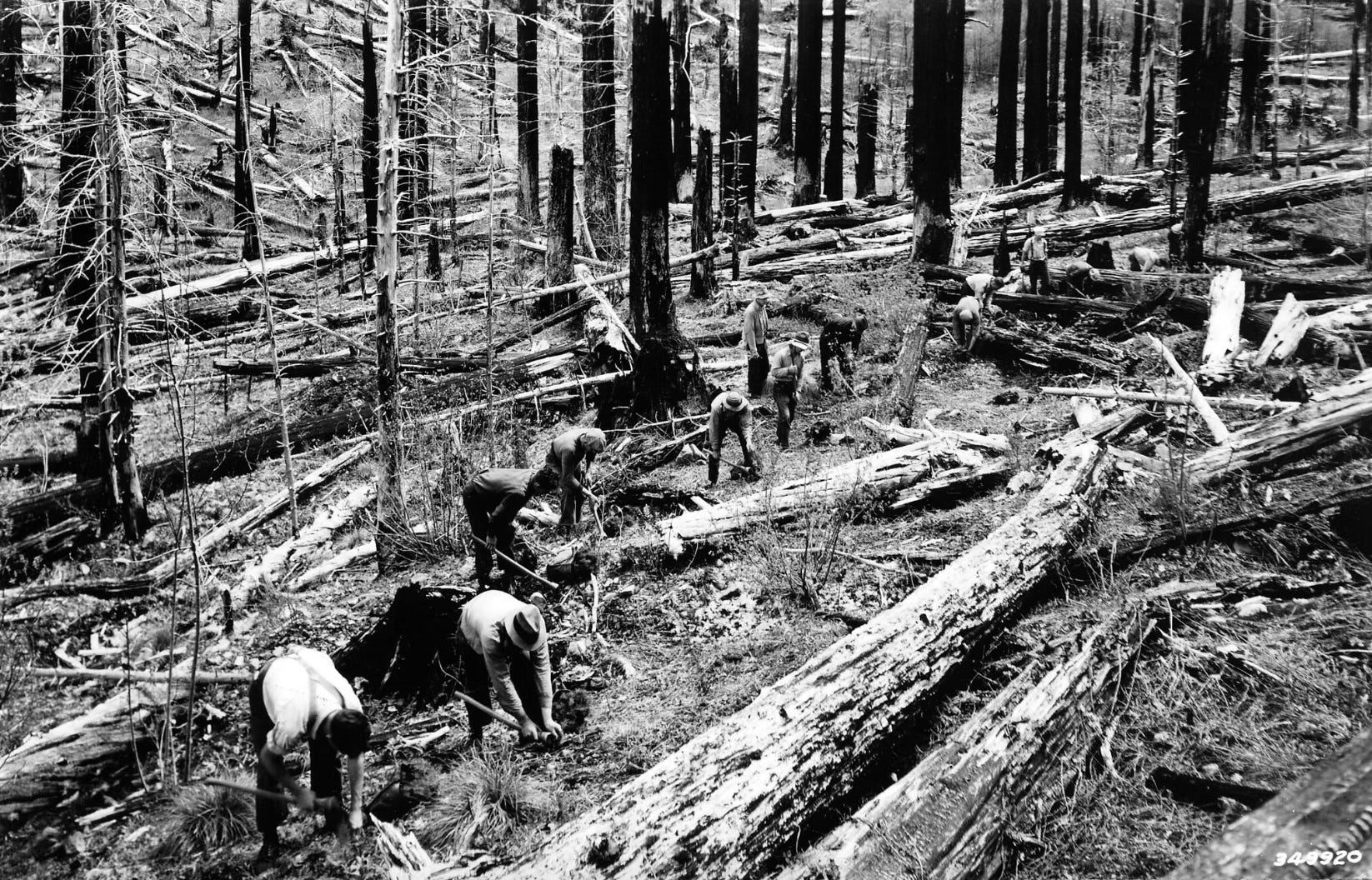
2026 is turning into one of the worst fire seasons in Washington history. The reasons are many: a fourth straight year of drought, unusually hot weather, previous forest management, each play a role. The last is perhaps the most important in that forests across the state are primed to burn because of how we have managed them for the past 100 plus years. Intriguingly, the long held belief in Washington state that wildfire is one of the great evils of the world and must be held in check, which has dictated many people’s relationship to wildfires, can be traced back to a single fire, the Yacolt Burn of 1902, still the state’s most deadly.
Some people say that a man named Monroe Vallett started the Yacolt Burn by torching the debris left behind after logging. Other people accuse workers who lit a wasps’ nest on fire and the flames spread out of control. More than likely, the Yacolt Burn originated at multiple locations and was fanned by warm, dry east winds coming over the Cascades and down the Columbia Gorge. No matter who is to blame, the “roaring tempest … swept death and destruction” that torched at least 238,920 acres in Washington.
The fire began around noon on September 11, 1902, near the town of Yacolt, about 30 miles northeast of Portland. Within hours, the smoke led to chickens starting to roost. North of the school, flames exploded into balls of fire, killing eleven people out for a picnic, and fifty miles away the smoke-tinted sun caused people to drop to their knees and pray.
By the time the fire mostly burned out, it had destroyed trees estimated to contain 12 billion board feet of wood; killed at least 38 people; forced at least 146 families out of their homes; ruined schools, churches, bridges, mines, and sawmills; and killed uncountable livestock and wild animals. The Yacolt Burn was so big and deadly it led to regulations and practices that have guided fire fighting in Washington state for more than a century.
One direct result of the conflagration was the initial establishment of the Weyerhaeuser Company as a major logging concern. In 1900, Frederick Weyerhaeuser, who had started in the lumber industry in Illinois in the 1850s, acquired 900,000 acres of land in Washington state. At the time Weyerhaeuser’s company consisted of a handful of employees in Tacoma and a small mill in Everett. They had no plans to start harvesting their timber.
The Yacolt Burn, though, torched 20,000 acres of Weyerhaeuser timber, and the company realized they needed to recoup potential losses. The solution, known as salvage logging, was harvesting burned-out trees that could be cut into usable lumber. Over the next two decades, Weyerhaeuser salvaged as much as 75 million board feet annually, ultimately helping to jump-start the company’s rise as the region’s dominant logging business and one of the country’s most prominent.
Such salvage logging has continued to the present as a widespread and controversial technique across the Cascades. Studies have found that removing dead trees after a fire disrupts ecosystem dynamics; contributes to increased erosion because of road building; results in overall loss of organic carbon; and has a negative effect on cavity-nesting species, such as the Northern Spotted Owl, because of the removal of dead trees.
As Weyerhaeuser expanded and thrived, the company began to lobby journalists and legislators, which soon resulted in statewide fire prevention legislation. Weyerhaeuser and other lumber companies also funded forest-protection associations to develop, promote, and keep in the public eye the idea that fire was the enemy of good forestry and needed to be defeated at all costs. The war against fire had begun, and the logging companies were its leading supporters.
The newly developed policies around suppression also led to a new feature of the forests: fire lookouts. Beginning around 1915, these structures began to pop up on high points across the mountains with at least 450 lookouts eventually built in the Cascades. Those who staffed them had one primary goal: to spot and stop the spread of fires. In 1935, the USFS codified this operating principle under their 10:00 a.m. rule, which aimed to extinguish a fire by that time the morning after detection. Nine years later, the Forest Service started the Smokey Bear anti-fire campaign, and fire became a public enemy.
After the Yacolt Burn, fire in the Cascades was no longer seen as an aspect of nature one could tolerate or as a process with ecological benefits. Like wolves and bears and other predators, fire, in the eyes of settlers, lumber companies, and government agencies, was the enemy. It was a menace that stood in the way of progress. It had to be stopped at all costs. We are now paying the consequences with forests and communities not resilient to fire.
The above is adapted from my new book, In the Range of Fire and Ice, which contains a detailed account of the Yacolt Burn and its influences on wildfire policies in Washington state. My fire chapter also explores the deep human-fire connection, which stretches back thousands of years, and which has been essential to the structure of the Cascades’ forests on both sides of the divide.
When I began researching the Yacolt Burn, I was surprised by how little information existed, including even a decent map. I eventually tracked down a variety of sources, contemporary to the fire and more recent, to tell the story. I also went out in the field with and talked to numerous wildfire researchers. Here’s one of the fascinating stories, still visible but only from space, of the Yacolt.