Canada Geese graced my morning run the other day. A flight of the big honkers was skimming the sky, heeding the call of the seasons and traveling south. As usually happens, the birds’ conversations of honks and cackles initially attracted my attention. Looking up I saw about 20 birds in their classic V-formation, black and gray wings flapping with distinct whooshes of air. Their majestic arrows of flight are one of my favorite natural features of autumn and an eloquent reminder that cool weather is coming. (I cannot resist a bad attempt at humor. Q: Why is one side of the V longer than the other? A: There are more birds in it. Remember, I said it wasn’t good.)
As ornithologist Arthur Cleveland Bent wrote of Canada Geese in Life Histories of North American Wild Fowl. “What man is so busy that he will not pause and look upward at the serried ranks of our grandest waterfowl, as their well-known honking notes announce their coming and their going, he knows not whence or whither?” Mr. Bent is correct. Tis indeed sad that so many men and women are, in fact, too busy or unaware to notice these spectacular birds as they herald the seasonal change.
Hearing the chatter above, I often wonder what the geese are discussing. I assume that they are conversing about the weather, where’s a good place to stop and poop and eat, and which route they should take. Occasionally just one goose is speaking, perhaps a storyteller sharing a tale with her or his cohorts. But I base these ideas on my naive human-centric focus and there’s just as likely a chance that geese hold more complicated discussions. They could be addressing the complex physics of upwash and vortices and how the additional lift and reduced drag created by the V-formation benefits the birds’ ability to fly; or maybe commenting on the curious land-based creatures below. More likely is that the birds are less concerned about where they are headed and how to get there and are more focused on not being killed by a predator and are simply alerting others to potential issues.
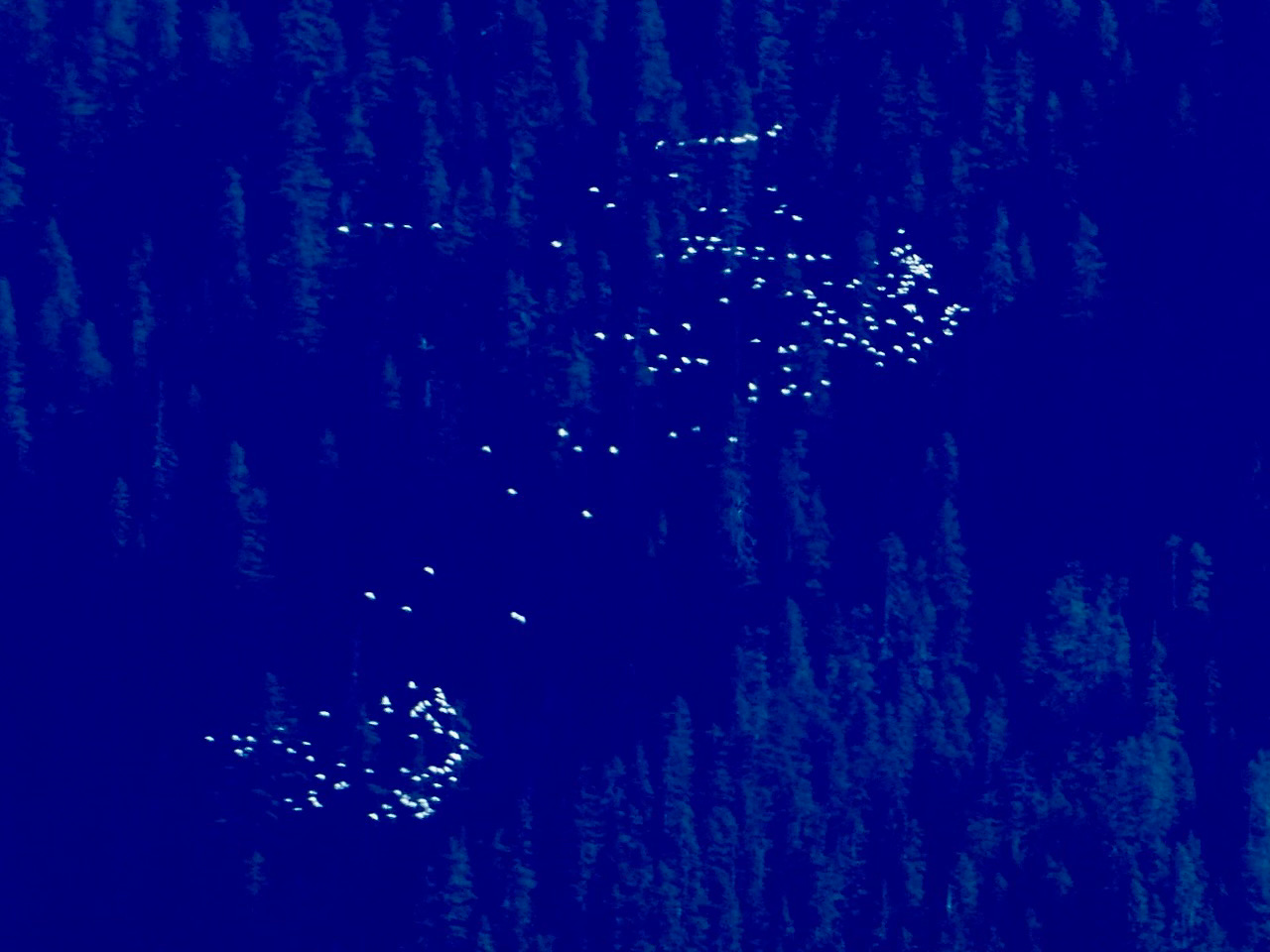
I also had the pleasure this weekend of seeing another flock of birds flying in formation. Marjorie and I were on top of Mount Defiance, about 40 miles east of Seattle above Interstate 90. Looking across the serrated ridges of peaks, we noticed shards of white light moving against the forested green hillsides. At first, we couldn’t figure out what was going on but then realized we were seeing dozens upon dozens of birds, their white wings and bodies reflecting the sunlight.
With my binoculars, I discerned a couple hundred individuals, constantly shifting dabs of white swirling from group to group. They seemed to be seeking optimal wind though just as likely their movements could have reflected their shear pleasure of flight. Periodically, the birds vanished, as if they had entered a hole in the sky, but it was more simple; the groups were turning just enough to prevent the light from reflecting off of the birds’ white feathers and their dark silhouettes blended with the dark forest behind them.
Later in the day, after hiking down from the summit, we were sitting at a lake when I heard light conks and honks above us: a V of birds was passing overhead. Now, I could confirm what we suspected atop Mount Defiance. We were seeing migrating Snow Geese, clearly indicated by their black wing tips. I don’t know if they were headed south or merely circling around and possibly headed to the Skagit River valley, where tens of thousands annually overwinter. (I have seen Snow Geese many times up there but never had seen them soaring in such a lovely setting as from Mount Defiance.) No matter where they were headed, their flight was one of the more ethereal views I have seen in the Cascades.
By the way, geese are somewhat unusual, or perhaps it is we humans who are odd, in that a group of geese on the ground and a group of geese in the air are labeled differently. Those in the air are known as a flock or skein, whereas walking geese are a gaggle. Skein comes from a French term referencing yarn or thread, certainly a fine description of the strung out lines of flying geese. Not surprisingly, gaggle derives from the sounds that geese make; it has been applied to the birds since the 1400s.
Geese also have merited another lexicological curiosity. We have bestowed upon the males of the species the term gander, an appellation of Old English origin from the Germanic. But we have not done the same with the females. By the way, a locally famous birder told me that ganders are also known as dudes, but I think that just may be her secret language of birds. Still, I thought some of you might like to know how some ornithologists see the world.
For some not clearly defined reason, people have long had less-than-favorable opinions of geese. Consider Samuel Johnson’s A Dictionary of the English Language (1755) and his definition of a goose: “A large waterfowl proverbially noted, I know not why, for foolishness.” We also have the phrase “a silly goose.” Even less kind is how many modern people see the birds, as a no good problem whose main attribute is pooping on grass, often in our carefully tended yards and parks.
I have been annoyed by and have stepped in my fair share of goose poop, but I forgive the birds their digestive attributes. After all they are simply exploiting a resource that we have created and doing what comes naturally to them. Plus, whenever I see Canada Geese flying overhead, I cannot help but rejoice in their beauty and grace and celebrate the wildness they represent.
October 14 - Third Place Books, Lake Forest Park, 7PM - Last minute. I have the honor of interviewing Lyanda Lynn Haupt and artist Justin Gibbens about their new book, Among the Birds: Field Notes from Cascadia. To register, click here.