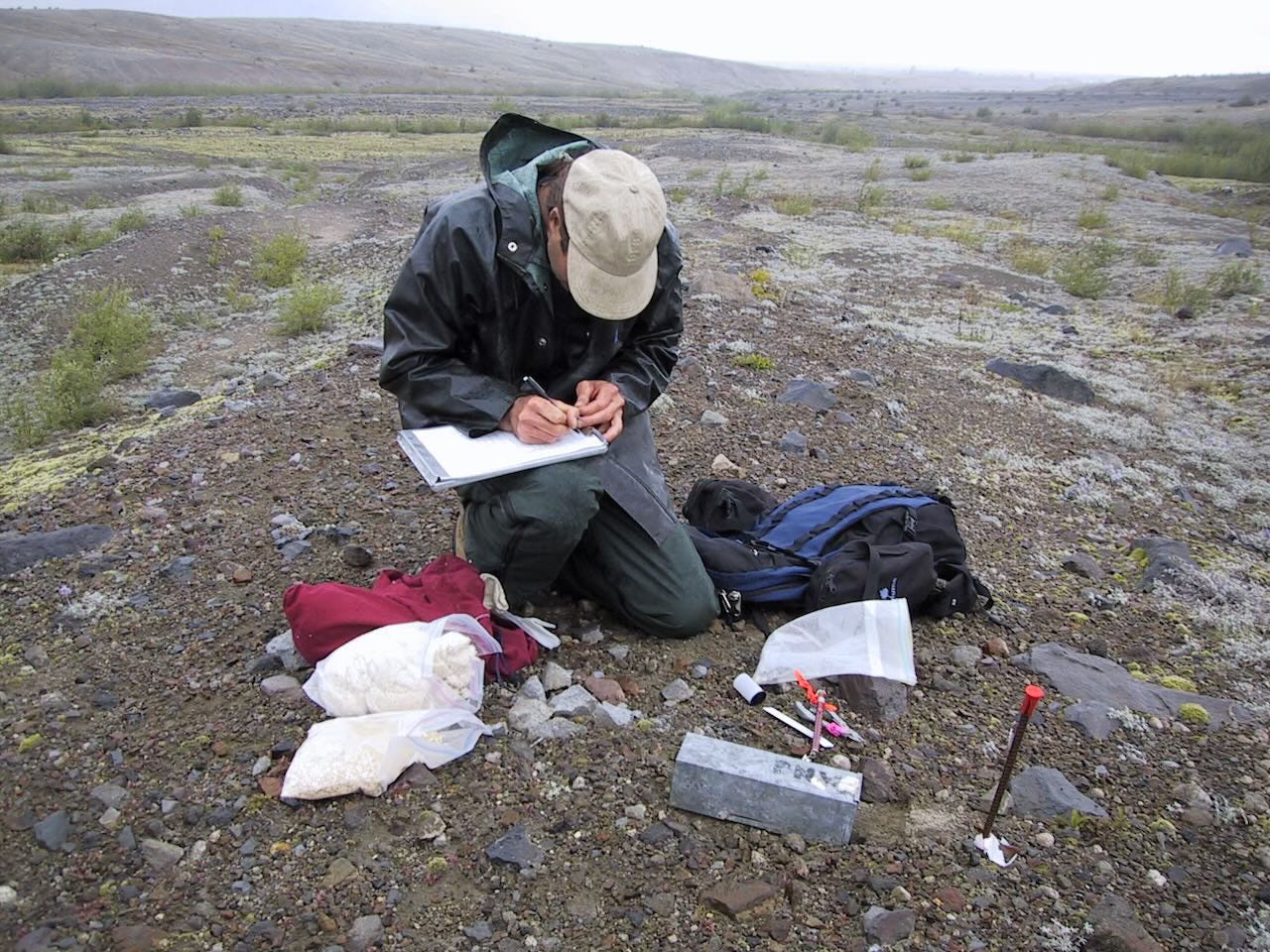
In June 1982, ecologists Charlie Crisafulli and Jim McMahon were surveying the Pumice Plain at Mount St. Helens. Traveling by helicopter, they were seeking out life on the area most devastated by the 1980 eruption. Not surprisingly little stirred in the moonscape, but then they landed and came across a dab of purple and green, as if paint splotches had splattered across an endless field of grey. The stunning and surprising color was a flowering lupine, the first plant they’d seen for miles. Surrounded by a ring of seedlings, the plant had to be at least a year old, in order to produce the seedlings.
Crisafulli, who eventually spent four decades studying the ecological recovery at the volcano, established a 200-square-yard study plot around that pioneering plant. Within four years, he counted 16,000 lupines in the plot; three years later, 35,000. “People sometimes ask me how I can go back and study the exact same place year after year,” he says. “I always tell them it’s never the same.”
How had life found a way back? The deep ash and pumice held few nutrients, but lupines, like other plants in the pea family, have a special trick up their branches, or in this case, actually down their roots. Lupines have the ability to fix, or convert, inert atmospheric nitrogen into a usable form, which allows the species to thrive in environments inhospitable to most other plants. Technically, lupines don’t actually fix the nitrogen; they outsource that skill to bacteria, which do their good deed in nodules on the plant’s roots.
Once the lupines enriched the soil with nitrogen, adding organic material to it when they died, other plants and then animals soon followed. Within a decade of the eruption, Crisafulli had documented more than 27 plant species in the study plot. A large patch of strawberries sprang up just outside it, probably from a single seed deposited in bird or mammal feces. Crisafulli eventually trapped a variety of small mammals on the Pumice Plain, including ground squirrels, mice, and shrews. Each has sped up the area’s recovery by caching seeds, burrowing through soil, and luring predators such as raptors and weasels.
Lupines are one of the great stories of Mount St. Helens but that is not the only place they thrive. I have seen them throughout the Cascades and Olympics, on beaches, in the desert, in the tundra, and in cities. I cannot think of a habitat where I haven’t seen them and would argue that they are one of the more ubiquitous plants out there. Thankfully, as they are lovely. Lupines are primarily in the blue shades but also tint over to magentas and purplish with a few species dialing over to yellows. They range in size from low in stature to ones that top out at four to five feet tall.
I am enchanted by the flowers, especially when they blue a hillside, as you’ll see is something that appealed to Mr. Henry David Thoreau, but what I like most are the leaves. With their palmate leaves (with 5 to 12 leaflets), they are particularly easy to distinguish. The structure, like our own palms, is perfect for catching water and I am always pleased to see how the leaves form a cup of a single droplet of water. The little aqueous orbs seem to be almost otherworldly in their ability to harvest light, as if the droplet is glowing from within.
By the way, lupine originates in ancient Rome. Only a handful of lupine species (around a dozen) grow in the Old World, whereas more than 250 occur in North and South America. According to the great 19th century botanist Asa Gray, the scientific name (all species are Lupinus sp.) derives from the Latin term for wolf, because lupines “were thought to devour the fertility of the soil.” His contemporary Henry David Thoreau found this preposterous and wrote “this is scurrilous,” in June 1852. He was correct, considering lupines perform the exact opposite behavior by feeding the soil with nitrogen.
Like many, Mr. Thoreau was quite smitten with the flowers. “It paints a whole hill-side with its blue, making such a field (if not meadow) as Proserpine might have wandered in. Its leaf was made to be covered with dew-drops. I am quite excited by this prospect of blue flowers in clumps, with narrow intervals, such a profusion of the heavenly, the Elysian color, as if these were the Elysian Fields. . . . That is the value of the lupine. The earth is blued with it.” What else needs to be said? Nice work Henry.
Wow, thanks to all subscribers who came out to my book launch at Third Place Books last week. I was humbled and honored that there were 450 people who registered for the talk! About 350 showed up and bought 120 copies. Golly ned.
If you missed the launch, I have two more talks this upcoming week.
Sept. 16 - Burke Museum – 6:30 PM – In conversation with the great book reviewer Mary Ann Gwinn for In the Range of Fire and Ice. RSVP for event.
Sept. 17 – Edmonds Bookshop – Edmonds Waterfront Event Center – 6:30 PM – In conversation with Teresa Wippel of myedmondsnews.com for In the Range of Fire and Ice. RSVP for event.
I also had the pleasure to be on New Day NW on King 5 for a little chat about In the Range of Fire and Ice. Here’s a link.