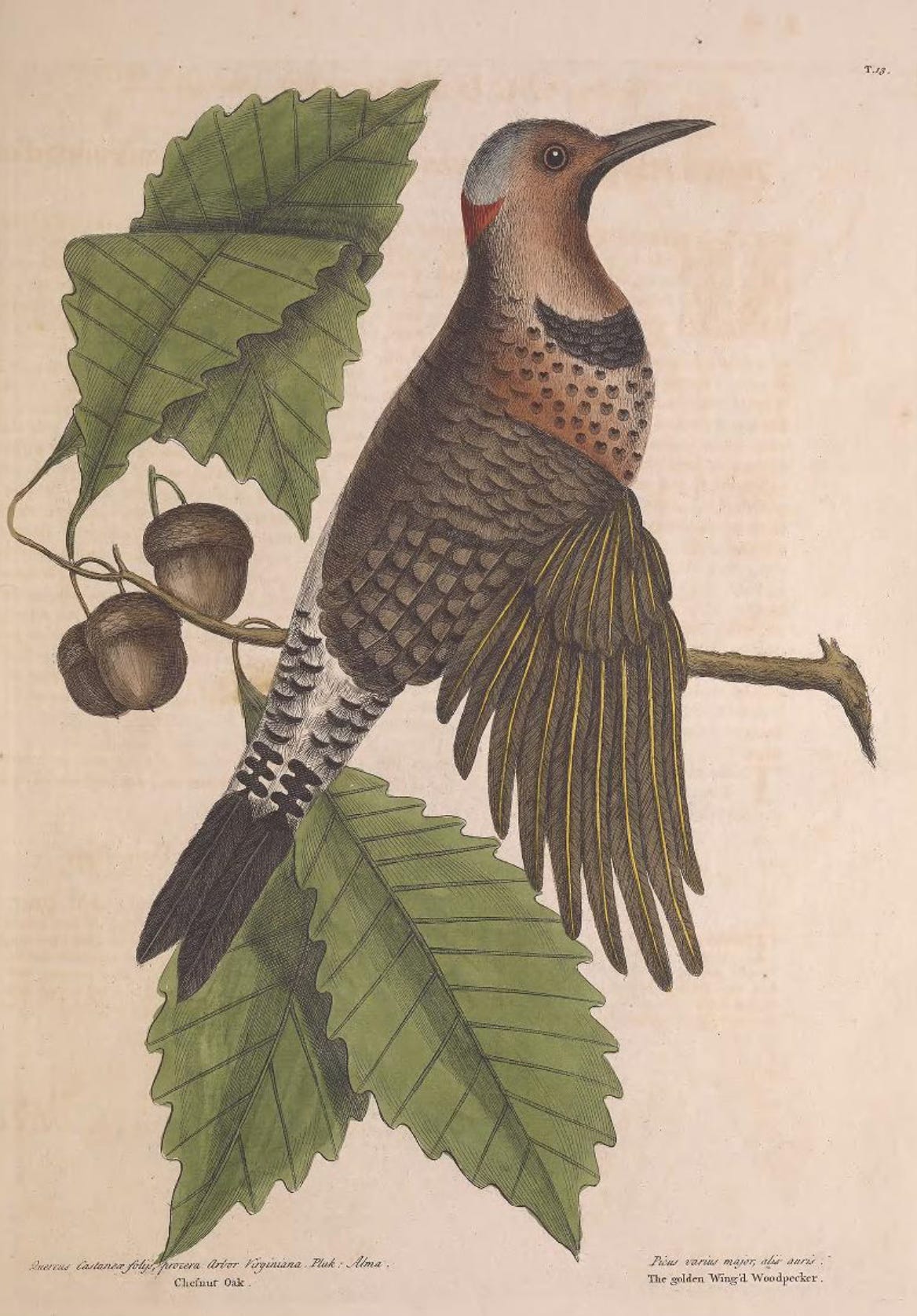
My guess is that many urban dwellers, particularly in Seattle, have heard the sounds of Northern Flickers. With a rapid, rhythmic banging, the birds pound all sorts of surfaces to produce what one ornithologist described as the sound of a miniature pneumatic drill. In my neighborhood, I have seen flickers drilling trees, utility poles, and everyone’s favorite, some sort of metal surface, which produces a resonant and astoundingly loud sound that can be heard deep inside our house.
Studies have found that both sexes drill. What makes them particularly troublesome for some people is that birds establish a favored location, near a breeding territory; the key seems to be resonance. Although it appears that drilling is primarily about territoriality, males in spring—as in right now—drum more when a potential partner is nearby and making her own sounds. Breeding season is also the time for what is known as the long call, a series of repeated modulated pulses often described as swik-wik-wik... or kick, kick, kick..... The other well-known flicker call is swik-a, wik-a, wik-a... Mr. Thoreau described the sound as a cackle.
One of the challenges for flickerologists is that the birds, like some members of our species, integrate their concerns about courtship with their focus on territorial defense, at least in regard to the nest. Therefore the bird gang has not been able to tease out the answers to why flickers call and drum when they do. Intriguingly, flickers have not been found to defend their feeding territory.
Unlike their fellow members of the woodpecker family, flickers don’t exactly cotton to their name and instead forage on the ground, seeking out insects, particularly ants. In 1911, ornithologist Foster Ellenborough Lascelles Beal reported that he had examined 684 Northern Flicker stomachs from 35 states. He found that ants made up fifty percent of the contents; one stomach contained more than 5,000 ants along with another 100 pupae. (But the most pismire-phillic of the woodpecker gang is the Williamson Sapsucker, found with 86% ant content in their stomachs. (“Food of the Woodpeckers of the United States,” U.S.D.A. Biological Survey, Bull. 37))
I have watched flickers many times hopping on the ground seeking ants. With their strong bills they pound and hammer the substrate, breaking up matter and probing for ants with their astonishing tongues. The birds often seek out meals in sidewalk cracks, which is why you might sometimes encounters a crack that looks to have vomited up its sand and soil insides. Like other members of the woodpecker family, flickers possess a food finding probe of epic proportions, often twice the length of the bird’s head. Beal described the tongue as cylindrical with a hard, barbed point; it curled up around the back of the skull and in some species extended around the eye. Now that’s a useful tongue. Flickers also eat fruit, which historically caused issues because people found the birds to be palatable, especially during wild cherry season, and shot and sold them.
Flickers have intrigued ornithologists since they first encountered the birds, particularly because of their (the birds not the birders) variation in coloring. Look at older books and you may find three species: gilded, red-shafted, and yellow-shafted, all in reference to their feathers. Newer books tend to marry the yellow and red into a single species, though you can still find splitters who reject the lumpers. The red-shafted variety occupies the PNW and much of the west.
In fact, the first west coast specimen of what is now called the Northern Flicker came from Nootka Sound, on Vancouver Island. Collected in 1778 on James Cook’s third expedition, it soon reached ornithologist John Latham, who noted the red feather shafts. He did not name the bird but mistakenly noted that “this bird was brought from the Cape of Good Hope.” It actually came from what Cook called “Hope Bay” leading into Nootka Sound.
A few years later, another ornithologist, Johann Friedrich Gmelin, followed Latham’s incorrect geographic reference and coined a scientific name, which referred to the Xhosa people, who lived near the Cape of Good Hope in South Africa. Unfortunately, Gmelin used a name—cafer, a variation of a word that “has now become universally regarded as an extreme ethnic slur and the absolute height of offensiveness,” according to a petition to the American Ornithological Society filed in 2019 by Stephfanie M. Aguillon and Irby J. Lovette.
The pair proposed to change the name to lathami, to honor the first describer; the AOS rejected the petition, stating that the change was beyond the scope of the committee. The original, offensive scientific name persists, for the subspecies. The modern scientific name for Northern Flicker is Colaptes auratus. Colaptes comes from the Greek kolapto for chisel and auratus from the Latin for golden; perhaps we could rename the bird the golden chiseler. Meanwhile, the authoritative Ernest Choate tells us of the Anglo Saxon word flicerian, or a fluttering of birds, which in turn may have also led to a flickering flame. Other common names for the species include high-holder, yellow-hammer, yarrup, heigh-ho, yawker bird, walk-up, wake up, clape, and hairy-wicket. I’ll let you try and tease out the origins of these names.
The many names of the species, which Mr. Choate claims as “numbering in the hundreds,” reflects how widespread and common flickers are. Just in the past week, I have seen them in the over 100 degree weather of the Sonoran desert and in the below 50 degree weather of rainy Seattle. I know that some urban residents find flickers to be annoying due to their staccato headbanging and loud and persistent call, but I always enjoy seeing and hearing them as the birds pursue their lives and remind us that amour is on the wing and in the air and sometimes you just need to let everyone know.
Word of the week - Pismire - A word for an ant that dates back to the 1300s. Chaucer wrote wisely: He is as angry as a pissemyre. The word comes from combining piss (in reference to the urine-like aroma of anthills) with mire, an ancient term for ants.