For many Christians, the book of Ecclesiastes has been an enigma. Maybe you’ve noticed that for yourself when you’ve read it. The Preacher of Ecclesiastes says all sorts of things, many of which are troubling, perplexing, and even seem heretical on the surface. The main refrain of the book itself is a classic example: “Vanity, vanity, all is vanity.” The NIV translates it: “Meaningless, meaningless, all is meaningless.” Our polite Sunday morning self, of course, doesn’t make any critical comments. But the honest question of every thoughtful Christian is inevitable: “Really? Is it really vanity? Is it really all meaningless? Doesn’t that go against what the rest of what the Bible teaches?” There are plenty of other passages in the book that similarly leave us scratching our heads.
So what are we to make of the enigma that is the Book of Ecclesiastes? Do we just ignore the tough bits? Do we jettison it from our Bibles? (if not officially, then at least practically by neglect). Do we take a superficial approach to it, giving trite Sunday School answers to the difficult questions? Never truly exploring what it really means? And where does Christ fit in this book?
As we open up this conversation, I want to put to you that the message of Ecclesiastes is both powerful and timely in an age of materialism such as the one in which we find ourselves. There’s no doubt about it, the book is uncomfortable, and if you’re looking for an easy ride, you won’t find it here. What you will find, however, is an honest assessment of life. Ecclesiastes is uncomfortable precisely because life itself is often uncomfortable. Things happen that we don’t understand, things that make no sense to us, things that make us feel afraid. There are things that happen in our lives that make it feel impossible to hold on to hope, indeed hope itself may completely evaporate at times (see Psalm 88). Despair and depression can take hold, and we live our lives feeling sightless and in a dark mist. In times like these, Ecclesiastes will prove to be a balm to the soul.
Contrary to the teaching of some commentators, however, Ecclesiastes is not the ramblings of a man who has succumbed to these trials. The writer is not a jaded old cynic. On the contrary, this book is an antidote to these uncomfortable truths in life. No, it’s not intended to make them disappear, and it won’t give you an easy answer. In fact, at times it won’t even give you an answer at all to some of life’s difficult questions. But what it will do is put strength into your limbs and resolve into your hearts. It will not lead you on easy paths, but it will lead you on faithful paths. Paths that have been tried and tested, paths that will fill you with wisdom and perseverance, and – yes – even hope. I dare go further. God’s desire for us as he has penned these words through Solomon, is that we should deeply and richly enjoy life in the fear of God.
But where do you begin in Ecclesiastes? How do you start to make sense of it? Trying to understand this book is much like holding a rubix cube and trying to solve it. You have no idea where to begin, and even when you think you’re making inroads, some new impossibility arises. The book is, in a sense, an enigma, but that’s part of the point. Wisdom literature in the Bible is meant to get you thinking, it’s designed to make you think, to consider, to wrestle with mysteries. Indeed, that is part of the journey toward hope. And so as we study this book, I want to begin by equipping you with the means to solve this riddle. The book is perplexing at times, but it is not unsolvable. In fact, it is designed to be solved, and in solving it we will be enriched and made wiser.
So to begin with, I want to give you a few basic tools that you will need for understanding Ecclesiastes. The first tool you will need is a correct approach. If you’re going to make any sense of Ecclesiastes, you need to realise what kind of a book it actually is. Now this is true of any piece of writing. As you approach it, you need to know what it is, and that knowledge will then shape how you read it. For example, you don’t come to read a newspaper the same way you would approach a joke book. You read a murder mystery in a very different way than you would read a history textbook. In this sense, it’s very important to get the right approach as we come to the book of Ecclesiastes. We need to understand what kind of book this is. If you read a fantasy novel as history, you will be very confused. If you read an academic journal as a children’s story, it simply will not work – you need to approach the book correctly.
One of the problems with the way we read Ecclesiastes is that, for many Christians, we try and read it the same way we would probably read a book like Romans. When we come to Romans, for example, it’s a letter, largely didactic in its flow of thought. It has a logical structure as it deals with doctrine, and it changes gears obviously as it directly applies doctrine to life in the latter part of the epistle.
Now Ecclesiastes is not like that, it’s much more like a Psalm. Let me give you an example, Psalm 73 will serve well to illustrate for us. In Psalm 73, the Psalmist gives a personal account of his struggles with suffering. In particular, he recounts the way he experiences suffering as wicked godless people seem to live a life of luxury. In the first half of the psalm, the psalmist reflects on the mindset that he had as he struggled with this conundrum. In verse three, for example, the psalmist says: “I was envious of the arrogant” (v3). That’s a description of what he was thinking at that point in time. Or how about verse four, where he talks about how wicked people have no troubles before death, and that they are always at ease. Now if you took those kinds of statements in isolation, they don’t sound very Christian. “I was envious of the arrogant.” Not very Christian to be jealous of the lifestyles of wicked people! And yet the psalmist clearly says that he was, and he describes what it was like to be in that mindset.
Now we don’t read Psalm 73 and think: “Whoa! This shouldn’t be in the Bible!!” We don’t read it and apply it by envying wicked people, that would be a complete misreading! What we rightly see is that this psalm is a divinely inspired description of the very real struggles that the psalmist faced. It’s a poem, a testimony of this man’s spiritual journey, and so as we read the Psalm we understand that there is a context for his statements.
Coming back to the Book of Ecclesiastes, the whole book kind of works like Psalm 73. What we’re seeing in Ecclesiastes is the Preacher’s account of his own journey, a journey that has ups and downs. Like many psalms, it is heavily auto-biographical, and often uses poetic devices. In fact, as a living member of the human race, the Preacher is still on the journey as he writes, which is why he doesn’t resolve so many of the questions that he raises. The point is that they aren’t supposed to be resolved yet, not in this life anyway. And so in this book we’re often seeing a man wrestling with what it means to live in a fallen world as he lives in a fallen world. At times his frustration and sadness are palpable as he struggles to come to terms with what he sees in the fallen world around him, and as he seeks to reconcile what he sees with his faith in God. And although there are many questions for which he lacks answers, yet as he continues he nonetheless comes to his ultimate conclusion in Ecc 12:13: “The end of the whole matter is this: fear God.” When all is said and done, Solomon accepts the conundrums of life by faith, and calls us to do the same. As the Psalmist does in Psalm 73, Solomon finds rest as he too submits to God by faith. He doesn’t have all the answers to life’s mysteries, but he does know who the Lord of all is, and he knows that God alone is to be feared. So then, as we work through this book, what we’ll be doing is taking a journey with the Preacher. We’ll be observing and wrestling with what it means to live in a fallen world, and in so doing we will have a little light for our own paths as well.
So that was our first tool for approaching the book rightly, you need to know what kind of writing it is. One other tool I want to give you at the outset is a metaphor, a metaphor for thinking about the book as a whole and for grasping what it is and how it works. Because while the book is similar to a psalm, it is not actually a psalm. I got this metaphor from one of the commentators, Philip Ryken, and I think it works really well as a way of capturing clearly what this book is all about and how it works.
I want you to think of Ecclesiastes as a labyrinth – a giant maze. Complex, puzzling, hard, exasperating, and even dangerous according to Greek mythology. It’s easy to get lost in this labyrinth. And yet there is also a destination… you go in to a labyrinth to get to the middle, and King Solomon wants us to arrive in the middle as well, to get to his destination. So Ecclesiastes is like a labyrinth, and the labyrinth itself can be viewed as a metaphor for life as well – because life is exactly what Solomon spends his time talking about. Like a labyrinth, life is complex and puzzling at times, it leaves us with many mysteries and many question unanswered. And so the Preacher is on a journey through life, and at the same time he’s using wisdom to explore this life, exploring what it means to live life and how to live life in a fallen world in the fear of God.
Now in this labyrinth of Ecclesiastes, as we make our way to the destination in the middle of this maze, there are two kinds of paths. There are paths that lead to dead ends, and there are paths that lead us to the destination – to the solution of the labyrinth of life. And one important thing to keep in mind is that as the Preacher seeks to guide us through this labyrinth, sometimes he shows us a dead end. He warns us of places we shouldn’t go. But as the book unfolds, he also leads us on good paths, paths that are part of the journey towards the destination.
Now what is this goal? What do we find in the middle of the labyrinth? The Preacher makes it very clear to us. In Ecc 12:13 he states the goal of his book very clearly: “The end of the matter; all has been heard. Fear God and keep his commandments, for this is the whole duty of man.” This is the place where he wants to bring us. This is the middle of the labyrinth, so to speak. The goal of life in a fallen world is to live in the fear of God, and everything that the Preacher writes in this book is designed to bring us to this goal. Whether by warning us away from wrong paths, or enlightening us toward right paths, the Preacher aims to teach us the fear of the Lord.
You see there are many things in this life under the sun that are mysterious to us, many things that don’t make sense. The Preacher knows this, and admits it candidly. He faces up to life in all its difficulty, and his purpose is often not to teach us to solve these mysteries, but to embrace them by faith knowing that we cannot solve them. In this way we learn to trust God and live life in the fear of God. And so the Book of Ecclesiastes is a precious book in scripture, because it shows us what it means to embrace the frustrations that we experience in life. It shows us that even in the face of these frustrations, we may yet continue on and pursue the fear of God – both enjoying life’s blessings as gifts from God, and walking patiently through life’s trials as appointed by God.
So, practically speaking, if you want to understand the Book of Ecclesiastes, this is a good way of doing it: at every point ask yourself the question: how does this part teach me to fear God? And really, as we work through this book, that’s the question that I’m constantly going to be putting to us: How does this passage teach us to fear God?
Now, having said that, we have a basic idea as to how we ought to approach the book. We have a way of thinking about it, and now we can begin our study in earnest.
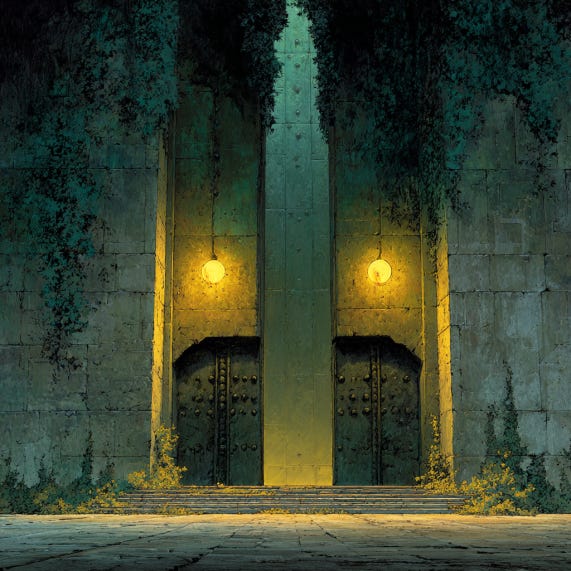
So let’s approach the great doors of this labyrinth…
Note: God gives his word freely, and he gives his gifts freely to the church. I want to follow his example, so I don’t put any of my content behind a paywall. If it blesses you in some small way, I give glory to God! However, it does take time, coffee, books, and effort to produce the content. If you’d like to support this work, or contribute towards improving it, I would welcome your coffee-flavoured assistance!